
Databricks Databricks Machine Learning Professional Practice Exams
Last updated on Oct 21,2026- Exam Code: Databricks Machine Learning Professional
- Exam Name: Databricks Certified Machine Learning Professional
- Certification Provider: Databricks
- Latest update: Oct 21,2026
Which of the following lists all of the model stages are available in the MLflow Model Registry?
- A . Development. Staging. Production
- B . None. Staging. Production
- C . Staging. Production. Archived
- D . None. Staging. Production. Archived
- E . Development. Staging. Production. Archived
A machine learning engineer is converting a Hyperopt-based hyperparameter tuning process from manual MLflow logging to MLflow Autologging. They are trying to determine how to manage nested Hyperopt runs with MLflow Autologging.
Which of the following approaches will create a single parent run for the process and a child run for each unique combination of hyperparameter values when using Hyperopt and MLflow Autologging?
- A . Startinq a manual parent run before calling fmin
- B . Ensuring that a built-in model flavor is used for the model logging
- C . Starting a manual child run within the objective function
- D . There is no way to accomplish nested runs with MLflow Autoloqqinq and Hyperopt
- E . MLflow Autoloqqinq will automatically accomplish this task with Hyperopt
Which of the following describes concept drift?
- A . Concept drift is when there is a change in the distribution of an input variable
- B . Concept drift is when there is a change in the distribution of a target variable
- C . Concept drift is when there is a change in the relationship between input variables and target variables
- D . Concept drift is when there is a change in the distribution of the predicted target given by the model
- E . None of these describe Concept drift
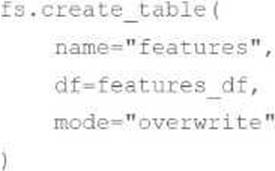
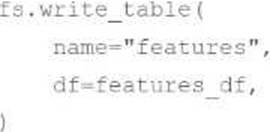
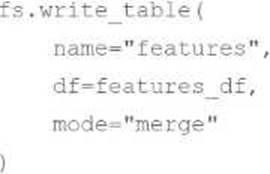
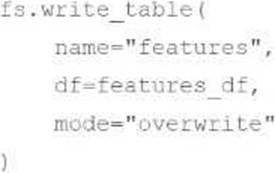
A data scientist has computed updated feature values for all primary key values stored in the Feature Store table features. In addition, feature values for some new primary key values have also been computed. The updated feature values are stored in the DataFrame features_df. They want to replace all data in features with the newly computed data.
Which of the following code blocks can they use to perform this task using the Feature Store Client fs?
A)
B)
C)
D)
E)
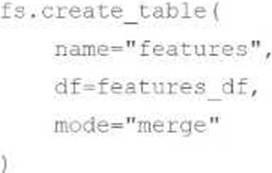
- A . Option A
- B . Option B
- C . Option C
- D . Option D
- E . Option E
A machine learning engineer needs to select a deployment strategy for a new machine learning application. The feature values are not available until the time of delivery, and results are needed exceedingly fast for one record at a time.
Which of the following deployment strategies can be used to meet these requirements?
- A . Edge/on-device
- B . Streaming
- C . None of these strategies will meet the requirements.
- D . Batch
- E . Real-time
A machine learning engineer has created a webhook with the following code block:
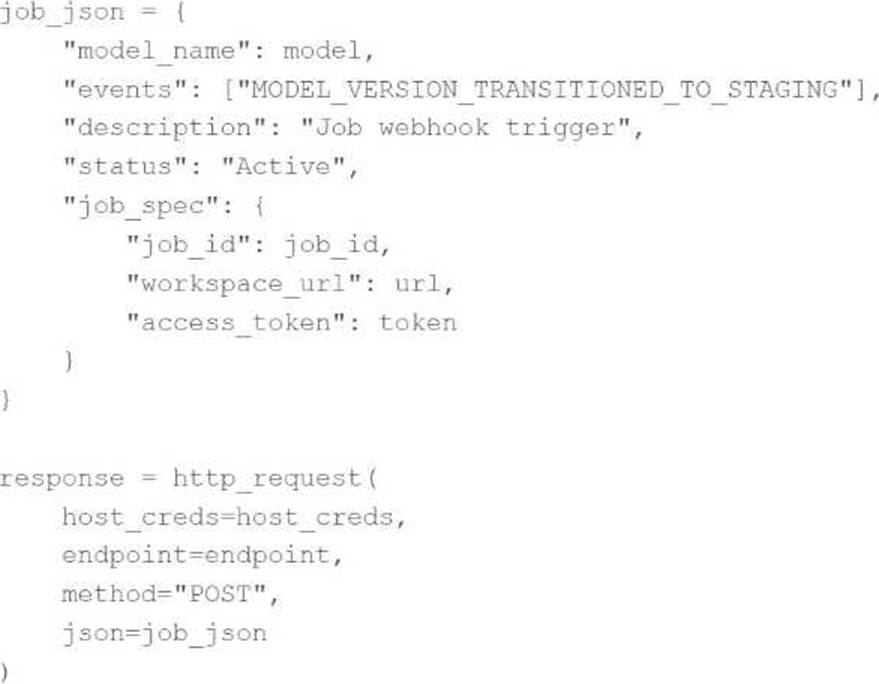
Which of the following code blocks will trigger this webhook to run the associate job?
A)
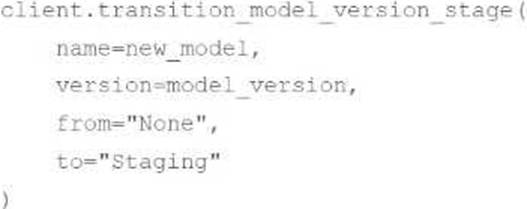
B)
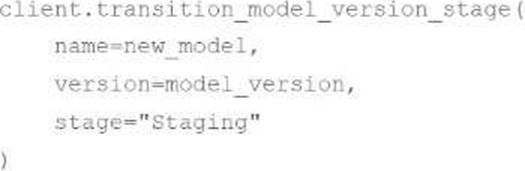
C)
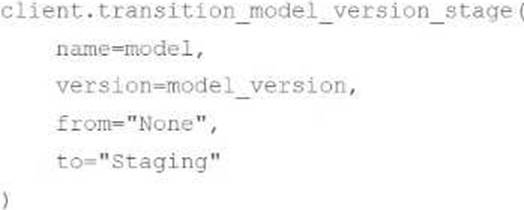
D)
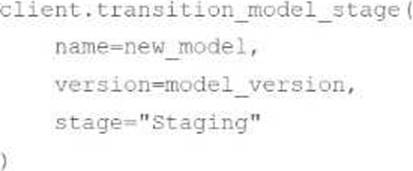
E)
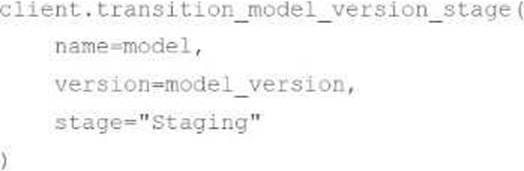
- A . Option A
- B . Option B
- C . Option C
- D . Option D
A machine learning engineer is attempting to create a webhook that will trigger a Databricks Job job_id when a model version for model model transitions into any MLflow Model Registry stage.
They have the following incomplete code block:
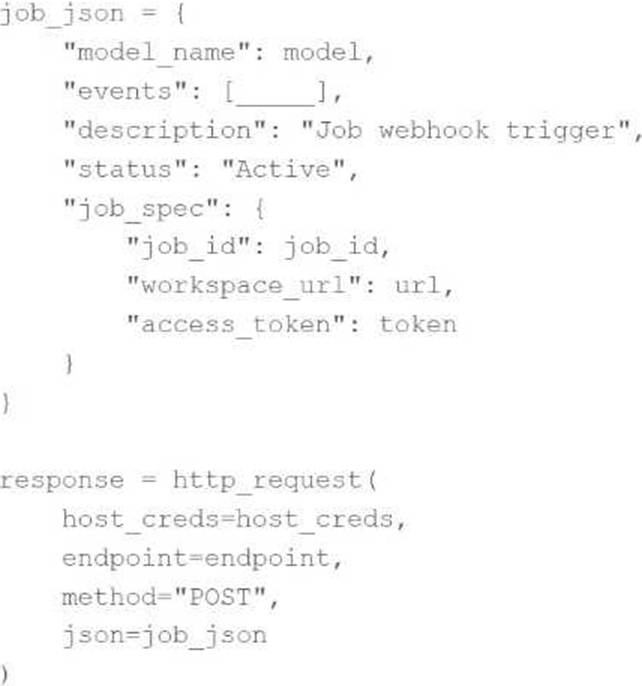
Which of the following lines of code can be used to fill in the blank so that the code block accomplishes the task?
- A . "MODEL_VERSION_CREATED"
- B . "MODEL_VERSION_TRANSITIONED_TO_PRODUCTION"
- C . "MODEL_VERSION_TRANSITIONED_TO_STAGING"
- D . "MODEL_VERSION_TRANSITIONED_STAGE"
- E . "MODEL_VERSION_TRANSITIONED_TO_STAGING",
"MODEL_VERSION_TRANSITIONED_TO_PRODUCTION"
Which of the following is a simple statistic to monitor for categorical feature drift?
- A . Mode
- B . None of these
- C . Mode, number of unique values, and percentage of missing values
- D . Percentage of missing values
- E . Number of unique values
Which of the following MLflow Model Registry use cases requires the use of an HTTP Webhook?
- A . Starting a testing job when a new model is registered
- B . Updating data in a source table for a Databricks SQL dashboard when a model version transitions to the Production stage
- C . Sending an email alert when an automated testing Job fails
- D . None of these use cases require the use of an HTTP Webhook
- E . Sending a message to a Slack channel when a model version transitions stages
A machine learning engineer has developed a model and registered it using the FeatureStoreClient fs. The model has model URI model_uri. The engineer now needs to perform batch inference on customer-level Spark DataFrame spark_df, but it is missing a few of the static features that were used when training the model. The customer_id column is the primary key of spark_df and the training set used when training and logging the model.
Which of the following code blocks can be used to compute predictions for spark_df when the missing feature values can be found in the Feature Store by searching for features by customer_id?
- A . df = fs.get_missing_features(spark_df, model_uri) fs.score_model(model_uri, df)
- B . fs.score_model(model_uri, spark_df)
- C . df = fs.get_missing_features(spark_df, model_uri) fs.score_batch(model_uri, df)
df = fs.get_missing_features(spark_df) - D . fs.score_batch(model_uri, df)
- E . fs.score_batch(model_uri, spark_df)