
The Open Group OGBA-101 Practice Exams
Last updated on Oct 21,2026- Exam Code: OGBA-101
- Exam Name: TOGAF Business Architecture Foundation Exam
- Certification Provider: The Open Group
- Latest update: Oct 21,2026
Which of the following is a benefit of Value Stream Mapping?
- A . It helps to identify value, duplication, and redundancy across the enterprise.
- B . It helps to assess an organization’s effectiveness at creating, capturing, and delivering value for different stakeholders.
- C . It helps to ensure that investments and project initiatives are prioritized and funded at a level matching with their value.
- D . It highlights the value of individual work packages needed to develop the business architecture.
B
Explanation:
Value Stream Mapping (VSM) is a powerful tool used to assess an organization’s effectiveness at creating, capturing, and delivering value for different stakeholders. It involves mapping out the entire process of value creation from end to end, identifying each step involved, and analyzing how value is added at each stage. VSM helps in identifying bottlenecks, inefficiencies, and opportunities for improvement, ultimately aiming to optimize the value delivery process to better meet stakeholder needs.
In TOGAF, what does the Enterprise Continuum provide?
- A . A method for version control
- B . A view of the Architecture Repository
- C . Templates for business planning
- D . Specific business scenarios for stakeholder analysis
When developing a Business Architecture, which of the following best describes the approach to take If no Architecture Descriptions exist?
- A . Review the contents of the Architecture Repository.
- B . Identify the business goals, business objectives, and drivers for the enterprise
- C . Information should be gathered, and Business Architecture models developed.
- D . Validate the business principles and update the Statement of Architecture Work.
C
Explanation:
In the absence of existing Architecture Descriptions, the development of a Business Architecture would begin with the gathering of relevant information about the business. This information can come from strategic documents, business plans, process documents, and stakeholder interviews, among other sources. Once gathered, this information would be used to create Business Architecture models that articulate the business vision, strategy, governance, organization, and key business processes. These models provide a blueprint that captures the essence of the business and guides subsequent architecture work.
Which of the following is a difference between an organization map and an organization chart?
- A . An organization map highlights where in the organization that stakeholder concerns are not being
addressed by a business architecture. - B . An organization map can be impacted by a business model change.
- C . An organization map reduces the time, cost, and risk of business operations.
- D . An organization map is limited to formal relationships between business units.
A
Explanation:
An organization map is a technique that can be used to show how a business architecture addresses stakeholder concerns across different parts of an organization3. It can highlight gaps or overlaps in the coverage of stakeholder concerns by a business architecture. An organization chart, on the other hand, is a diagram that shows the formal structure and hierarchy of an organization, such as reporting relationships and roles4. An organization chart does not necessarily show how stakeholder concerns are addressed by a business architecture.
An organization map differs from an organization chart in that it is designed to show more than just the formal hierarchy and relationships between different units within an organization. It provides a view of the enterprise from the perspective of the business architecture, highlighting areas where stakeholder concerns might not be addressed effectively, whereas an organization chart typically shows the formal reporting structures only.
Which of the following is the element of a value stream stage that describes the end state condition denoting the completion of the value stream stage?
- A . Target state
- B . Exit criteria
- C . Completion stage
- D . End point
B
Explanation:
In TOGAF’s Business Architecture, a value stream stage is a high-level representation of a sequence of activities that create value for an organization. The end state condition denoting the completion of a value stream stage is known as the "Exit Criteria." This term is used to specify the conditions that must be met for the stage to be considered complete, ensuring that the output meets the required quality and performance standards before progressing to the next stage. The concept of "Exit Criteria" is essential to ensure that each stage of the value stream adds the expected value and aligns with the overall business objectives.
Which of the following can be used to help define information concepts in an information map?
- A . Stakeholder Map
- B . Value streams
- C . Statement of business goals and drivers
- D . Organization Map
C
Explanation:
A statement of business goals and drivers can be used to help define information concepts in an information map. This statement provides the context and rationale for the information requirements of the enterprise, which can then be reflected in the information map, ensuring that the information architecture supports the business objectives.
What is presented as "striking a balance between positive and negative outcomes resulting from the realization of either opportunities or threats"?
- A . Agile development
- B . Transition Management
- C . Architecture Security
- D . Risk Management
D
Explanation:
Risk management in TOGAF involves balancing positive and negative outcomes resulting from the realization of either opportunities or threats. Here’s a detailed explanation: Definition of Risk Management:
Risk Management: The process of identifying, assessing, and controlling risks arising from operational factors and making decisions that balance risk costs with benefits. Balancing Outcomes:
Opportunities and Threats: Risk management aims to strike a balance between the positive outcomes (opportunities) and negative outcomes (threats) of different scenarios. This involves assessing the potential benefits and drawbacks of various actions and decisions.
Decision-Making: Effective risk management supports informed decision-making by considering the potential impacts of risks and opportunities on the organization’s objectives.
TOGAF
Reference: Architecture Risk Management: TOGAF includes guidelines for managing risks associated with architecture development. This involves identifying risks early in the ADM phases and continuously monitoring and mitigating them throughout the architecture lifecycle.
Phase F: Migration Planning: During this phase, risk management is crucial for planning the transition
from the current state to the target architecture. It ensures that risks are identified, assessed, and
mitigated to ensure a smooth transition.
Benefits:
Minimizing Negative Impacts: By effectively managing risks, organizations can minimize the negative impacts of threats and enhance the positive outcomes of opportunities.
Enhancing Resilience: Risk management helps in building organizational resilience by preparing for potential disruptions and ensuring continuity of operations.
In summary, risk management is about striking a balance between positive and negative outcomes resulting from the realization of either opportunities or threats, supporting informed decision-
making and enhancing organizational resilience.
Exhibit.
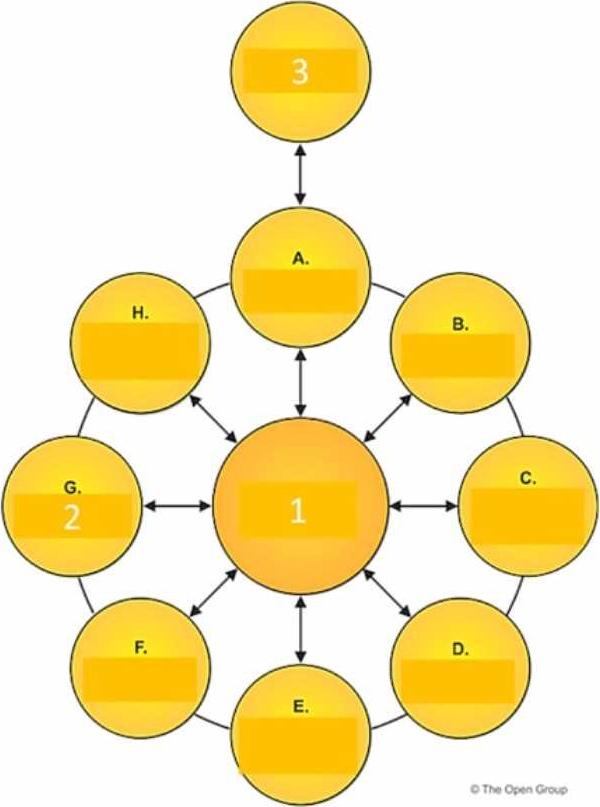
Consider the diagram of an architecture development cycle.
Select the correct phase names corresponding to the labels 1, 2 and 3?
- A . 1 Architecture Governance – 2 Implementation Governance – 3 Preliminary
- B . 1 Requirements Management – 2 Change Management – 3 Strategy
- C . 1 Requirements Management – 2 Implementation Governance – 3 Preliminary
- D . 1 Continuous Improvement – 2 Migration Planning – 3 Architecture Vision
C
Explanation:
The diagram of an architecture development cycle shows three phases of the TOGAF ADM. The correct phase names corresponding to the labels 1, 2 and 3 are Requirements Management, Implementation Governance, and Preliminary respectively3. These phases are described as follows: Requirements Management (label 1): This phase provides a process for managing architecture requirements throughout the ADM cycle3. It ensures that requirements are captured, stored, prioritized, and addressed by relevant ADM phases3. It also ensures that requirements are validated and updated as necessary3.
Implementation Governance (label 2): This phase provides a process for ensuring that the implementation projects conform to the defined architecture3. It involves establishing an implementation governance model, defining architecture contracts and compliance reviews, and monitoring and supporting the implementation projects3.
Preliminary (label 3): This phase provides a process for preparing and planning the architecture project3. It involves defining the scope and vision of the project, customizing the ADM process and content framework, defining principles and governance structures, and evaluating the enterprise architecture maturity and readiness3.
Explain how business models can be used according to the TOGAF standard.
- A . To estimate resource requirements for the definition of the architecture.
- B . To plan the Implementation activities for the architecture project.
- C . To identify new capabilities required to realize the target business model.
- D . To define a taxonomy of services needed to support the change
C
Explanation:
According to the TOGAF standard, business models are used to understand and describe the business itself, including its organization, its objectives, and how it operates. This understanding is crucial when defining an enterprise architecture as it provides a frame of reference. Business models help in identifying new capabilities that the business must develop to achieve its future state as outlined in the target business model. These capabilities may be processes, information, or technologies that the business must adopt or adapt to fulfill the strategic objectives and deliver value. TOGAF emphasizes the alignment of IT with business strategy, and the business model serves as a key link in ensuring that the capabilities delivered by the enterprise architecture will enable the desired business outcomes.