
The Open Group OGBA-101 Practice Exams
Last updated on Oct 21,2026- Exam Code: OGBA-101
- Exam Name: TOGAF Business Architecture Foundation Exam
- Certification Provider: The Open Group
- Latest update: Oct 21,2026
Which of the following supports the need to govern Enterprise Architecture?
- A . The Architecture Project mandates the governance of the target architecture.
- B . The TOGAF standard cannot be used without executive governance.
- C . Best practice governance enables the organization to control value realization.
- D . The stakeholder preferences may go beyond the architecture project scope and needs control.
C
Explanation:
One of the reasons that supports the need to govern Enterprise Architecture is that best practice governance enables the organization to control value realization6. Value realization is the process of ensuring that the expected benefits from implementing an Enterprise Architecture are achieved and sustained over time6. Best practice governance provides a framework and mechanisms for monitoring and evaluating the performance and outcomes of Enterprise Architecture initiatives, as well as ensuring alignment with strategic objectives and stakeholder expectations.
Which of the following best describes a business capability?
- A . It is an articulation of the relationships between business entities that make up the enterprise.
- B . It delineates what a business does without an explanation of how, why, or where the capability is used.
- C . It is a detailed description of the architectural approach to realize a particular solution.
- D . It is a qualitative statement of intent that should be met by the enterprise architecture capability developing the business architecture.
B
Explanation:
In TOGAF, a business capability represents a high-level abstraction of what a business does, independent of how, why, or where the capability is used. Here’s a detailed explanation: Definition of Business Capability:
Business Capability: A business capability describes the capacity or ability of a business to act or achieve a specific outcome. It is an abstraction of the business functions, representing what the business does.
Key Characteristics:
What, Not How: A business capability focuses on what the business does, without delving into the specifics of how, why, or where it is implemented or utilized. This abstraction helps in maintaining a clear and consistent understanding across the organization.
Independence: Business capabilities are designed to be independent of the organizational structure, processes, or systems that support them. This ensures that they remain stable even as the organization evolves.
TOGAF
Reference: Phase B: Business Architecture: In this phase, business capabilities are identified and mapped to understand the core functions of the business. This helps in aligning the architecture with business strategy and objectives.
Capability-Based Planning: TOGAF emphasizes capability-based planning, where business capabilities are used as the foundation for planning and decision-making. Importance:
Strategic Alignment: Business capabilities provide a stable and consistent view of what the business does, which is crucial for aligning the architecture with strategic goals.
Foundation for Analysis: By focusing on what the business does, capabilities serve as a foundation for various analyses, including gap analysis, impact analysis, and capability maturity assessments.
In summary, a business capability delineates what a business does without an explanation of how, why, or where the capability is used, providing a stable and consistent foundation for strategic planning and architecture development.
Complete the sentence. A key principle of value streams is that value is always defined from the perspective of the_____________
- A . Shareholder
- B . Architect
- C . Sponsor
- D . Stakeholder
D
Explanation:
A key principle of value streams is that value is always defined from the perspective of the stakeholder2. A stakeholder is any person or group who has an interest in or influence on an enterprise or its activities5. A stakeholder can be internal or external to the enterprise. A stakeholder can also be a customer, end user, partner, supplier, regulator, employee, or any other role that interacts with or benefits from the enterprise’s products or services5. Value streams should reflect how stakeholders perceive and measure value in terms of outcomes, benefits, costs, risks, and satisfaction2.
Which of the following is the element of a value stream stage that describes the end state condition denoting the completion of the value stream stage?
- A . Target state
- B . Completion stage
- C . End point
- D . Exit criteria
D
Explanation:
In the context of a value stream within TOGAF, a value stream stage represents a segment of the overall process that delivers value to stakeholders. Each stage has specific characteristics and elements that help define its progress and completion. The "exit criteria" is a key element that describes the end state condition, denoting the completion of a value stream stage.
Here’s how TOGAF defines and uses these concepts:
Value Stream Definition:
A value stream represents an end-to-end collection of activities that create a result for a customer, stakeholder, or end-user. It provides a visual representation of how value is delivered.
Value Stream Stages:
Each value stream consists of multiple stages, each contributing to the overall value delivery. These stages need to be clearly defined to ensure the value stream can be effectively managed and improved.
Exit Criteria:
Definition: Exit criteria are the conditions that must be met to signify the completion of a value stream stage. These criteria ensure that all necessary tasks have been completed and that the output meets the required quality and performance standards.
Purpose: By defining exit criteria, organizations can ensure that each stage of the value stream is completed before moving to the next, maintaining quality and consistency across the process. TOGAF
Reference: Phase B: Business Architecture: In this phase, value streams and their stages are modeled. Defining exit criteria for each stage helps in managing transitions and ensuring that each part of the value stream is delivering the intended value.
In summary, the exit criteria define the end state condition of a value stream stage, ensuring that all necessary tasks are completed and quality standards are met before proceeding to the next stage.
Which of the following Business Architecture concepts should the architect examine and search for when developing the Architecture Vision?
- A . Architecture Principles, Business Goals
- B . Implementation Factor Catalog. Business Value Assessment Matrix
- C . Architecture Continuum, Architecture Repository
- D . Organization Map. Business Capabilities
A
Explanation:
When developing the Architecture Vision, which is part of the TOGAF ADM Phase A, architects should examine the Architecture Principles and Business Goals. These components provide the foundational guidance and the strategic context for the architecture work. They ensure that the resulting architecture aligns with the overall direction and objectives of the enterprise.
Consider the following:
You need to analyze a new value stream within the scope of a project.
Which of the following would you use?
- A . Converting the value stream stages to entities and then building a logical data model
- B . Heat mapping by value stream stages.
- C . An organization chart showing the business units that work with the enterprise and their value.
- D . Combining information mapping with a business process model.
D
Explanation:
To analyze a new value stream within the scope of a project, it is effective to combine information mapping with a business process model. This approach allows for a comprehensive understanding of the value stream, including the information required and produced at each stage, and how this information supports the business processes involved in delivering value.
What is defined as the effect of uncertainty on objectives?
- A . Threat
- B . Continuity
- C . Risk
- D . Vulnerability
C
Explanation:
Risk is defined as the effect of uncertainty on objectives. It can be positive or negative depending on whether it enhances or hinders the achievement of objectives. Threat is a potential cause of risk that could have a negative impact on objectives. Continuity is the ability to maintain or resume normal operations after a disruption or disaster. Vulnerability is a weakness or exposure that could be exploited by a threat to cause harm or damage.
Which of the following is a benefit of developing a TOGAF business scenario?
- A . It provides a versatile approach to business planning.
- B . It can be an important aid to vendors in delivering appropriate solutions.
- C . It provides an organizing framework for the change activity in a project.
- D . It provides general rules and guidelines to support planning at the enterprise level.
B
Explanation:
Developing a TOGAF business scenario provides several benefits, particularly in aiding vendors to deliver appropriate solutions. Here’s a detailed explanation:
TOGAF Business Scenarios:
Business scenarios are used to capture and describe business requirements, helping to identify and
understand business needs and challenges.
Role in Vendor Engagement:
Clarity of Requirements: Business scenarios provide clear and detailed descriptions of the business context, needs, and requirements. This helps vendors understand what solutions are necessary to address specific business challenges.
Alignment of Solutions: By providing a comprehensive view of the business environment and requirements, business scenarios ensure that the solutions proposed by vendors are aligned with the actual business needs and strategic goals.
TOGAF ADM
Reference: Phase A: Architecture Vision: In this phase, business scenarios are developed to capture stakeholder concerns and requirements, providing a basis for the architecture vision.
Vendor Communication: Business scenarios are communicated to vendors to ensure that their solutions fit within the overall architecture and meet the specific requirements of the business. Benefits:
Effective Solution Design: Vendors can design solutions that are tailored to the specific needs of the business, reducing the risk of misalignment and ensuring better outcomes.
Improved Collaboration: Business scenarios facilitate better collaboration between the enterprise and vendors by providing a common understanding of the requirements and expected outcomes. In summary, developing a TOGAF business scenario aids vendors in delivering appropriate solutions by providing clear and detailed descriptions of business requirements, ensuring alignment with business needs and strategic goals.
In the diagram, what are the items labelled A, B, and C?
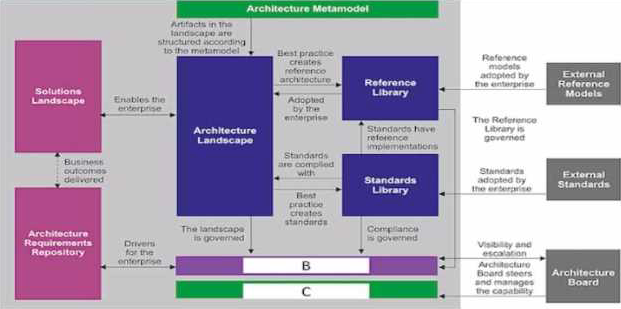
- A . A-Enterprise Repository, B-Governance Repository. C-Board Repository
- B . A-Architecture Repository, B-Governance Repository. C-Architecture Capability
- C . A-Architecture Repository, B-Governing Board, C-Enterprise Capability
- D . Enterprise Repository, B-Board repository, C-Enterprise Capability
C
Explanation:
In the provided diagram, item A refers to the Architecture Repository, which is a part of the TOGAF framework where all the architecture assets are stored. This includes the architectural models, patterns, architecture descriptions, and other artifacts relevant to the architecture. Item B is labeled as the Governing Board, which is likely referring to the Architecture Board or a similar governance structure responsible for oversight and decision-making regarding the enterprise architecture. Item C refers to Enterprise Capability, which encompasses the processes, tools, skills, and other capabilities that enable the architecture function within the enterprise.
Consider the diagram.
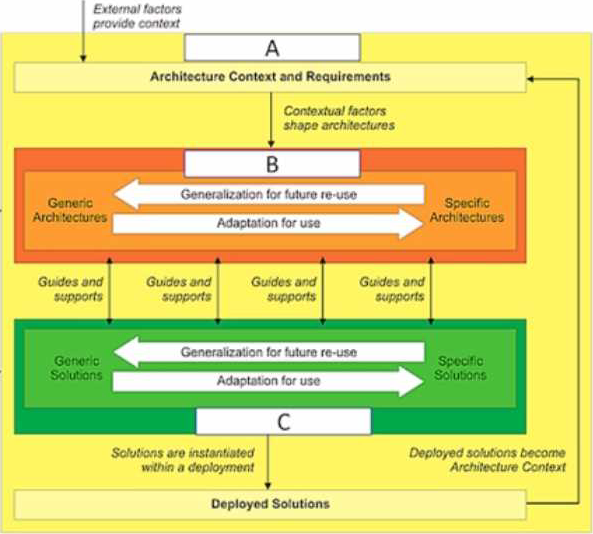
What are the items labelled A, B and C?
- A . A-Enterprise Strategic Architecture, B-Segment Architecture, C-Solutions Architecture
- B . A-Enterprise Continuum, B-Architecture Continuum. C-Solutions Continuum
- C . A-Architecture Vision, B-Business Architecture. C-lnformation Systems Architecture
- D . A-Enterprise Architecture, B-Architecture Building Blocks, C-Solutions Building Blocks
B
Explanation:
The diagram shows the Enterprise Continuum, which is a view of the Architecture Repository that provides methods for classifying architecture and solution artifacts as they evolve from generic Foundation Architectures to Organization-Specific Architectures4. The Enterprise Continuum comprises two complementary concepts: the Architecture Continuum and the Solutions Continuum. The Architecture Continuum shows the relationships among foundational frameworks, common system architectures, industry architectures, and enterprise architectures4. The Solutions Continuum shows the relationships among foundational solutions, common system solutions,
industry solutions, and enterprise solutions4.