
Fortinet NSE7_OTS-7.2.0 Practice Exams
Last updated on Oct 21,2026- Exam Code: NSE7_OTS-7.2.0
- Exam Name: Fortinet NSE 7 - OT Security 7.2.0
- Certification Provider: Fortinet
- Latest update: Oct 21,2026
With the limit of using one firewall device, the administrator enables multi-VDOM on FortiGate to provide independent multiple security domains to each ICS network.
Which statement ensures security protection is in place for all ICS networks?
- A . Each traffic VDOM must have a direct connection to FortiGuard services to receive the required security updates.
- B . The management VDOM must have access to all global security services.
- C . Each VDOM must have an independent security license.
- D . Traffic between VDOMs must pass through the physical interfaces of FortiGate to check for security incidents.
As an OT network administrator, you are managing three FortiGate devices that each protect different levels on the Purdue model. To increase traffic visibility, you are required to implement additional security measures to detect exploits that affect PLCs.
Which security sensor must implement to detect these types of industrial exploits?
- A . Intrusion prevention system (IPS)
- B . Deep packet inspection (DPI)
- C . Antivirus inspection
- D . Application control
Refer to the exhibit.
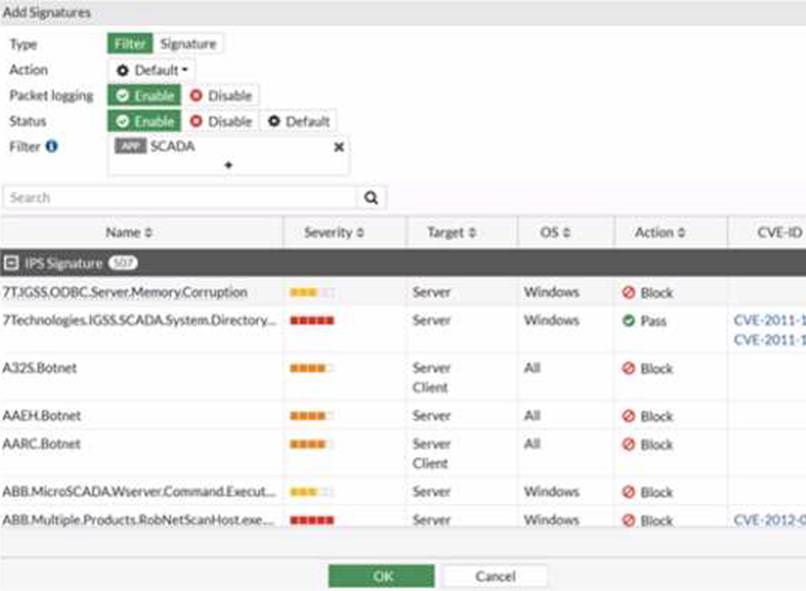
The IPS profile is added on all of the security policies on FortiGate.
For an OT network, which statement of the IPS profile is true?
- A . FortiGate has no IPS industrial signature database enabled.
- B . The listed IPS signatures are classified as SCADAapphcat nns
- C . All IPS signatures are overridden and must block traffic match signature patterns.
- D . The IPS profile inspects only traffic originating from SCADA equipment.
Refer to the exhibit.
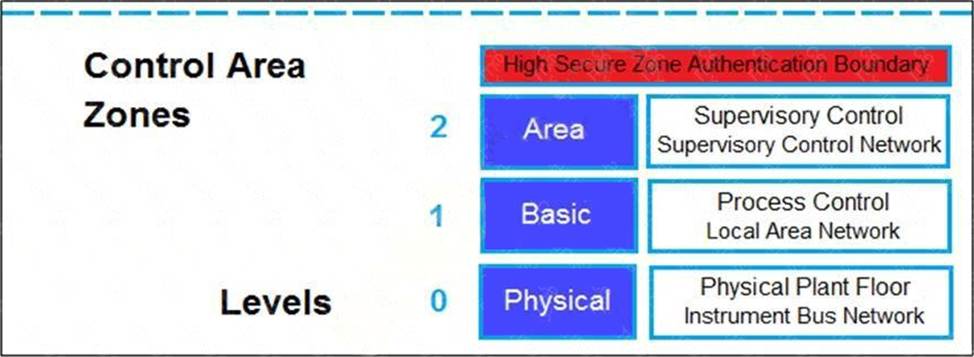
Based on the Purdue model, which three measures can be implemented in the control area zone using the Fortinet Security Fabric? (Choose three.)
- A . FortiGate for SD-WAN
- B . FortiGate for application control and IPS
- C . FortiNAC for network access control
- D . FortiSIEM for security incident and event management
- E . FortiEDR for endpoint detection
What two advantages does FortiNAC provide in the OT network? (Choose two.)
- A . It can be used for IoT device detection.
- B . It can be used for industrial intrusion detection and prevention.
- C . It can be used for network micro-segmentation.
- D . It can be used for device profiling.
A, D
Explanation:
Typically, in a microsegmented network, NGFWs are used in conjunction with VLANs to implement security policies and to inspect and filter network communications. Fortinet FortiSwitch and FortiGate NGFW offer an integrated approach to microsegmentation.
An OT administrator has configured FSSO and local firewall authentication. A user who is part of a user group is not prompted from credentials during authentication.
What is a possible reason?
- A . FortiGate determined the user by passive authentication
- B . The user was determined by Security Fabric
- C . Two-factor authentication is not configured with RADIUS authentication method
- D . FortiNAC determined the user by DHCP fingerprint method
An OT administrator configured and ran a default application risk and control report in FortiAnalyzer to learn more about the key application crossing the network. However, the report output is empty despite the fact that some related real-time and historical logs are visible in the FortiAnalyzer.
What are two possible reasons why the report output was empty? (Choose two.)
- A . The administrator selected the wrong logs to be indexed in FortiAnalyzer.
- B . The administrator selected the wrong time period for the report.
- C . The administrator selected the wrong devices in the Devices section.
- D . The administrator selected the wrong hcache table for the report.
B, C
Explanation:
https://fortinetweb.s3.amazonaws.com/docs.fortinet.com/v2/attachments/32cb817d-a307-11eb-b70b-00505692583a/FortiAnalyzer-7.0.0-Administration_Guide.pdf
Which three common breach points can be found in a typical OT environment? (Choose three.)
- A . Global hat
- B . Hard hat
- C . VLAN exploits
- D . Black hat
- E . RTU exploits
An OT network administrator is trying to implement active authentication.
Which two methods should the administrator use to achieve this? (Choose two.)
- A . Two-factor authentication on FortiAuthenticator
- B . Role-based authentication on FortiNAC
- C . FSSO authentication on FortiGate
- D . Local authentication on FortiGate
Refer to the exhibit.
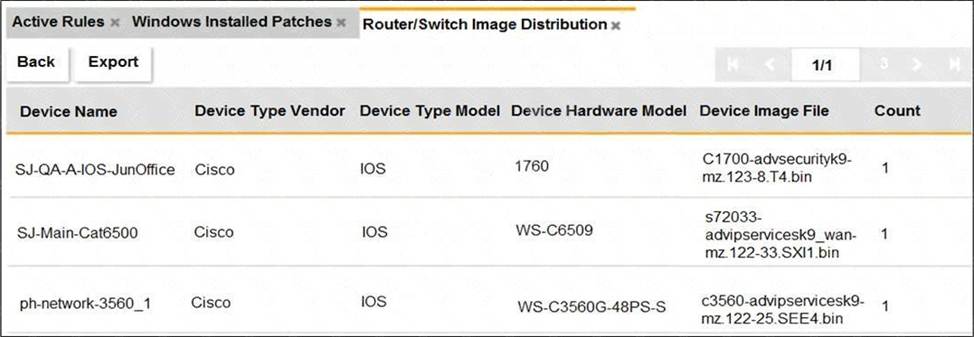
An OT administrator ran a report to identify device inventory in an OT network.
Based on the report results, which report was run?
- A . A FortiSIEM CMDB report
- B . A FortiAnalyzer device report
- C . A FortiSIEM incident report
- D . A FortiSIEM analytics report