CIPS L4M5 Practice Exams
Last updated on Oct 21,2026- Exam Code: L4M5
- Exam Name: Commercial Negotiation
- Certification Provider: CIPS
- Latest update: Oct 21,2026
Leitax is a consumer electronics firm with headquarters in the US and with a global sales presence. The company maintains seven to nine models in its product portfolio, each of which has multiple SKUs. Product life ranges from fifteen to nine months and is getting shorter. The demand planning and master planning processes at the company were ill-defined. Data relevant to forecasting were usually inaccurate, incomplete, or unavailable and the lack of objectives and monitoring mechanisms for the demand planning process meant that process improvement could not be managed. Support for supply management was equally ill-defined, as master production schedules were sporadic and unreliable and suppliers had learned to mistrust them. Leitax’s newly appointed Supply chain director, Jessica realises that the “buy-in” of different functional groups was critical to the improvement of demand planning. She invites relevant stakeholders to a meeting so that they can express their opinions openly.
What tactic is Jessica using?
- A . Coalition
- B . Pressure
- C . Consultation
- D . Persuasion
A
Explanation:
There are nine commonly used influence tactic:
Procurement gets involved in negotiating purchase requisitions only when there is a value analysis to ensure that only value-adding aspects are included. Is this statement true?
- A . No, purchasing can negotiate other details of the purchase requisition even where value analysis is absent
- B . No, value analysis is a very technical process that requires the expertise of engineering and financial analysts
- C . Yes, the role of purchasing is to add value to the purchase, and therefore every purchase requisition must go through a team value analysis
- D . Yes, value analysis is the single most important responsibility of procurement in the processing of repeat requisitions
A
Explanation:
Procurement can negotiate various aspects of a purchase requisition even without a formal value analysis. While value analysis can enhance cost-effectiveness, procurement professionals often negotiate on pricing, terms, and conditions to add value independently of value analysis, as per CIPS’s guidelines on procurement flexibility in negotiations.
End users are the only stakeholders that are involved in the preparation of a negotiation. Is this statement true?
- A . Yes, because end-users have greater expert power
- B . Yes, because only end-users understand their demand
- C . No, because end-users are external stakeholders
- D . No, because budget holders also play an important role
D
Explanation:
Commercial negotiation objectives should be driven by the business needs of the organisation. Organisations are made up of different stakeholder groups, some of whom may have different, even conflicting objectives. From a negotiation perspective, stakeholders can be defined as persons or groups that have interest (or stake) in the outcome of the negotiation you are leading or participating in.
CIPS distinguishes between 3 sets of stakeholders:
– Internal stakeholders
– Connected stakeholders
– External stakeholders
End-users are examples of internal stakeholders. They are the people who will benefit from the purchase of a product or service. However, their interest may conflict with other groups, i.e. the budget controllers whose objective is minimising the expense. In negotiation perspective, procurement should involve different groups of stakeholder. LO 1, AC 1.1
Katie is preparing a negotiation with a strategic supplier. Through deep market analysis, she realises that her company and the supplier have equal bargaining power. Via regular communication, Katie knows that both parties are arguing on amount of liquidated damages and neither party shall concede all of their requirements but some are negotiable. Katie and her counterpart from supplying company still desire a long-term relationship and hope that the meeting between them will be a solution for current situation.
Which of the following is the most appropriate approach that Katie should adopt to achieve the above outcome?
- A . Avoiding approach
- B . Competing approach
- C . Compromising approach
- D . Accommodating approach
C
Explanation:
Competing is assertive and uncooperative, a power-oriented mode. When competing, an individual pursues his or her own concerns at the other person’s expense, using whatever power seems appropriate to win his or her position. Competing might mean standing up for your rights, defending a position you believe is correct, or simply trying to win. Competing will not allow long-term relationship to flourish.
Compromising is intermediate in both assertiveness and cooperativeness. When compromising, the objective is to find an expedient, mutually acceptable solution that partially satisfies both parties. Compromising falls on a middle ground between competing and accommodating, giving up more than competing but less than accommodating. Likewise, it addresses an issue more directly than avoiding but doesn’t explore it in as much depth as collaborating. Compromising might mean splitting the difference, exchanging concessions, or seeking a quick middle-ground position. It is a valid approach when long-term relationships are at stake and it is important to find some common ground on which to base an agreement. Both sides get something but not everything. Therefore, this is the most appropriate for this scenario.
Avoiding is unassertive and uncooperative. When avoiding, an individual does not immediately pursue his or her own concerns or those of the other person. He or she does not address the conflict. Avoiding might take the form of diplomatically sidestepping an issue, postponing an issue until a better time, or simply withdrawing from a threatening situation. In the scenario, both parties want to take the opportunity, then avoiding is not an appropriate solution.
Accommodating is unassertive and cooperative―the opposite of competing. When accommodating, an individual neglects his or her own concerns to satisfy the concerns of the other person; there is an element of self-sacrifice in this mode. Accommodating might take the form of selfless generosity or charity, obeying another person’s order when you would prefer not to, or yielding to another’s point of view. In the scenario, neither party shall concede all of their requirements, it is unnecessary to adopt this approach.
LO 1, AC 1.1
When is the best time for buyer to propose the negotiation agenda to potential supplier?
- A . At opening stage
- B . At conclusion stage
- C . At testing stage
- D . At preparation stage
D
Explanation:
A business negotiation agenda is a formal agreed upon list of goals to be achieved or items to be discussed in a particular order during a meeting or negotiation. Agendas can be formal and obvious, or informal and subtle in negotiations.
The agenda is one of the main structural elements of negotiation, in addition to such questions as site, identification of participants, and elements of timing. Together, they answer the who, what, when, and where questions. As with other aspects of negotiation, the agenda can be used either manipulatively to enhance leverage or to improve the prospects for agreement and the possibilities for mutual gain. In most cases, it will be used both ways, reflecting the nature of negotiation as a “mixed-motive” situation.
Although it can be instrumental to [research] volunteer as a sole source to write the agenda, in most
cases it becomes a joint activity to construct a consensual basis for subsequent negotiation. In these situations, agenda-building becomes one of the pre-negotiation activities that set the tone for the relationship (Saunders, 1985). In other situations, the parties may engage in actual negotiation without a formal or written agenda. When this occurs, the risks and uncertainties may be high but the party who appreciates the importance of the informal agenda has a tremendous advantage.
Whether one plans it or not, during the course of negotiation the parties will discuss a finite set of issues in some sequence and from a particular perceptual framework. Consciousness of the universality and centrality of the agenda is prerequisite to guiding negotiation to a successful conclusion.
Reference: CIPS study guide page 146-150
Managing the negotiation agenda | SpringerLink
What is Negotiations Agenda – Negotiation Coaching (brightfocusconsult.com)
Procurement team is required to improve leverage with their suppliers through spend consolidation.
To check whether there is any opportunity to consolidate spend, which of the following should be priority of procurement team?
- A . Spend analysis
- B . Value engineering
- C . Price analysis
- D . Total cost analysis
A
Explanation:
In order to identify opportunities where you can increase your leverage with supplier, you need to understand your spend. Undertaking spend analysis of your accounts payable (AP) data is an essential first step here.
Which of the following are most likely to harm trust between buyer and supplier in a commercial relationship? Select TWO that apply.
- A . Avoidance of submitting important documentations
- B . Reduced response time during contract performance
- C . Resolving some conditions that would otherwise have them competing for resources
- D . Subjective assessment of performance
- E . Exploring a disagreement to learn from each other’s insights
A, D
Explanation:
Trust-destroying behaviours:
– Rumours of partnership or relationship breaking down
– Emotion-based assessment of performance
– Avoiding accountability, passing the blame to others
– General mood C resentment, distrust, frustration, etc LO 1, AC 1.4
In a commercial negotiation, a procurement professional believe that the larger the order quantity from buyer, the lower the supplier’s average costs.
Is this assumption true?
- A . No, because supplier’s average costs will rise as the buyer’s demand increases
- B . No, because the supplier may need to invest in new facility to meet buyer’s demand
- C . Yes, because larger order quantity will bring a considerable profit to supplier
- D . Yes, because larger order quantity will always enable the supplier to reach its economy of scale
B
Explanation:
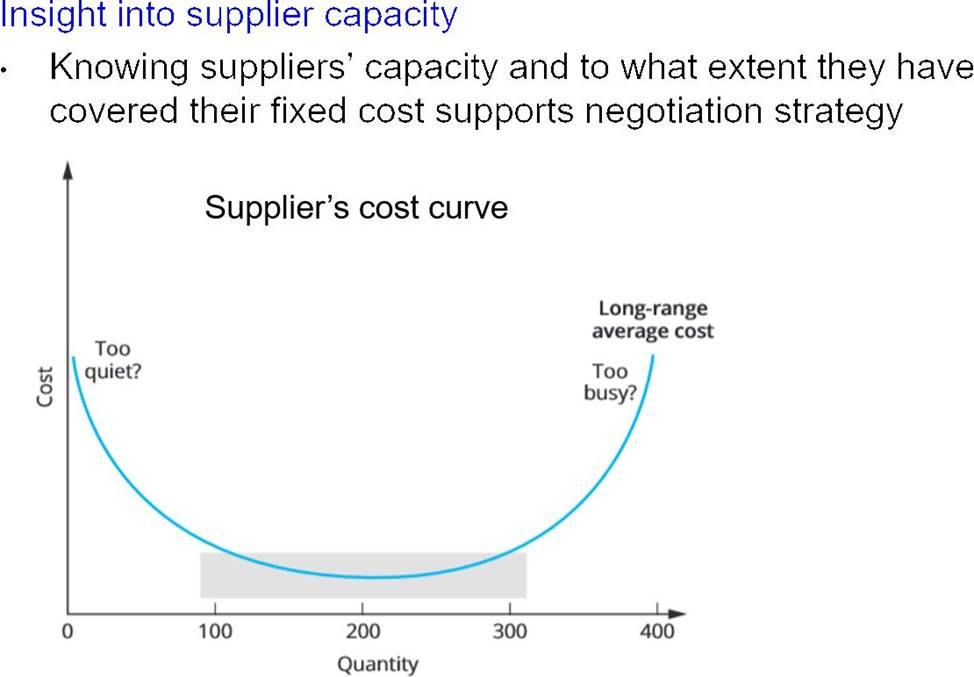
In some markets, suppliers experience peaks and troughs in demand and so buyers can increase their leverage through developing an understanding of how busy their vendor are at particular time during the year or business cycle and targetting at quieter period. Similarly, if a buyer can develop an understanding of supplier capacity and to what extent have they covered their fixed cost, they may be able to target suppliers when their average costs are likely to be lowest. Vendor’s average costs will be higher at low and high capacity utilisation.