
CIPS L4M2 Practice Exams
Last updated on Oct 21,2026- Exam Code: L4M2
- Exam Name: Defining Business Needs
- Certification Provider: CIPS
- Latest update: Oct 21,2026
In this course, the acronym ‘CPA’ stands for:
- A . Cost price adjustment
- B . Certified price assessor
- C . Critical path analysis
- D . Contract price adjustment
D
Explanation:
Contract price adjustment.
A contract may contain a contract price adjustment clause if the parties feel that costs may move significantly over the contract period. For example, in respect of commodities, metals, currencies or even sometimes, labour. Normally reference would be made to an index or indices which would help determine the direction and extent of adjustment in a minimally controversial way. An example of a widely-used index / formula in the UK is the BEAMA formula.
Which of the following is the purpose of benchmarking?
- A . To identify and adapt the best practices to improve organisation’s performance
- B . To copy other organisation’s intellectual properties, processes and practices
- C . To coerce all suppliers to sacrifice their profit
- D . To resist continuous improvement
A
Explanation:
According to US Department of the Navy, Benchmarking is a strategic and analytic process of continuously measuring an organisation’s products, services, and practices against a recognised leader in the studied area.
Successful benchmarking will help you:
– Find who does the process best and close the gap
– Recognise the leading organisations in a process or activity
– Create performance standards derived from an analysis of the best in business
– Ensure that comparisons are relevant
– Measure your performance, your processes, and your strategies against best in business
– Measure business processes
– Assess performance over time
– Accelerate continuous process improvement (CPI)
– Establish more credible goals for CPI
– Establish actionable objectives
– Discover and clarify new goals
– Establish customer expectations of business standards set by the best suppliers in industry
– Help your organisation achieve breakthrough improvements
– Create a sense of urgency for change
– Increase customer satisfaction
– Become direction setting
– Provide a positive, proactive structured process
Benchmarking does not:
– Copy the other’s processes
– Steal other business confidentiality
– Stop. Benchmarking is a continuous process.
Reference: – CIPS study guide page 49-51
– The Department of the Navy Benchmarking Handbook LO 1, AC 1.3
Ymira is asked to develop the specification for water purifier which will be used at the company headquarter. She believes that the specification can be drafted based on the information available on the Internet, such as blog posts, comparison websites, how-to websites, life hacks, etc.
Which of the following traits will make the information more useful?
- A . Trustworthy sources
- B . Objectivity
- C . Subjectivity
- D . Written by inexperienced author
- E . Promotional information
A, B
Explanation:
Internet is a great source of information, however, information from the Internet needs to be tested for accuracy and reliability.
To check the information from the Internet, a buyer can use the criteria with acronym SAMOA:
Source (of the information)
Audience (intended as the recipient of the information)
Methodology (used to collect and analyse the data)
Objectivity (of the information – there should be no bias)
Accuracy
Reference: CIPS study guide page 125-126
LO 3, AC 3.1
Which of the following statements is the best definition of ‘value engineering?
- A . Analysing perceived value after the product is available for sale
- B . Building value into a new product from design stage onwards
- C . Producing good value products right first time.
- D . Value achieved by an engineering department
B
Explanation:
Value Engineering (VE) is concerned with new products. It is applied during product development.
The focus is on reducing costs, improving function or both, by way of teamwork-based product evaluation and analysis. This takes place before any capital is invested in tooling, plant or equipment.
This is very significant, because according to many reports, up to 80% of a product’s costs (throughout the rest of its life-cycle), are locked in at the design development stage. This is understandable when you consider the design of any product determines many factors, such as tooling, plant and equipment, labour and skills, training costs, materials, shipping, installation, maintenance, as well as decommissioning and recycle costs.
LO 3, AC 3.4
Bob is a new procurement specialist at XYZ Ltd. He is assigned to categorise the company’s sup-plies. After analysing, Bob realises that a group of low value products is sourced from a tiny geo-graphical area which is prone to flooding.
What would be the best strategy to manage this category of products?
- A . Source this group of products from only one supplier
- B . Find an alternative source to secure supply
- C . Assign some of procurement jobs to user department
- D . Form partnership relationship with the current supplier
B
Explanation:
In the scenario, the products have low value and high risk of supply. This group is known as bottleneck or critical in Kraljic’s portfolio matrix. The objective for such items would be securing the supply. The company can achieve this goal by ‘making’ the products themselves, or finding an alternative option.
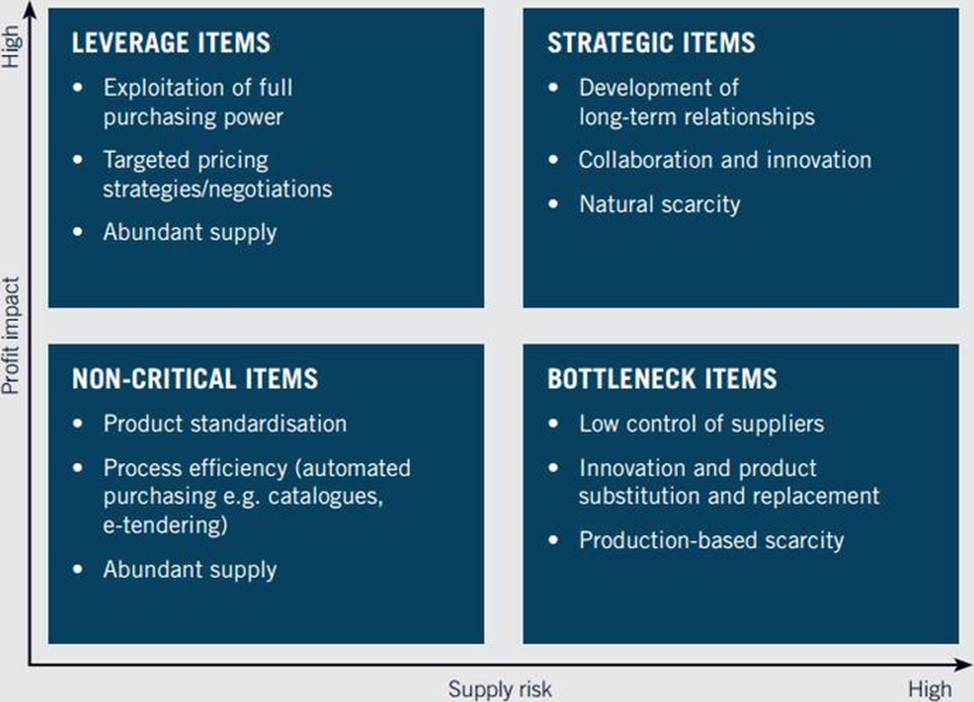
Reference: CIPS study guide page 82-84
LO 2, AC 2.1
Datong is a defense and law enforcement equipment supplier. They are developing new product but largely concerns about the detailed specifications of components and the capability of supply market.
Which of the following approach should Datong adopt in order to optimise the specification and shorten time to market?
- A . Request for quotation from potential suppliers
- B . Invite the supplier to tendering process
- C . Early supplier involvement
- D . Control the budget tightly
C
Explanation:
To improve production process and reduce supply risk, Datong should collaborate with suppliers early in procurement cycle. Collaborating with suppliers in this way is often referred as Early Supplier Involvement (ESI)
‘Request for quotation from potential suppliers’: Quotations should only be requested if the buyer know exactly what they need. In this scenario, Datong is not yet sure about the specifications of product’s components, request for quotation is not a good idea.
‘Mapping out business plan’: A business plan, as defined by Entrepreneur, is a “written document describing the nature of the business, the sales and marketing strategy, and the financial back-ground, and containing a projected profit and loss statement.” A business plan is not appropriate with improving production process and reducing supply risk.
‘Budget controlling’: Budget controlling largely concerns with dealing with budget variances. Tighter budget alone cannot lead to improved processes and fewer risks. LO 3, AC 3.1
Jasmine identified a possible new supplier that offers commercial improvements in her category of spend. She decided to put forward a business case to justify the necessity for a new supplier assessment and audit with the aim of adding the supplier to the approved list. Jasmine decided to carry out a cost-benefits analysis.
Is this the right approach for Jasmine to use?
- A . No, cost-benefits analysis should be done by accounts only
- B . Yes, cost-benefits analysis will show if benefits offered outweigh the cost of the approval
- C . Yes, cost-benefits analysis is a regulatory requirement for any business case
- D . No, cost-benefits analysis is not required; she should request supplier approval
A state school has a procurement requirement to buy new art materials for the next school semester and needs to forecast purchases against its restricted budget.
What would be the key business requirement in this purchasing decision?
- A . Total cost of goods
- B . Quality of materials
- C . Timescales of delivery
- D . Social impact