
Juniper JN0-224 Practice Exams
Last updated on Oct 21,2026- Exam Code: JN0-224
- Exam Name: Automation and DevOps, Associate (JNCIA-DevOps)
- Certification Provider: Juniper
- Latest update: Oct 21,2026
Which two data structures are used in JSON? (Choose two.)
- A . tuples
- B . objects
- C . arrays
- D . dictionaries
B, C
Explanation:
In JSON (JavaScript Object Notation), the two primary data structures are:
Objects: These are collections of key-value pairs, where each key is a string, and the value can be a string, number, array, boolean, or another object. In Python, this structure is analogous to a dictionary.
Arrays: These are ordered lists of values, where each value can be of any data type, including another array or object. In Python, this structure is similar to a list.
Option A (tuples) and Option D (dictionaries) refer to Python-specific data structures and are not directly used in JSON.
Supporting
Reference: JSON Documentation and Tutorials: JSON objects and arrays are the standard data structures used in this format, as described in many tutorials and the official JSON documentation.
Which two statements about NETCONF are true? (Choose two.)
- A . It uses the operations layer to lock the configuration of a Junos device.
- B . It uses the messages layer to commit the configuration of a Junos device.
- C . It uses the messages layer to lock the configuration of a Junos device.
- D . It uses the operations layer to commit the configuration of a Junos device.
A, D
Explanation:
NETCONF (Network Configuration Protocol) operates through different layers, with the operations layer being particularly important for managing configurations:
Operations Layer (A & D): This layer is responsible for actions like locking and committing the configuration on a Junos device. The lock operation prevents other sessions from modifying the configuration, and the commit operation applies the configuration changes to the device.
Options B and C are incorrect because the messages layer handles the communication aspects, such as exchanging data between the client and server, not performing configuration operations like locking and committing.
Reference: IETF RFC 6241 (NETCONF): Describes the protocol layers and their functions, with a focus on the operations layer.
Juniper Networks NETCONF Documentation: Provides insights into how NETCONF operations are managed in Junos
What is the correct Python script syntax to prompt for input?
- A . hostIP = input("Device IP address: ")
- B . hostIP = input{Device IP address: }
- C . hostIP = input"Device IP address: "
- D . input("Device IP address: ") = hostIP
A
Explanation:
In Python, the correct syntax to prompt the user for input and store that input in a variable is:
input(prompt): The input() function is used to take input from the user. The string provided as an argument (inside the parentheses) is displayed as a prompt to the user. The input provided by the user is returned as a string and can be stored in a variable.
Example:
hostIP = input("Device IP address: ")
In this example, "Device IP address: " is the prompt displayed to the user, and the user’s input will be stored in the variable hostIP.
Options B, C, and D are syntactically incorrect in Python.
Reference: Python Official Documentation: Describes the use of the input() function for getting user input.
Python Tutorials: Various tutorials demonstrate how to properly use the input() function in scripts.
You are asked to write an on-box script that will be triggered when a specific interface on a Junos device goes down.
Which type of on-box script should you use to accomplish this task?
- A . commit
- B . event
- C . operation
- D . SNMP
B
Explanation:
An event script is used to automate responses to system events in Junos, such as an interface going down. These scripts are triggered automatically when a specified event occurs, making them suitable for tasks like monitoring interface status and executing actions when the status changes.
Option B (event) is correct because event scripts are designed for reacting to system events like an interface going down.
Option A (commit) is used for configuration changes, Option C (operation) is used for operational tasks, and Option D (SNMP) is not applicable in this context.
Supporting
Reference: Juniper Networks Event Scripts Documentation: Details how event scripts are used to automate responses to specific system events in Junos
Exhibit.
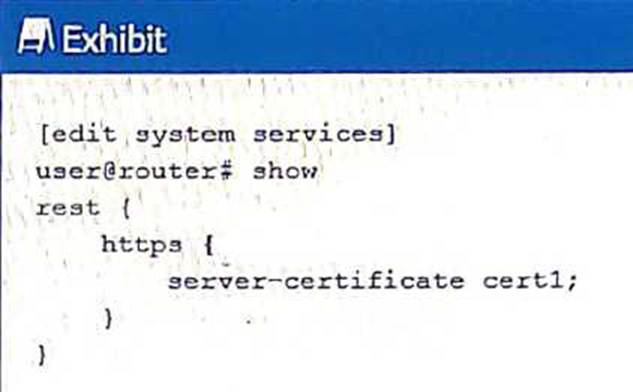
Referring to the exhibit, which statement about REST is correct?
- A . The device is configured to allow only two simultaneous REST connections.
- B . The device is configured to allow connections from the REST API Explorer
- C . The device is configured to allow HTTP connections on port 3030.
- D . The device is configured to allow HTTPS connections on port 3443.
Exhibit.
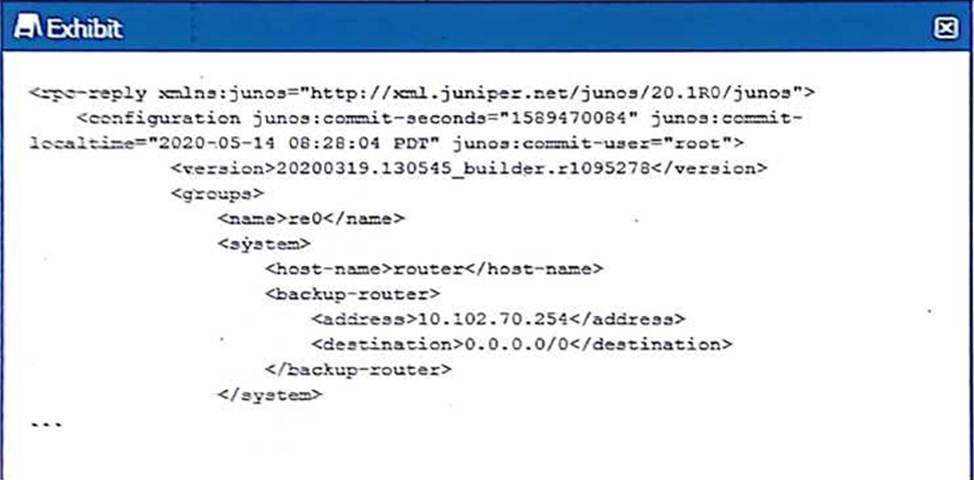
Referring to the exhibit, which XPath statement would retrieve the commit-user attribute in the candidate configuration?
- A . configuration/@ junos: commit-user
- B . configuration:@ junos: commit-user
- C . configuration/junos: commit-user
- D . configuration/commit-user
Which statement is correct about DevOps?
- A . DevOps is a collection of strict guidelines that promotes the project completion over all other aspects.
- B . DevOps is meant to define and restrict the development and operations tools used for a project.
- C . DevOps is meant to unite the development, operations, and other teams to improve project collaborations.
- D . DevOps is a defined standard written and maintained by the IEEE standards group.
C
Explanation:
DevOps is a set of practices, tools, and cultural philosophies that aims to integrate and automate the processes between software development and IT operations teams. The primary goal of DevOps is to shorten the systems development life cycle and provide continuous delivery with high software quality.
Option C is correct because DevOps fundamentally focuses on breaking down the silos between development and operations teams, fostering a collaborative environment where these teams work together throughout the entire software lifecycle. This collaboration extends to other stakeholders, including quality assurance (QA), security, and more, to ensure that the product is continuously delivered and improved based on real-time feedback.
DevOps promotes a cultural shift where teams are no longer isolated but work together to share responsibilities, which leads to increased efficiency, faster problem resolution, and a more streamlined deployment process. This culture of collaboration is supported by various automation tools and practices such as Continuous Integration (CI), Continuous Deployment (CD), Infrastructure as Code (IaC), and automated testing.
Supporting
Reference: Juniper Networks Automation and DevOps Documentation: This documentation emphasizes the importance of collaboration between development and operations teams to streamline processes and improve efficiency, aligning perfectly with the principles of DevOps.
"The DevOps Handbook" by Gene Kim, Patrick Debois, John Willis, and Jez Humble: This book provides an in-depth look into how DevOps practices enhance collaboration and lead to faster, more reliable software delivery.
IEEE and Industry Standards: While DevOps practices are widely adopted, they are not defined or maintained by IEEE or any other formal standards body, which is why option D is incorrect.
Which type of on-box automation script is designed to run every time a user executes a configuration change?
- A . event
- B . SNMP
- C . commit
- D . operation
C
Explanation:
In Junos OS, a commit script is an on-box automation script that runs every time a configuration change is committed. Commit scripts are used to enforce configuration policies, validate configuration changes, or make automatic adjustments to configurations when certain conditions are met.
Commit Script (C): Executes automatically during the commit process, ensuring that the new configuration adheres to specific rules or conventions before it is applied to the system.
Event, SNMP, and operation scripts are used for other purposes in Junos automation but do not run automatically with every configuration change.
Reference: Junos OS Automation Scripts Guide: Provides details on different types of scripts, including commit scripts, and their use cases.
Juniper Networks Documentation: Offers examples and best practices for creating and using commit scripts.
Which two programing languages would be used for on-box scripting with Junos devices? (Choose two.)
- A . Python
- B . Puppet
- C . Ansible
- D . XSLT
Which two statements are correct about a Python dictionary data type? (Choose two.)
- A . The data contained in a dictionary data type cannot be removed once the dictionary has been created.
- B . The data stored in a dictionary data type is sequenced and indexed.
- C . The data contained in a dictionary data type is a key/value pair.
- D . The data stored in a dictionary data type is not sequenced or indexed.
C, D
Explanation:
A Python dictionary is a data type that stores data in the form of key/value pairs. It has the following characteristics:
Key/Value Pair (C): Each entry in a dictionary is a pair consisting of a unique key and a value. The key is used to access the corresponding value.
Not Sequenced or Indexed (D): Unlike lists or tuples, dictionaries do not maintain order for their entries (in versions prior to Python 3.7). Even though Python 3.7+ maintains insertion order, dictionaries are not considered indexed or sequenced in the traditional sense like lists, where elements are accessed via positional index.
Option A is incorrect because dictionary entries can be added, modified, or removed after the dictionary is created. Option B is incorrect because dictionaries are not accessed by a numeric index but rather by their keys.
Reference: Python Official Documentation: Details the nature of dictionaries, including their mutability and key/value structure.
Python Data Structures Guide: Explains dictionary operations and characteristics.