
Juniper JN0-224 Practice Exams
Last updated on Oct 21,2026- Exam Code: JN0-224
- Exam Name: Automation and DevOps, Associate (JNCIA-DevOps)
- Certification Provider: Juniper
- Latest update: Oct 21,2026
You want to perform a dry run on the myPlays playbook and use a custom inventory file called myRouters.ini.
Which Ansible command would you use in this scenario?
- A . ansible-playbook myPlays –check -i myRouters.ini
- B . ansible-playbook myPlays ―extra-vars "inventory_file=myRouters .ini"
- C . ansible-playbook myPlays ―extra-vars "dry run=True" myRouters.ini
- D . ansible-playbook myPlays ―limit myRouters
A REST API client uses which two HTTP methods to execute RPC requests on the server? (Choose two.)
- A . POST
- B . HEAD
- C . GET
- D . CONNECT
A, C
Explanation:
REST APIs use HTTP methods to perform different operations on resources. In the context of RPC (Remote Procedure Call) requests:
GET: This method is used to retrieve data from the server. In a REST API, it is commonly used to fetch information about resources, such as the current configuration or operational state.
POST: This method is used to send data to the server to create or update a resource. In the context of RPC, POST is often used to execute a procedure on the server that may result in the modification of a resource or triggering of an action.
Options B (HEAD) and D (CONNECT) are not typically used for executing RPC requests:
HEAD is similar to GET but only retrieves the headers, not the body of the response.
CONNECT is used to establish a tunnel to the server, primarily for SSL-encrypted communication, and is not commonly associated with RESTful RPC operations.
Supporting
Reference: Juniper Networks REST API Documentation: The documentation provides detailed information about the use of HTTP methods in Juniper’s RESTful services.
"RESTful Web Services" by Leonard Richardson and Sam Ruby: This book explains the principles of REST and how different HTTP methods, particularly GET and POST, are used to interact with RESTful APIs.
Your organization is developing an application to automate management of Junos network appliances. You want to use the existing PyEZ libraries to improve the development process.
Which API would satisfy this requirement?
- A . REST API
- B . JETAPI
- C . RPC API
- D . XML API
Which two tools would you use to make REST API requests? (Choose two.)
- A . cURL
- B . NETCOfJF
- C . Web browser
- D . SSH
AC
Explanation:
REST API requests can be made using various tools that support HTTP methods. Two common tools are:
cURL: A command-line tool that allows you to send HTTP requests, including GET, POST, PUT, and DELETE. It is widely used for testing and interacting with RESTful APIs due to its simplicity and flexibility.
Web Browser: Modern web browsers can be used to send HTTP GET requests directly by entering the URL into the address bar. Additionally, browser extensions like Postman or built-in developer tools can be used to construct and send more complex REST API requests.
Option B (NETCOfJF) is incorrect as it does not refer to a standard tool for making REST API requests.
Option D (SSH) is incorrect because SSH is a protocol used for secure remote login and command execution, not for sending REST API requests.
Supporting
Reference: cURL Documentation: Official cURL documentation provides extensive information on how to use cURL to interact with REST APIs.
Web Development and REST API Guides: Many web development resources and REST API documentation recommend using web browsers and tools like cURL for testing and interacting with APIs.
Exhibit.
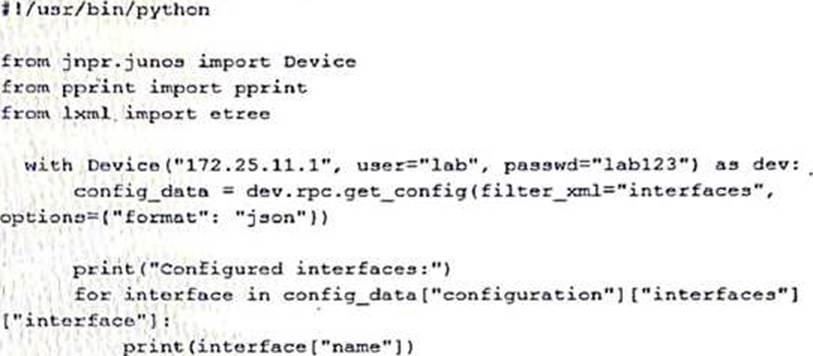
Referring to the exhibit, which two statements about the script are correct? (Choose two.)
- A . The script prints the name of each configured interface.
- B . The script retrieves the interface configuration in XML
- C . The script prints interface information for each interface name.
- D . The script retrieves the interface configuration in JSON.
Which two statements are valid regarding Junos automation? (Choose two.)
- A . The jsd process handles XML API calls.
- B . The mgd process handles JET API requests.
- C . The jsd process handles JET API requests.
- D . The mod process handles XML API calls.
C, A
Explanation:
In Junos automation, several processes handle API requests, and understanding which process handles what is crucial:
jsd Process:
XML API Calls (A): The jsd process is responsible for handling XML API calls, which are a significant part of Junos automation. XML API allows for structured and standardized communication with Junos devices, enabling automation scripts to query and configure devices.
JET API Requests (C): The jsd process also handles JET (Junos Extension Toolkit) API requests. JET provides a more modern, programmable interface for interacting with Junos OS, and jsd is the process that manages these interactions.
mgd Process (Incorrect Option):
Not for JET API Requests: The mgd process handles general management operations, such as CLI commands and managing the configuration database, but it does not handle JET API requests. That role is fulfilled by jsd.
mod Process (Incorrect Option):
Not for XML API Calls: The mod process deals with managing chassis components and is not involved in handling XML API calls.
Reference: Juniper Networks JET and XML API Documentation: Describes the roles of jsd in handling both XML and JET API requests.
Junos Automation and DevOps Documentation: Provides insights into how different processes interact with Junos APIs.
You are asked to develop an on-box Junos script that prevents deletion of the SNMP configuration.
Which type of script serves this purpose?
- A . commit script
- B . event script
- C . op script
- D . SNMP script
A
Explanation:
A commit script in Junos is used to enforce policies and configuration constraints on the device. These scripts are written in Extensible Stylesheet Language Transformations (XSLT) or Python and are executed automatically during the commit process of a configuration change.
In this context, to prevent the deletion of the SNMP configuration, a commit script is the appropriate choice. It can be designed to check the configuration changes being committed and reject any commit that attempts to delete or modify the SNMP configuration. This script essentially acts as a gatekeeper, ensuring that only allowable changes are committed to the device configuration.
Supporting
Reference: Juniper Networks Commit Scripts Documentation: The official Juniper documentation provides examples and use cases of commit scripts, including how they can be used to prevent unauthorized changes to the device configuration.
"Junos Automation Scripting" by Jonathan Looney: This resource gives practical examples and best practices for creating commit scripts to enforce configuration policies in Junos OS.
What are two important aspects of the DevOps culture? (Choose two.)
- A . communication
- B . separation of duties
- C . use of specific tools
- D . people
A, D
Explanation:
Two important aspects of the DevOps culture are:
Communication (A): In a DevOps environment, continuous and effective communication between development, operations, and other stakeholders is crucial. It ensures that everyone is aligned, reduces misunderstandings, and facilitates faster and more efficient workflows.
People (D): DevOps is as much about the people as it is about the processes and tools. The culture emphasizes collaboration, shared responsibility, and a mindset focused on continuous improvement. Empowering people to work together across different disciplines is at the heart of DevOps.
Options B and C are not primary aspects of the DevOps culture. While tools are essential in implementing DevOps practices, the culture emphasizes communication and collaboration among people more than the use of specific tools or rigid separation of duties.
Reference: DevOps Handbook: Discusses the cultural aspects of DevOps, with a focus on communication and people.
DevOps Best Practices: Highlights the importance of fostering a culture that prioritizes collaboration and shared goals.
Which two statements about NETCONF are correct? (Choose two.)
- A . The default port for NETCONF is port 930.
- B . The default port for NETCONF is port 830.
- C . NETCONF cannot use the default SSH port.
- D . NETCONF can use the default SSH port.
B, D
Explanation:
NETCONF (Network Configuration Protocol) is used for network device management and can operate over SSH. The following are true about NETCONF:
Default Port 830 (B): By default, NETCONF uses port 830 for communication over SSH. This is the standard port reserved for NETCONF sessions.
Use of Default SSH Port (D): NETCONF can also operate over the standard SSH port (port 22) if configured to do so. This allows flexibility in network management scenarios where port 830 might not be available or used.
Options A and C are incorrect because they refer to incorrect or non-applicable port numbers for NETCONF.
Reference: IETF RFC 6241: Specifies the use of NETCONF over SSH, including port details.
Juniper Networks NETCONF Documentation: Discusses the configuration and operation of NETCONF on Junos devices, including port usage.
What will determine which data serialization format is used for interfacing with a system?
- A . the system’s API
- B . the operating system
- C . programming language version
- D . IDE specifications