
DELL EMC D-SNC-DY-00 Practice Exams
Last updated on Oct 21,2026- Exam Code: D-SNC-DY-00
- Exam Name: Dell SONiC Deploy Exam
- Certification Provider: DELL EMC
- Latest update: Oct 21,2026
A deployment requires routing and dynamic access control lists.
What bundle must be used for this deployment?
- A . Enterprise Standard
- B . Enterprise Standard
- C . Edge Standard
- D . Cloud Premium
B
Explanation:
For a deployment that requires routing and dynamic access control lists, the appropriate bundle to use is the Enterprise Standard bundle. This bundle includes advanced routing capabilities and supports dynamic access control lists for comprehensive network management and security.
References:
Dell Technologies SONiC documentation
Dell Networking Bundle Configuration Guide
An administrator for a service provider uses this command on a switch:

What is the result of running the command?
- A . Maps the VLAN traffic that a CVLAN identifies to a VNI on a VTEP
- B . Maps the VLAN traffic that a TPID identifies to a VNI on a VTEP
- C . Maps the VLAN traffic that an SVLAN identifies to a VNI on a VTEP
C
Explanation:
The command interface vxlan vtep-stacking followed by map vni 10010 vlan 100 maps the VLAN traffic that an SVLAN identifies to a VNI on a VTEP. In this context, SVLAN (Service VLAN) is being mapped to a VXLAN Network Identifier (VNI) for encapsulation and transport across the VXLAN tunnel.
References:
Dell Technologies SONiC documentation
VXLAN Configuration Guide
What are three characteristics of VLAN translation?
- A . VLAN translation is not supported on MC-LAG port channel interfaces.
- B . Trunk or access ports can be configured as members of any VLANs that are not used as an SVLAN.
- C . By default, VLAN stacking is enabled on Z9432F-ON switches.
- D . The SVLAN header is replaced with a VNI if the provider network uses a VXLAN overlay.
- E . SVLAN configuration for both Q-in-Q VLAN tunneling and VLAN translation is possible on the same interface.
A B E
Explanation:
VLAN translation is not supported on MC-LAG port channel interfaces (A): This is a restriction commonly seen in network configurations involving Multi-Chassis Link Aggregation (MC-LAG) where VLAN translation capabilities are not applied.
Trunk or access ports can be configured as members of any VLANs that are not used as an SVLAN (B): This ensures that the VLAN configuration on trunk or access ports is flexible and does not overlap with Service VLANs (SVLANs).
SVLAN configuration for both Q-in-Q VLAN tunneling and VLAN translation is possible on the same interface (E): This allows for complex VLAN tagging and translation configurations to be applied to the same interface, supporting advanced networking scenarios.
References:
Dell Technologies SONiC documentation
Dell Networking Configuration Guide
Which three actions are required to route traffic sourced from voice servers to a dedicated Internet link?
- A . Create a class-map and attach an ACL with the IP of the next-hop to it.
- B . Create an ACL that selects IPs of voice servers
- C . Attach a policy to the egress interface
- D . Create a policy-map and attach the configured class-map and set the next-hop IP
- E . Create a class-map and attach that ACL.
B C D
Explanation:
To route traffic from voice servers to a dedicated Internet link, the following steps are necessary:
Create an ACL that selects IPs of voice servers (B): This ACL will match the traffic coming from the specified IP addresses of the voice servers.
Create a policy-map and attach the configured class-map and set the next-hop IP (D): The policy-map will use the class-map to identify the voice server traffic and then set the next-hop IP for routing.
Attach a policy to the egress interface (C): The policy-map must be applied to the egress interface to ensure that the traffic is routed correctly.
References:
Dell SONiC QoS Configuration Guide
Dell Technologies InfoHub
Feel free to refer to the Dell SONiC documentation and Dell Technologies InfoHub for more detailed explanations and additional context.
What two methods can be used to upgrade or downgrade Enterprise SONiC?
- A . Boot Loader
- B . SONiC-CLI
- C . MF-CLI
- D . GRUB
A D
Explanation:
Enterprise SONiC can be upgraded or downgraded using:
Boot Loader (A): The boot loader can be used to select and load different versions of the SONiC firmware.
GRUB (D): GRUB (Grand Unified Bootloader) is another method used to manage and select different SONiC firmware versions during system boot-up.
References:
Dell Technologies SONiC documentation
SONiC Upgrade Guide
Refer to the exhibit.
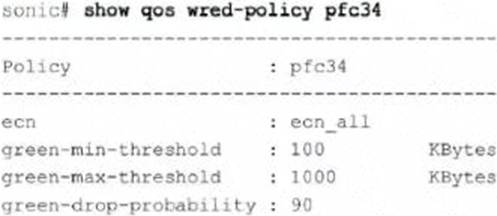
What can be determined from this show command?
- A . Traffic below 100 KB is marked as congested
- B . ECN is enabled for all colors
- C . ECN is enabled for all DSCP values
- D . There is a 10% probability that traffic is marked as congested
B
Explanation:
The output of the command show qos wred-policy pfc34 shows the ECN (Explicit Congestion Notification) configuration for the policy pfc34. The line ecn: ecn_all indicates that ECN is enabled for all traffic classes (all DSCP values). Additionally, the green-min-threshold, green-max-threshold, and green-drop-probability settings are shown, but there is no indication of a 10% probability for marking traffic as congested. Therefore, the correct answer is B.
References:
Dell Enterprise SONiC documentation
Dell Technologies InfoHub
Which two elements are configured when RoCE is enabled?
- A . IB
- B . ETS
- C . PFC
- D . TCP
B C
Explanation:
When RDMA over Converged Ethernet (RoCE) is enabled, Enhanced Transmission Selection (ETS) and Priority Flow Control (PFC) are two key elements that need to be configured. ETS allows for bandwidth allocation among different traffic classes, and PFC provides lossless Ethernet operation for specific traffic classes to support low-latency, high-performance network communication.
References:
Dell Technologies SONiC documentation
RDMA over Converged Ethernet Configuration Guide
What is the impact of entering the qos-mode uniform command on a VTEP interface?
- A . The DCSP values for the local and remote VTEPs are synchronized.
- B . The local VNI value is aligned to the VNI of the remote VTEP interface.
- C . A uniform VNI value is configured on local and remote VTEP interfaces.
- D . The payload DSCP value is copied to the outer header DSCP value.
D
Explanation:
Entering the qos-mode uniform command on a VTEP interface ensures that the DSCP (Differentiated Services Code Point) value of the payload is copied to the outer header DSCP value. This maintains the Quality of Service (QoS) markings across the VXLAN tunnel, allowing consistent traffic prioritization.
References:
Dell Technologies SONiC documentation
VXLAN and QoS Configuration Guide
Refer to the exhibit.
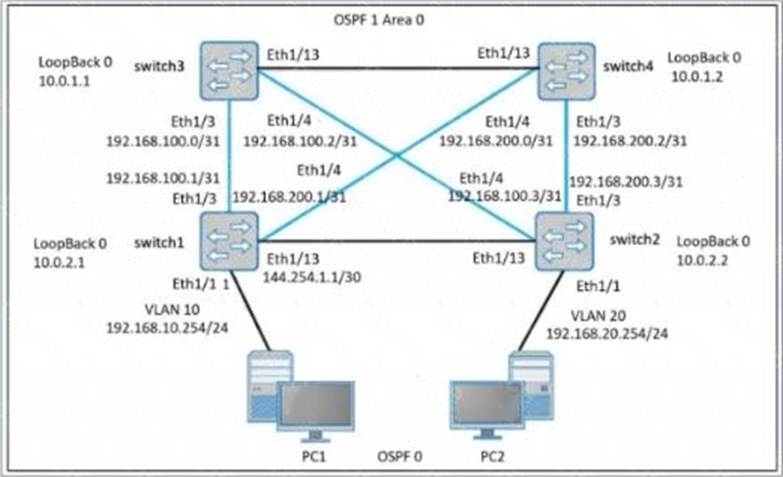
The router ID has not been manually configured.
What router ID is used for Switch 3?
- A . 192.168.100.2
- B . 192.168.100.0
- C . 10.0.2.1
- D . 10.0.1.1
D
Explanation:
In the absence of a manually configured router ID, OSPF typically uses the highest IP address on the switch’s active interfaces. For Switch 3 in the exhibit, the highest IP address is 10.0.1.1 on Loopback 0. Therefore, 10.0.1.1 is used as the router ID for Switch 3.
References:
Dell Technologies SONiC documentation
OSPF Configuration Guide