
VMware 2V0-32.24 Practice Exams
Last updated on Oct 22,2026- Exam Code: 2V0-32.24
- Exam Name: VMware Cloud Operations 8.x Professional V2
- Certification Provider: VMware
- Latest update: Oct 22,2026
DRAG DROP
An administrator has been tasked with importing a new certificate for vRealize Operations using vRealize Lifecycle Manager.
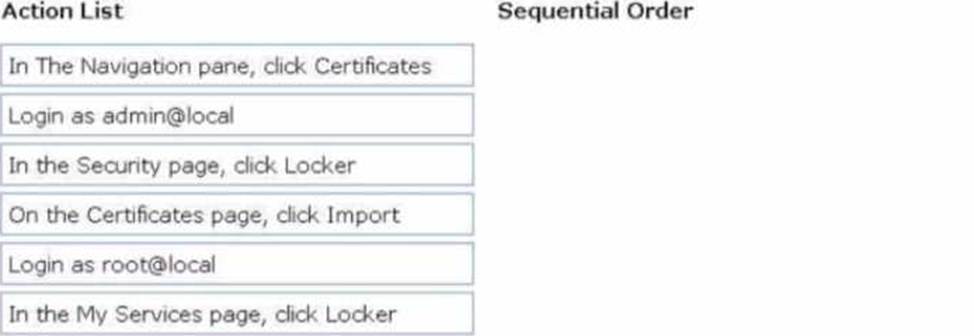
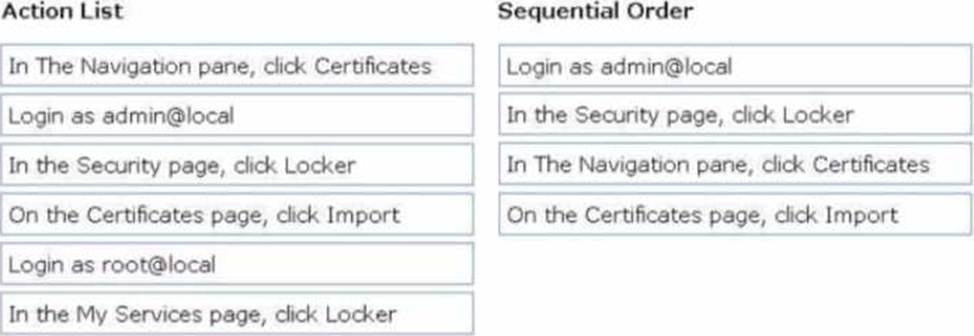
Drag and drop the four correct actions the administrator must complete from the action list on the left and place the actions into the correct sequence on the right. (Choose four.)
Explanation:
To import a new certificate for vRealize Operations using vRealize Lifecycle Manager (vRSLCM), the
correct sequence of actions is as follows:
Login as admin@local
In the My Services page, click Locker
In the Navigation pane, click Certificates
On the Certificates page, click Import
Login as admin@local:
The administrator must log in with administrative credentials to access vRSLCM’s services and settings.
In the My Services page, click Locker:
The "Locker" service in vRSLCM is used to manage certificates, credentials, and licenses.
In the Navigation pane, click Certificates:
Once in the Locker service, navigate to the Certificates section to manage and import SSL certificates.
On the Certificates page, click Import:
The final step is to click "Import" to upload the new certificate into vRSLCM.
Incorrect Steps:
Login as root@local: Root login is typically not required for vRSLCM operations.
In the Security page, click Locker: Locker is accessed through the My Services page, not the Security page.
By following this sequence, the certificate import process will be completed successfully.
An administrator looking to add a new FQDN of vRealize Suite bicycle Manager in the VMware Identity Manager catalogue.
Which action does the administrator need to take?
- A . Sync FQDN and re-register with VMware Identity Manager
- B . Update authentication provider and re-sync FQDN
- C . Delete vRealize Suite Lifecycle Manager and redeploy it
- D . Recreate authentication provider and sync VMware Identity Manager
A
Explanation:
To add a new FQDN of vRealize Suite Lifecycle Manager in the VMware Identity Manager catalog, the administrator needs to sync the FQDN and re-register with VMware Identity Manager . This involves updating the FQDN in vRealize Suite Lifecycle Manager and then initiating a synchronization process with VMware Identity Manager to reflect the changes in the catalog.
Which solution would an administrator use to manage the lifecycle operations of Tanzu Kubernetes clusters?
- A . VMware Tanzu Service Mesh
- B . VMware vSphere Lifecycle Manager
- C . VMware Tanzu Observability by Wavefront
- D . VMware Tanzu Kubernetes Grid
D
Explanation:
VMware Tanzu Kubernetes Grid is described as a comprehensive solution for operating Kubernetes-based applications in production, as well as creating, scaling and managing clusters. It provides a centralized control plane for managing the lifecycle operations of Tanzu Kubernetes clusters. (Source: https://tanzu.vmware.com/kubernetes)
Which hyperscaler partner is best suited for customers who need 100 GB bandwidth between SDDCs in the cloud? (Select one option)
- A . VMware Cloud on AWS
- B . Azure VMware Solution
- C . Oracle Cloud VMware Solution
- D . Google Cloud VMware Engine
A
Explanation:
VMware Cloud on AWS provides the highest level of performance, reliability, and scalability for customers who need to move large amounts of data between their SDDCs in the cloud. It is also the only hyperscaler partner that has the ability to quickly and easily provision entire SDDCs in the cloud. In addition, VMware Cloud on AWS offers the most comprehensive enterprise-grade features, such as automated backups and disaster recovery, which provide customers with peace of mind that their data is always secure and protected.
Thank You for Being Our Valued Customer We Hope You Enjoy Your Purchase
VMware 2V0-32.22 Exam Question & Answers VMware Cloud Operations 8.x Professional Exam
Which software development challenge can a cloud administrator address by adopting a cloud operating model?
- A . The length of time needed to provision the required infrastructure
- B . High operating expense (OPEX) spending due to software licenses
- C . The use of different programming languages by developers
- D . Lack of standardization of operating systems used by developers
A
Explanation:
https://blogs.vmware.com/management/2021/10/introduction-to-vmware-cloud-operating-model.html
Which four steps must a cloud administrator take to deploy a new private cloud In Azure VMware Solution? (Choose four.)
- A . Identify the maximum number of hosts needed for future capacity.
- B . Identify the desired availability zone.
- C . Identify a management CIDR of size /22.
- D . Open a support request with Microsoft Azure requesting capacity.
- E . Identify a management CIDR of size /20.
- F . Identify the desired region.
- G . Identify the current number of hosts needed.
BCDG
Explanation:
Identify the desired region. This determines where your private cloud will be deployed and which Azure services are available.
Identify a management CIDR of size /22. This determines the IP address range for your private cloud management components such as vCenter Server, NSX Manager, etc.
Open a support request with Microsoft Azure requesting capacity. This ensures that there are enough hosts available for your private cloud deployment.
Identify the current number of hosts needed. This determines how many hosts will be provisioned
initially for your private cloud cluster.
https://vmc.techzone.vmware.com/resource/avs-planning-and-deployment-guide
A Cloud Administrator is managing a VMware Cloud environment consisting of a single cluster with to hosts. The administrator is trying to create a new virtual machine and is getting the following error message: cannot complete file creation operation. There are currently 2 unable failure domains. the operation requires 3 more usable fault domain. failed to create object.
- A . The VM storage policy is configured Incorrectly for the cluster.
- B . There is insufficient CPU and memory based on the current virtual machine resource reservation settings.
- C . One of the hosts is in maintenance mode.
- D . vSphere Distributed Resource Scheduler (DRS) is enabled.
C
Explanation:
The error message that the Cloud Administrator is receiving indicates that the cluster is not able to meet the requirements of the new virtual machine due to insufficient fault domains. The most likely cause of this is that one of the hosts is in maintenance mode. When a host is in maintenance mode, it is not available to the cluster, and thus cannot provide the necessary fault domains. To correct this issue, the Cloud Administrator should ensure that all hosts in the cluster are available and not in maintenance mode before attempting to create the new virtual machine.
Reference: [1] https://docs.vmware.com/en/VMware-Cloud-on-AWS/services/VMware-Cloud-on-AWS-Outposts/GUID-host-maintenance-mode.html
A cloud administrator wants to restrict Junior administrators to creating, deleting, and managing virtual machines in the Development folder In the VMware Cloud on AWS vCenter Server instance.
Which type of access should be granted to these junior administrators?
- A . CloudAdmln role and global permissions
- B . CloudAdmin role on the Development folder
- C . Administrator role on the Development folder
- D . Administrator role on the cloud vCenter Server instance
B
Explanation:
This role is designed to give administrators access to manage virtual machines, networks, and other settings within the folder. The CloudAdmin role will also give the junior administrators access to all global permissions that are associated with the Development folder.
"The CloudAdmin role is designed to give administrators access to manage a single folder. This role grants access to manage virtual machines, networks, and other settings within the folder. Additionally, this role grants access to all global permissions that are associated with the folder. For example, if the folder has global permissions that allow users to create or delete virtual machines, the CloudAdmin role will grant access to those permissions within the folder."
The CloudAdmin user can grant other users or groups read-only access to VMware Cloud on AWS vCenter management objects such as the Mgmt-ResourcePool, Management VMs folder, Discovered Virtual Machines folder, vmc-hostswitch, and vsanDatastore. Because this read-only access does not propagate to management objects, you cannot grant it as a Global Permission and instead must explicitly grant it for each management object. VMware Cloud on AWS runs a script once a day that updates any newly-created management objects (such as objects in a new cluster) so that the CloudAdmin user and CloudAdminGroup SSO group have the updated role applied. The script itself does not grant additional access to any user or group, so you’ll need to wait until it completes before the CloudAdmin can use this workflow to grant read-only access to those objects.
Reference: https://docs.vmware.com/en/VMware-Cloud-on-AWS/services/com.vmware.vsphere.vmc-aws-manage-data-center-vms.doc/GUID-06B8A15B-4BE9-4236-8BEA-3F4F7C55D87A.html
Which three factors determine the size of vRealize Operations deployment? (Choose three.)
- A . Size of attached Cloud Proxies
- B . Size of monitored vCenter Servers
- C . Number of Remote Collectors
- D . Number of Objects
- E . Number of Metrics
- F . Number of Agents
DEF
Explanation:
Questions no: 43 Verified Answer = D, E, and F Comprehensive Detailed Explanation with all VMware Reference = Three primary factors determine the size of a vRealize Operations deployment:
D . Number of Objects : This refers to the number of entities being monitored, such as virtual machines, hosts, clusters, datastores, and applications. The more objects you monitor, the more resources vRealize Operations needs to collect and analyze data.
E . Number of Metrics : This refers to the number of data points collected for each object. vRealize
Operations collects various metrics, such as CPU usage, memory consumption, and network traffic.
The more metrics you collect, the higher the resource requirements.
F . Number of Agents : If you use agents to collect data from endpoints or applications, the number of agents deployed also affects the sizing of vRealize Operations. More agents mean more data to process and store.
Which statement most accurately describes the service features of VMware Cloud on Dell EMC? (Select one option)
- A . Dell technicians perform all software maintenance, as well as hardware fixes.
- B . When an onsite response is required to fix a problem related to a host, a Dell technician must arrive on site within 24 hours.
- C . An SDDC includes a minimum of one rack with three hosts. You can add hosts to the rack, up to the maximum supported by the rack.
- D . VMwareSite Recovery is included as part of the initial service offering.
C
Explanation:
The statement that most accurately describes the service features of VMware Cloud on Dell EMC is C. An SDDC includes a minimum of one rack with three hosts. You can add hosts to the rack, up to the maximum supported by the rack. An SDDC consists of a rack with a minimum of three hosts, which can then be expanded up to the maximum supported by the rack. VMware Site Recovery is not included as part of the initial service offering.
VMware Cloud on Dell EMC provides a service that enables customers to run their VMware-based workloads on Dell EMC’s hardware, in a jointly-engineered and fully-supported environment. The service allows customers to deploy a fully-configured VMware SDDC on Dell EMC VxRail or VxRack SDDC systems, with the option to add more hosts to the rack as needed.