
VMware 2V0-13.24 Practice Exams
Last updated on Nov 16,2026- Exam Code: 2V0-13.24
- Exam Name: VMware Cloud Foundation 5.2 Architect
- Certification Provider: VMware
- Latest update: Nov 16,2026
What are the best practices for optimizing VMware storage performance using Broadcom NVMe SSDs?
- A . Use RAID 1 for data redundancy
- B . Enable TRIM for SSDs
- C . Enable write caching
- D . Use SSDs for VM datastores
B, C, D
Explanation:
Write caching, using SSDs for datastores, and enabling TRIM can optimize VMware storage performance.
When designing a VMware environment with Broadcom solutions, which factors affect network security?
- A . VMware NSX
- B . vSAN
- C . vSphere Distributed Switch (VDS)
- D . Broadcom 25GbE Ethernet Adapter
C, D
Explanation:
The Broadcom 25GbE Ethernet Adapter and vSphere Distributed Switch (VDS) help improve network security in VMware.
What is the best way to ensure Broadcom network adapters work optimally in VMware environments?
- A . Use VMware’s network adapter optimization settings
- B . Keep the firmware and drivers updated
- C . Configure network teaming
- D . Disable Jumbo Frames
A, B, C
Explanation:
Keeping firmware updated, using optimization settings, and configuring teaming can ensure optimal performance.
When integrating VMware solutions with Broadcom hardware, which features are essential for cost-effective performance?
- A . Broadcom 25GbE Ethernet Adapter
- B . vSphere HA
- C . Broadcom NVMe SSD
- D . vSAN
A, C, D
Explanation:
Broadcom 25GbE Ethernet Adapters, Broadcom NVMe SSDs, and vSAN are cost-effective solutions for maintaining high performance in VMware environments.
Which Broadcom products are essential for improving data availability and resilience in VMware Cloud Foundation?
- A . Broadcom NVMe SSDs
- B . Broadcom Fibre Channel HBAs
- C . Broadcom RAID controllers
- D . Broadcom Ethernet adapters
B, C
Explanation:
Broadcom RAID controllers and Fibre Channel HBAs improve data availability and resilience in VMware Cloud Foundation.
Which VMware tools are essential for managing and optimizing cloud cost efficiency in VMware Cloud Foundation?
- A . VMware vRealize Automation
- B . VMware vSAN
- C . VMware vRealize Operations
- D . VMware vSphere
A, C
Explanation:
VMware vRealize Automation and vRealize Operations are essential for managing and optimizing cloud cost efficiency in VMware Cloud Foundation.
During a requirement capture workshop, the customer expressed a plan to use Aria Operations Continuous Availability. The customer identified two datacenters that meet the network requirements to support Continuous Availability; however, they are unsure which of the following datacenters would be suitable for the Witness Node.
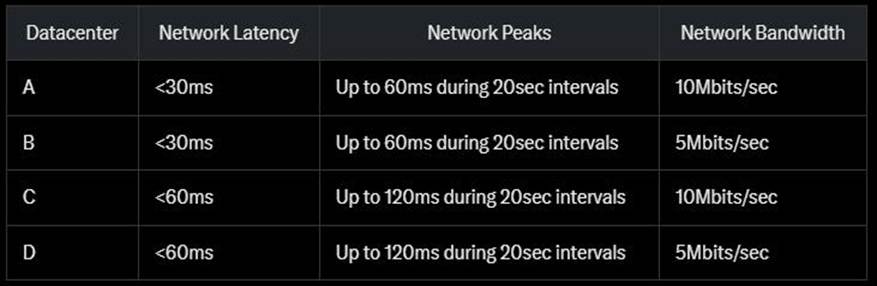
Which datacenter meets the minimum network requirements for the Witness Node?
- A . Datacenter A
- B . Datacenter B
- C . Datacenter C
- D . Datacenter D
A
Explanation:
VMware Aria Operations Continuous Availability (CA) is a feature in VMware Aria Operations (integrated with VMware Cloud Foundation 5.2) that provides high availability by splitting analytics nodes across two fault domains (datacenters) with a Witness Node in a third location to arbitrate in case of a split-brain scenario. The Witness Node has specific network requirements for latency and bandwidth to ensure reliable communication with the primary and replica nodes. These requirements are outlined in the VMware Aria Operations documentation, which aligns with VCF 5.2 integration.
VMware Aria Operations CA Witness Node Network Requirements:
Network Latency:
The Witness Node requires a round-trip latency of less than 100ms between itself and both fault domains under normal conditions.
Peak latency spikes are acceptable if they are temporary and do not exceed operational thresholds, but sustained latency above 100ms can disrupt Witness functionality.
Network Bandwidth:
The minimum bandwidth requirement for the Witness Node is 10Mbits/sec (10 Mbps) to support heartbeat traffic, state synchronization, and arbitration duties. Lower bandwidth risks communication delays or failures.
Network Stability:
Temporary latency spikes (e.g., during 20-second intervals) are tolerable as long as the baseline latency remains within limits and bandwidth supports consistent communication.
Evaluation of Each Datacenter:
Datacenter A: <30ms latency, peaks up to 60ms during 20sec intervals, 10Mbits/sec bandwidth
Latency: Baseline latency is <30ms, well below the 100ms threshold. Peak latency of 60ms during 20-second intervals is still under 100ms and temporary, posing no issue.
Bandwidth: 10Mbits/sec meets the minimum requirement.
Conclusion: Datacenter A fully satisfies the Witness Node requirements.
Datacenter B: <30ms latency, peaks up to 60ms during 20sec intervals, 5Mbits/sec bandwidth
Latency: Baseline <30ms and peaks up to 60ms are acceptable, similar to Datacenter A.
Bandwidth: 5Mbits/sec falls below the required 10Mbits/sec, risking insufficient capacity for Witness Node traffic.
Conclusion: Datacenter B does not meet the bandwidth requirement.
Datacenter C: <60ms latency, peaks up to 120ms during 20sec intervals, 10Mbits/sec bandwidth
Latency: Baseline <60ms is within the 100ms limit, but peaks of 120ms exceed the threshold. While temporary (20-second intervals), such spikes could disrupt Witness Node arbitration if they occur during critical operations.
Bandwidth: 10Mbits/sec meets the requirement.
Conclusion: Datacenter C fails due to excessive latency peaks.
Datacenter D: <60ms latency, peaks up to 120ms during 20sec intervals, 5Mbits/sec bandwidth
Latency: Baseline <60ms is acceptable, but peaks of 120ms exceed 100ms, similar to Datacenter C, posing a risk.
Bandwidth: 5Mbits/sec is below the required 10Mbits/sec. Conclusion: Datacenter D fails on both latency peaks and bandwidth. Conclusion:
Only Datacenter A meets the minimum network requirements for the Witness Node in Aria Operations Continuous Availability. Its baseline latency (<30ms) and peak latency (60ms) are within the 100ms threshold, and its bandwidth (10Mbits/sec) satisfies the minimum requirement. Datacenter B lacks sufficient bandwidth, while Datacenters C and D exceed acceptable latency during peaks (and D also lacks bandwidth). In a VCF 5.2 design, the architect would recommend Datacenter A for the Witness Node to ensure reliable CA operation.
Reference: VMware Cloud Foundation 5.2 Architecture and Deployment Guide (Section: Aria Operations Integration)
VMware Aria Operations 8.10 Documentation (integrated in VCF 5.2): Continuous Availability Planning
VMware Aria Operations 8.10 Installation and Configuration Guide (Section: Network Requirements for Witness Node)
What is the purpose of a vSphere cluster?
- A . Provide network isolation
- B . Group ESXi hosts for resource pooling
- C . Manage storage arrays
- D . Distribute workloads manually
B
Explanation:
A cluster groups hosts to pool resources and enable advanced features.
Which VMware tools can help streamline cloud migration in VMware Cloud Foundation?
- A . VMware vSphere
- B . VMware vRealize Automation
- C . VMware HCX
- D . VMware NSX
B, C
Explanation:
VMware HCX and vRealize Automation streamline cloud migration in VMware Cloud Foundation.
What is the primary function of VMware ESXi?
- A . Hypervisor for virtual machine management
- B . Data storage
- C . Backup and recovery
- D . Cluster management
A
Explanation:
ESXi functions as a hypervisor managing VMs directly on hardware.