VMware 2V0-11.25 Practice Exams
Last updated on Nov 16,2026- Exam Code: 2V0-11.25
- Exam Name: VMware Cloud Foundation 5.2 Administrator
- Certification Provider: VMware
- Latest update: Nov 16,2026
An organization is implementing a downtime avoidance solution and wants to ensure continuous availability of applications across separate sites that are connected via a high bandwidth/low latency link.
Which two VMware Cloud Foundation components support this capability with stretched clusters? (Choose two.)
- A . vSAN
- B . vSphere
- C . NSX Firewall
- D . vVOL
- E . vSphere Replication
A, B
Explanation:
vSAN: vSAN supports stretched clusters, allowing data to be mirrored across multiple sites to ensure continuous availability and enable high availability for virtual machines in case of a site failure.
vSphere: vSphere also supports stretched clusters, enabling the high availability of applications across multiple sites by allowing virtual machines to be run on either site in the event of a failure.
What is the first step to take when updating the vSAN database in a VMware Cloud Foundation environment?
- A . Place the vSAN cluster in maintenance mode
- B . Download the latest HCL database from VMware
- C . Check the VMware Compatibility Guide for supported versions
- D . Backup the vSAN database
D
Explanation:
The first step when updating the vSAN database (or performing any update to the vSAN environment) is to back up the vSAN database. This ensures that if any issues arise during the update process, the administrator can restore the environment to a previous state. This step is crucial to ensure data protection and prevent data loss.
Which is the appropriate first action to take to resolve dropped network packets on an ESXi host?
- A . Check physical network switch configuration
- B . Enable Storage I/O Control
- C . Increase the CPU and memory allocation for VMs
- D . Migrate VMs to another data store
A
Explanation:
Dropped network packets are often caused by misconfigurations or issues at the physical network layer. Checking the physical network switch configuration is the first step to ensure that the network settings, such as VLANs, uplinks, and port configurations, are correctly set up. This ensures proper connectivity and traffic flow for the ESXi host and the VMs.
An administrator has been tasked with creating a real-time view of key performance indicators for their VMware Cloud Foundation private cloud and an automated monthly report that shows the capacity consumed by each development team who use the environment.
Which VCF component should the administrator configure to complete their objectives?
- A . VMware Aria Operations for Networks
- B . VMware Aria Operations for Applications
- C . VMware Aria Operations for Logs
- D . VMware Aria Operations
D
Explanation:
VMware Aria Operations provides comprehensive monitoring, analytics, and performance management for the entire VMware Cloud Foundation environment. It enables real-time views of key performance indicators (KPIs) and can be configured to generate automated reports on capacity consumption, which aligns with the administrator’s objectives.
What are the steps to apply software updates in a VMware Cloud Foundation deployment using the VMware Async Patch CLI Tool?
- A . Upload the patch bundle to SDDC Manager, download the confirmation, and then apply the patch.
- B . Apply the patch directly in the VMware SDDC Manager UI from the Software Depot.
- C . Download the patch bundle, upload the bundle to SDDC Manager, and then apply the patch.
- D . Download the patch bundle, apply the patch directly, and then upload the confirmation to SDDC Manager.
C
Explanation:
To apply software updates in a VMware Cloud Foundation deployment using the VMware Async Patch CLI Tool, the process involves downloading the patch bundle, uploading it to SDDC Manager, and then using the appropriate commands or tools to apply the patch. This ensures that the patch is properly staged in the environment and applied to the necessary components.
What is the primary benefit of creating a VM template in VMware vCenter?
- A . It enables direct physical access to the underlying hardware.
- B . It accelerates the deployment of VMs with predefined configurations.
- C . It provides enhanced network security for VMs.
- D . It simplifies the process of taking snapshots of VMs.
B
Explanation:
The primary benefit of creating a VM template in VMware vCenter is that it allows for the rapid deployment of virtual machines (VMs) with predefined configurations, including the operating system, installed applications, and other settings. This accelerates the process of provisioning VMs, ensuring consistency and saving time during deployment.
A Cloud Administrator has been tasked with verifying all of the prerequisites are in place prior to deploying VMware Aria Suite Lifecycle.
The following information has been provided for the Aria Suite Lifecycle implementation:
hostname: lcm
domain: vcf.company.com
IP address: 10.0.0.150/24
IP gateway: 10.0.0.1
Which two items must the Cloud Administrator ensure are available prior to deploying VMware Aria Suite Lifecycle? (Choose two.)
- A . An Application Virtual Network is configured in SDDC Manager
- B . A DNS PTR Record for 10.0.0.1 that points to lcm.vcf.company.com
- C . A DNS A Record for lcm.vcf.company.com that points to 10.0.0.150
- D . An allocated IP address for the NSX standalone Tier-1 Gateway
- E . A CA-signed SSL certificate for Aria Suite Lifecycle added to SDDC Manager
C, D
Explanation:
A DNS A record is necessary to resolve the hostname (lcm.vcf.company.com) to the specified IP address (10.0.0.150) so that it can be correctly accessed during the deployment.
A DNS PTR record is required for reverse DNS lookup, which ensures proper identification of the IP address (10.0.0.1) to the hostname (lcm.vcf.company.com), which is important for network validation during the deployment process.
While preparing to enable Application Virtual Networks (AVNs) and deploying Aria Suite components, an administrator plans to deploy an NSX Edge cluster.
What is a requirement for deploying the NSX Edge cluster?
- A . The Edge transport nodes must be configured with an MTU of 1500.
- B . The Edge cluster must be deployed in the management domain.
- C . The Edge transport nodes must be deployed using the ‘large’ form factor.
- D . The Edge cluster must be configured for NSX Federation.
B
Explanation:
When deploying an NSX Edge cluster in a VMware Cloud Foundation (VCF) environment, it must be deployed in the management domain. The management domain is responsible for managing and orchestrating various resources, including the NSX Edge cluster, which is crucial for network virtualization and security within the environment.
What is the primary purpose of configuring a Key Management Server (KMS) in vCenter for VM Encryption?
- A . To provide high availability for virtual machines.
- B . To manage encryption keys for securing VM data.
- C . To monitor network traffic for VMs.
- D . To optimize the performance of encrypted VMs.
B
Explanation:
The primary purpose of configuring a Key Management Server (KMS) in vCenter for VM Encryption is to manage and store the encryption keys that are used to secure virtual machine data. The KMS ensures that encryption keys are handled securely and provides a central management point for encrypting VMs in a VMware environment.
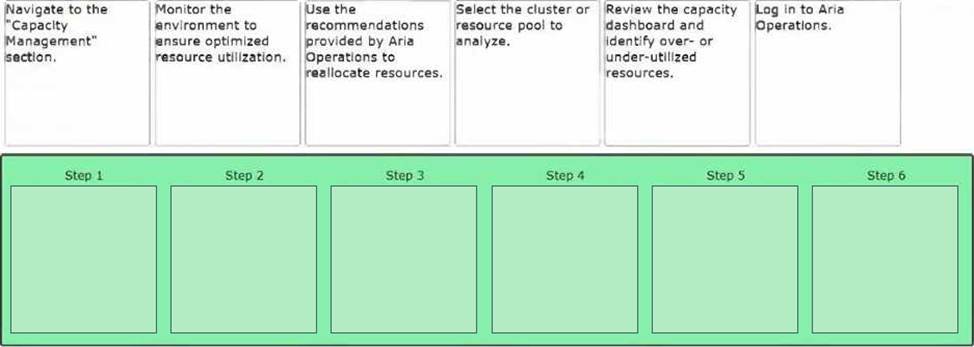
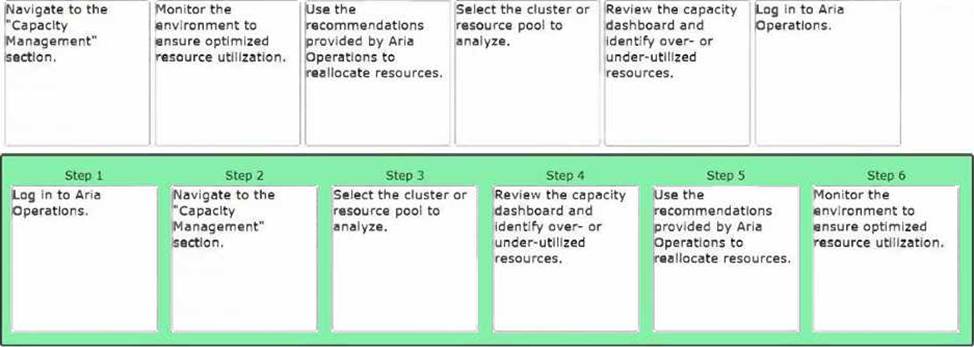
DRAG DROP
Put the following steps in the correct order to optimize resource allocation using Aria Operations.