
VMware 2V0-11.25 Practice Exams
Last updated on Nov 16,2026- Exam Code: 2V0-11.25
- Exam Name: VMware Cloud Foundation 5.2 Administrator
- Certification Provider: VMware
- Latest update: Nov 16,2026
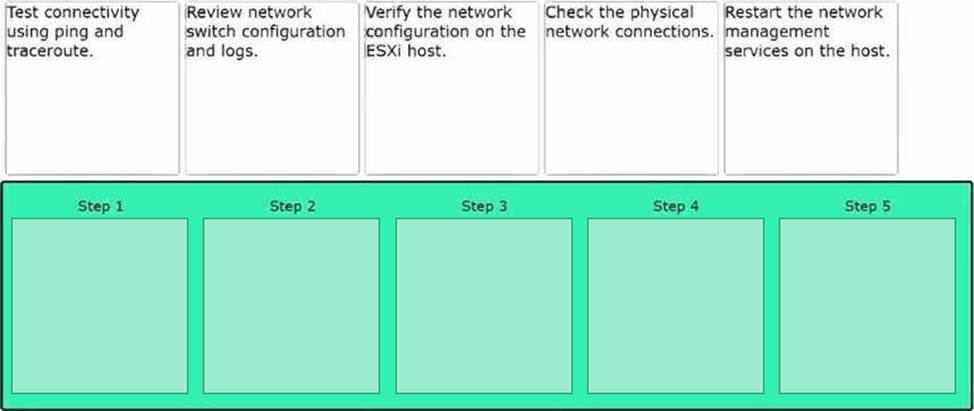
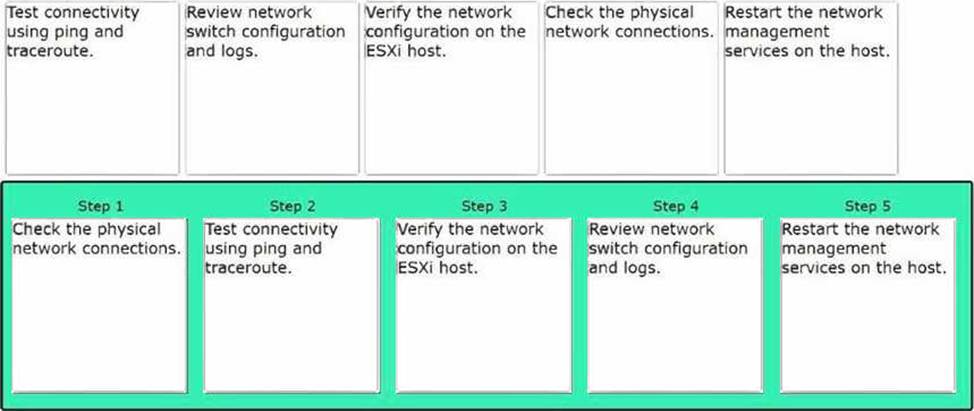
DRAG DROP
Arrange the steps in the correct order to resolve host connectivity issues.
An Administrator is tasked with setting up a new workload domain with VMware Cloud Foundation.
The workload domain will have the following configuration:
vSphere with Tanzu to support Kubernetes workloads
NSX for container and virtual machine networking
Aria Operations will be configured for monitoring of the infrastructure
Which three steps should be taken to complete the installation and configuration of this workload domain? (Choose three.)
- A . Install Aria Operations agents on all ESXi hosts.
- B . Integrate IaaS Control Plane with the existing vCenter Server.
- C . Configure NSX segments for Kubernetes namespaces.
- D . Deploy the Supervisor Cluster for IaaS Control Plane.
- E . Enable workload management in vCenter Server.
C, D, E
Explanation:
NSX segments need to be configured for Kubernetes namespaces to provide network connectivity and isolation for the Kubernetes workloads that will be deployed.
The Supervisor Cluster must be deployed as part of the IaaS Control Plane to manage the Kubernetes workloads and enable vSphere with Tanzu.
Enabling workload management in vCenter Server allows the deployment and management of Kubernetes workloads alongside virtual machines, utilizing vSphere with Tanzu.
An organization wants to centralize its VM templates, ISO images, and scripts to streamline deployment processes across multiple sites using Content Libraries.
Which three steps are required to create a new Content Library? (Choose three.)
- A . Configure the library to automatically sync with the vSphere Update Manaqer.
- B . Choose "Create a new library" and enter a name and description for the library.
- C . Select "Local content library" and choose the datastore to store the library contents.
- D . Navigate to the Content Libraries section in the vSphere Client.
- E . Add the necessary permissions to allow users to upload content to the library.
B, C, D
Explanation:
When creating a new Content Library, you first need to specify a name and description to define the
library’s purpose.
For a Local Content Library, you need to choose the datastore where the library contents will be stored. This is essential for proper organization and accessibility of content.
To create and manage content libraries, you must navigate to the Content Libraries section in the vSphere Client.
A disk failure has occurred in a vSAN cluster.
What four steps should be taken to recover from this disk failure? (Choose four.)
- A . Use the vSohere Client to check the vSAN Health Service
- B . Disable disk group encryption
- C . Rebuild the affected disk group
- D . Perform a full resync of the vSAN objects
- E . Replace the failed disk with a new one
- F . Ensure the new disk is claimed by the vSAN cluster
A, C, E, F
Explanation:
Checking the vSAN Health Service in the vSphere Client is the first step in diagnosing the issue and verifying the status of the vSAN components after the disk failure.
Rebuilding the affected disk group is necessary to ensure that data is re-optimized and replicated in accordance with the vSAN policy.
Replacing the failed disk with a new one ensures that the storage capacity is restored.
Ensuring that the new disk is claimed by the vSAN cluster is important to ensure that it is recognized and integrated into the vSAN disk group.
What are three prerequisites for deploying an NSX Edge cluster in a VMware Cloud Foundation
solution? (Choose three.)
- A . Verify that the NSX host overlay VLAN and NSX Edge overlay VLAN are routed to each other.
- B . Set up vSAN storage policies for the Edge VMs.
- C . Create DNS entries for the NSX Edge nodes.
- D . Install Aria Operations and enable Edge Cluster monitoring.
- E . Assign separate VLAN IDs and subnets for the NSX host overlay and NSX Edge overlay networks.
A, C, E
Explanation:
The NSX host overlay VLAN and NSX Edge overlay VLAN need to be routed to each other to ensure proper communication between the host and NSX Edge clusters.
DNS entries for the NSX Edge nodes are required to enable name resolution, which is important for the proper functioning of the NSX Edge cluster.
Assigning separate VLAN IDs and subnets for the NSX host overlay and NSX Edge overlay networks is necessary to maintain network isolation and optimize traffic flow between components.
What is the primary purpose of configuring a Virtual Distributed Switch (VDS) in a vSphere environment?
- A . To automate the deployment of virtual machines.
- B . To provide centralized management of network configurations across multiple ESXi hosts.
- C . To manage storage policies for datastores.
- D . To enable VM snapshots across multiple datastores.
B
Explanation:
A Virtual Distributed Switch (VDS) in a vSphere environment enables centralized management of network configurations across multiple ESXi hosts. It simplifies network administration by allowing the administrator to configure network settings, such as VLANs, port groups, and policies, for multiple hosts at once, ensuring consistency and scalability.
An administrator needs to configure an ESXi host and create a host profile to ensure consistent configuration across multiple hosts in a cluster.
Which three steps are necessary to achieve this? (Choose three.)
- A . Configure the desired settings on a reference ESXi host.
- B . Extract the host profile from the configured reference host.
- C . Manually configure each host to match the reference host settings.
- D . Remediate the non-compliant hosts to ensure they match the host profile.
- E . Apply the host profile to all hosts in the cluster.
A, B, D
Explanation:
First, configure the desired settings on a reference ESXi host. This host will be used as the template for creating a consistent configuration across the cluster.
After configuring the reference host, extract the host profile from it. This captures the configuration of the reference host as a host profile.
Remediation is necessary to ensure that other hosts in the cluster align with the reference host’s configuration. The host profile can be applied, and remediation will correct any non-compliant settings on other hosts.