
The Open Group OGEA-101 Practice Exams
Last updated on Oct 21,2026- Exam Code: OGEA-101
- Exam Name: TOGAF Enterprise Architecture Part 1 Exam (English)
- Certification Provider: The Open Group
- Latest update: Oct 21,2026
Consider the following chart:
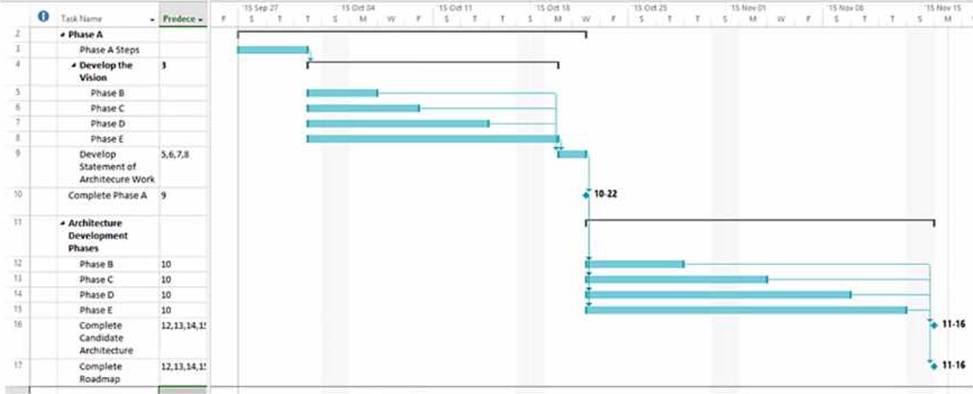
Which important concept for Enterprise Architecture Practitioners does it illustrate?
- A . Enterprise Architects must use Gantt charts to communicate with Stakeholders.
- B . An Enterprise Architecture must be developed in phases with a limited fixed duration.
- C . ADM phases must be run in a sequenced approach to produce the Architecture.
- D . ADM phases must be run simultaneously until the relevant information has been produced.
C
Explanation:
The chart shown is a Gantt chart, which is commonly used for project management to illustrate a project schedule. In the context of TOGAF (The Open Group Architecture Framework), which is a framework for enterprise architecture, this Gantt chart is demonstrating the sequenced approach to the Architecture Development Method (ADM). The ADM is the core process of TOGAF which provides a tested and repeatable process for developing architectures. The ADM is described as being iterative, over the whole process, between phases, and within phases. For each iteration of the ADM, a fresh decision must be taken about each of the parameters (scope, granularity, time period, and architecture assets).
The ADM consists of a number of phases that have to be followed in sequence:
Preliminary Phase: Framework and principles
Phase A: Architecture Vision
Phase B: Business Architecture
Phase C: Information Systems Architectures, including Data and Application Architectures
Phase D: Technology Architecture
Phase E: Opportunities and Solutions
Phase F: Migration Planning
Phase G: Implementation Governance
Phase H: Architecture Change Management
Requirements Management
Each phase is dependent on the outputs of the previous phase and the Requirements Management phase runs throughout. The Gantt chart clearly shows the dependency and sequence in which these phases occur, implying that a structured approach is followed to produce the enterprise architecture.
Reference:
The TOGAF Standard, Version 9.2, a standard of The Open Group
The TOGAF documentationavailableat
https://publications.opengroup.org/standards/architecture and https://publications.opengroup.org/guides/architecture
Complete the sentence. When considering agile development, Architecture to Support Portfolio will identify what products the Enterprise needs, the boundary of the products, and what constraints a product owner has; this defines the Enterprise’s
- A . risk tolerance
- B . business continuity
- C . backlog
- D . operating model
C
Explanation:
When considering agile development, Architecture to Support Portfolio will identify the necessary products for the enterprise, define their boundaries, and outline the constraints for a product owner. This process directly relates to defining the enterprise’s backlog, which in agile methodologies, is a prioritized list of work for the development team that is derived from the roadmap and its requirements.
Complete the following sentence:
Presenting different_________and_________to stakeholders helps architects to extract hidden agendas principles and requirements that could impact the final Target Architecture
- A . Alternatives Trade-offs
- B . Solutions Applications
- C . Architecture Views Architecture Viewpoints
- D . Business Scenarios Business Models
C
Explanation:
According to the TOGAF Standard, an architecture view is a representation of a system from the perspective of a related set of concerns1. An architecture viewpoint is a specification of the conventions for a particular kind of architecture view1. Presenting different architecture views and architecture viewpoints to stakeholders helps architects to extract hidden agendas, principles, and requirements that could impact the final target architecture. This is because different stakeholders may have different concerns and interests in the system, and by showing them how the system addresses their concerns from different perspectives, the architects can elicit more feedback and validation from them2. For example, a business stakeholder may be interested in the business architecture view, which focuses on the business processes, functions, and capabilities of the system3. A security stakeholder may be interested in the enterprise security view, which addresses the security aspects of the system, such as confidentiality, integrity, and availability3. By presenting these views to the respective stakeholders, the architects can ensure that the system meets their expectations and needs, and also identify any potential issues or gaps that may affect the target architecture.
Reference: 1: The TOGAF Standard, Version 9.2 – Architectural Artifacts – The Open Group1; 2: Understanding TOGAF Views and Viewpoints in Enterprise Architecture2; 3: Developing Architecture Views – The Open Group4
Complete the following sentence. In the ADM, documents which are under development and have not undergone any formal review and approval process are called______ Documents which have been reviewed and approved are called ______
- A . "draft"- "finalized"
- B . "draft" – "approved"
- C . "concept" – "deliverable"
- D . "Version 0.1" – "Version 1.0"
B
Explanation:
According to the TOGAF Standard, 10th Edition, documents which are under development and have not undergone any formal review and approval process are called draft documents, while documents which have been reviewed and approved are called approved documents 1. Draft documents are typically marked with a version number of 0.x, indicating that they are incomplete or provisional. Approved documents are typically marked with a version number of 1.0 or higher, indicating that they have been finalized and authorized. The other options are not correct, as they are not the terms used by the TOGAF Standard to distinguish between documents under development and documents that have been reviewed and approved. The terms “finalized”, “concept”, “deliverable”, and “Version 0.1” and “Version 1.0” are not specific to the TOGAF Standard, and they may have different meanings or interpretations in different contexts.
Reference: 1: TOGAF Standard, 10th Edition, Part II: Architecture Development Method, Chapter 7: Applying Iteration to the ADM, Section 7.2.3 Document Categorization.
Exhibit
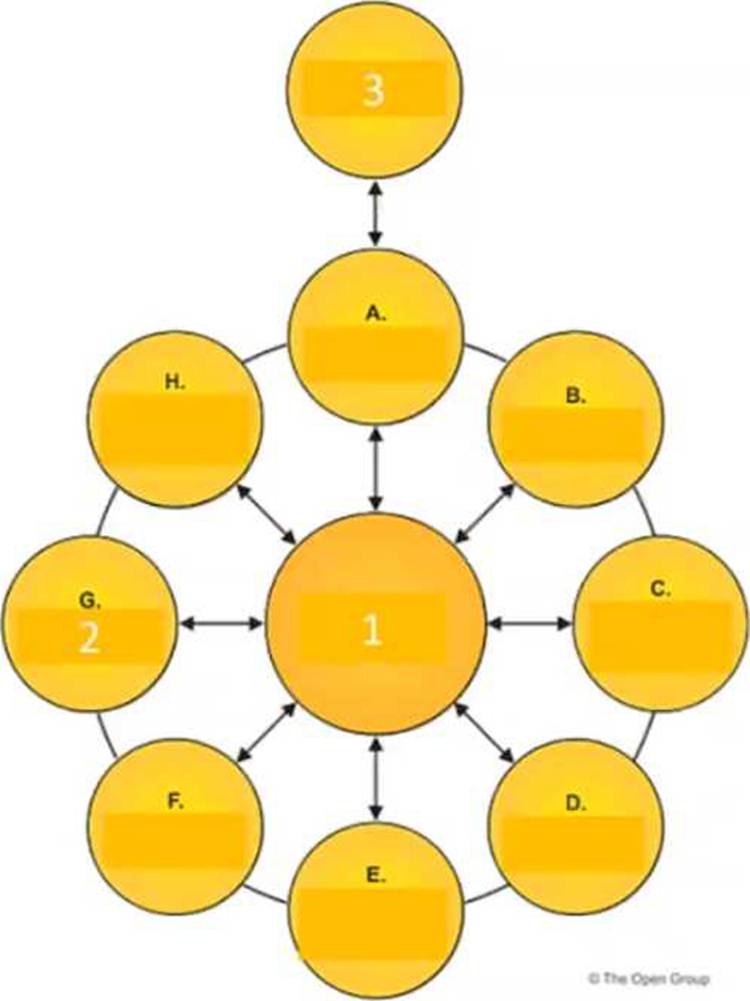
Consider the illustration showing an architecture development cycle
Which description matches the phase of the ADM labeled as item 2?
- A . Conducts implementation planning for the architecture defined in previous phases
- B . Establishes procedures for managing change to the new architecture
- C . Operates the process of managing architecture requirements
- D . Provides architectural oversight for the implementation
D
Explanation:
Based on the illustration, the phase of the ADM labeled as item 2 is the Implementation Governance phase. This phase provides architectural oversight for the implementation. It ensures that the implementation project conforms to the architecture. It also provides a framework for monitoring and managing the implementation.
The Implementation Governance phase involves the following activities:
– Finalizing the Architecture Roadmap and the supporting Implementation and Migration Plan
– Assigning an Architecture Board to oversee the implementation
– Establishing Architecture Contracts with the implementation partners
– Reviewing and approving the implementation project plans and deliverables
– Performing Architecture Compliance reviews to ensure alignment with the architecture
– Performing Architecture Audit reviews to ensure quality and performance of the architecture
– Resolving any architecture issues or change requests that arise during the implementation
– Maintaining the architecture lifecycle and ensuring its continuity
The Implementation Governance phase is essential for ensuring that the architecture is realized as intended and that it delivers the expected business value and outcomes.
Reference: Implementation Governance
Which of the following best describes the purpose of the Architecture Roadmap?
- A . It provides for effective communication of the end architecture project to the stakeholders
- B . It is sent from the sponsor and triggers the start of an architecture development cycle
- C . It forms the basis of a contractual agreement between the sponsor and the architecture organization
- D . It lists work packages on a timeline showing progress towards the Target Architecture
D
Explanation:
The purpose of the Architecture Roadmap is to provide a high-level view of how the Baseline Architecture will transition to the Target Architecture over time. It lists work packages on a timeline showing progress towards the Target Architecture, as well as dependencies, risks, and benefits. The Architecture Roadmap forms part of the Implementation and Migration Plan and guides the execution of the architecture projects.
Reference: https://pubs.opengroup.org/architecture/togaf9-doc/arch/chap20.html
What is an objective of the ADM Implementation Governance Phase?
- A . To provide continual monitoring of the governance framework
- B . To ensure conformance for the target architecture
- C . To finalize the Implementation and Migration Plan
- D . To establish the resources for architecture governance
B
Explanation:
The objective of the ADM Implementation Governance Phase is to provide an architectural oversight of the implementation and to ensure conformance for the target architecture. This phase involves establishing procedures and processes to monitor and control the implementation projects and to verify that they comply with the defined architecture.
Reference: The TOGAF® Standard | The Open Group Website, Section 3.2.7 Phase G: Implementation Governance.
What does the TOGAF ADM recommend for use in developing an Architecture Vision document?
- A . Requirements Management
- B . Architecture Principles
- C . Gap Analysis
- D . Business Scenarios
D
Explanation:
Business scenarios are a technique recommended by the TOGAF ADM for use in developing an Architecture Vision document12. Business scenarios are a means of capturing the business requirements and drivers, the processes and actors involved, and the desired outcomes and measures of success34. Business scenarios help to create a common vision and understanding among the stakeholders, and to identify and validate the architecture requirements. Business scenarios also provide a basis for analyzing the impact and value of the proposed architecture.
Reference: • The TOGAF Standard, Version 9.2 – Phase A: Architecture Vision – The Open Group
• TOGAF® Standard ― Introduction – Phase A: Architecture Vision
• The TOGAF Standard, Version 9.2 – Definitions – The Open Group
• Business Scenarios – The Open Group
• [The TOGAF Standard, Version 9.2 – Architecture Requirements Specification – The Open
Group]
• [The TOGAF Standard, Version 9.2 – Architecture Vision – The Open Group]
• [The TOGAF Standard, Version 9.2 – Business Transformation Readiness Assessment – The Open Group]
What are the four architecture domains that the TOGAF standard deals with?
- A . Business, Data, Application, Technology
- B . Capability, Segment, Enterprise, Federated
- C . Baseline, Candidate, Transition, Target
- D . Application, Data, Information, Knowledge
A
Explanation:
The TOGAF standard divides Enterprise Architecture into four primary architecture domains: business, data, application, and technology. These domains represent different aspects of an enterprise and how they relate to each other. The business domain defines the business strategy, governance, organization, and key business processes. The data domain describes the structure of the logical and physical data assets and data management resources. The application domain provides a blueprint for the individual applications to be deployed, their interactions, and their relationships to the core business processes. The technology domain describes the logical software and hardware capabilities that are required to support the deployment of business, data, and application services. Other domains, such as motivation, security, or governance, may span across these four primary domains.
Reference:
The TOGAF Standard, Version 9.2 – Core Concepts
Domains – The Open Group
TOGAF® Standard ― Introduction – Definitions – The Open Group
The TOGAF Standard, Version 9.2 – Definitions – The Open Group
TOGAF and the history of enterprise architecture | Enable Architect
Consider the following descriptions of deliverables consumed and produced across the TOGAF ADM cycle.
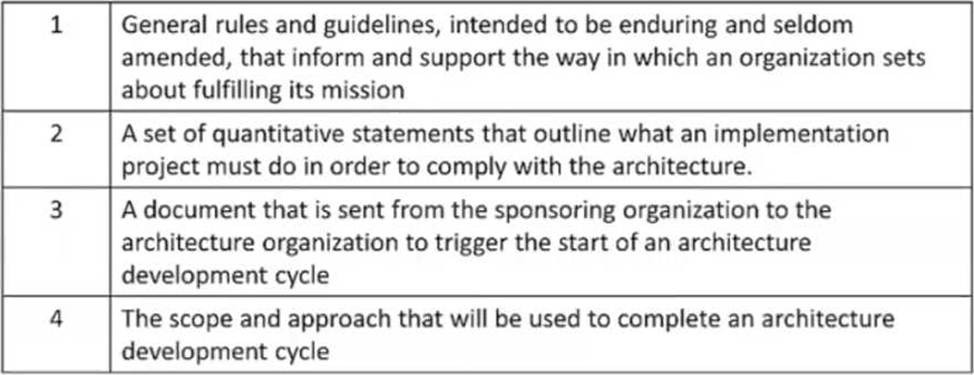
Which deliverables match these descriptions?
- A . 1 Architecture Requirements Specification – 2 Request for Architecture Work – 3 Statement of Architecture Work – 4 Architecture Principles
- B . 1 Statement of Architecture Work – 2 Architecture Principles – 3 Architecture Requirements Specification – 4 Request for Architecture Work
- C . 1 Architecture Principles – 2 Architecture Requirements Specification – 3 Request for Architecture Work – 4 Statement of Architecture Work
- D . 1 Request for Architecture Work – 2 Statement of Architecture Work – 3 Architecture Principles – 4 Architecture Requirements Specification
D
Explanation:
The Request for Architecture Work is a deliverable that is sent from the sponsor and triggers the start of an architecture development cycle. It defines the scope, budget, schedule, and deliverables for a specific architecture project. The Statement of Architecture Work is a deliverable that is produced by the architect and defines the approach and resources needed to complete an architecture project. It forms the basis of a contractual agreement between the sponsor and the architecture organization. The Architecture Principles are a deliverable that is produced by the architect and defines the general rules and guidelines for the architecture work. They reflect the business principles, business goals, and business drivers of the organization. The Architecture Requirements Specification is a deliverable that is produced by the architect and defines the requirements that govern the architecture work. It covers both functional and non-functional requirements as well as constraints and assumptions.