
The Open Group OG0-093 Practice Exams
Last updated on Oct 22,2026- Exam Code: OG0-093
- Exam Name: TOGAF 9 Combined Part 1 and Part 2
- Certification Provider: The Open Group
- Latest update: Oct 22,2026
Which of the following is an objective of the Preliminary Phase?
- A . Develop the Architecture Vision document
- B . Draft the Implementation and Migration Plan
- C . Ensure conformance requirements for the target architecture are defined
- D . Establish the Organizational Model for enterprise architecture
- E . Operate the governance framework
Which of the following does TOGAF provide as a set of reference materials for establishing an architecture function within an organization?
- A . Architecture Content Framework
- B . Technical Reference Model
- C . Integrated Information Infrastructure Reference Model
- D . Architecture Development Method
- E . Architecture Capability Framework
Complete the sentence. The TOGAF Technical Reference Model _____
- A . is an example and should be tailored to the needs of an organization
- B . must be used "as is" for developing comprehensive architecture models
- C . contains several industry specific frameworks
- D . is intended to contain the Enterprise Continuum
- E . contains only solution building blocks
Which of the following best describes the Standards Information Base?
- A . A repository area that defines the parameters, structures, and processes to support governance.
- B . A repository area that describes the organization specific architecture framework and methodologies.
- C . A repository area that provides guidelines, templates, and pattern used to create new architectures.
- D . A repository area that lists a set of specifications to which architectures must conform
- E . A repository area that provides a record of the governance activity across the enterprise.
D
Explanation:
Reference: https://pubs.opengroup.org/architecture/togaf91-doc/arch/chap41.html
Consider the following descriptions of deliverables consumed and produced across the TOGAF ADM cycle.
Which deliverables match these descriptions?
- A . 1 Architecture Contracts – 2 Architecture Requirements Specification – 3 Architecture Vision – 4 Architecture Principles
- B . 1 Architecture Principles – 2 Architecture Contracts – 3 Architecture Requirements Specification – 4 Request for Architecture Work
- C . 1 Architecture Principles – 2 Architecture Contracts – 3 Request for Architecture Work – 4 Architecture Requirements Specification
- D . 1 Architecture Requirements Specification – 2 Architecture Principles – 3 Architecture Vision – 4 Architecture Contracts
Consider the following ADM phases objectives.
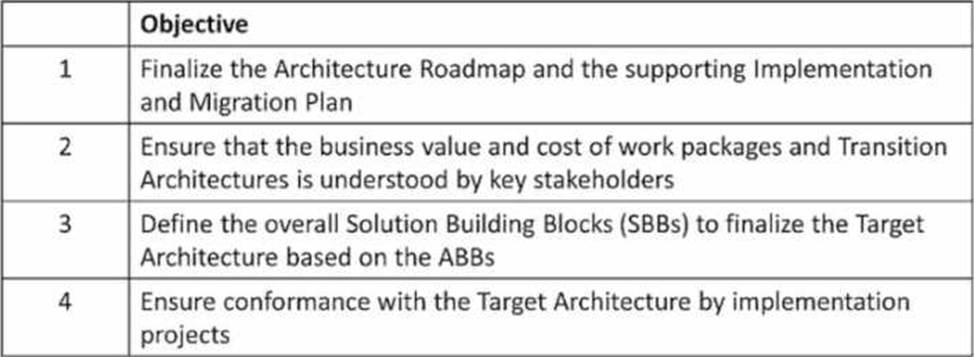
Which phase does each objective match?
- A . 1G-2E-3F-4E
- B . 1F-2F-3E-4G
- C . 1F-2G-3F-4F
- D . 1E-2F-3E-4G
Which statement about Requirements Management is most correct?
- A . The purpose of Requirements Management is to process change requests.
- B . Requirements Management is a step of all ADM Phases
- C . Requirements Management and stakeholder engagement are placed at the center of architecture development.
- D . Stakeholder requirements are captured once in Phase A and managed throughout the ADM cycle.
Which one of the following provides a foundation for making architecture and planning decisions, framing policies, procedures, and standards, and supporting resolution of contradictory situations?
- A . Architecture principles
- B . Buy lists
- C . Procurement policies
- D . Requirements
- E . Stakeholder concerns
Which of the following statements best describes risk management in the ADM?
- A . Risk analysis is best conducted in the Architecture Vision phase so that the risk is eliminated in subsequent phases
- B . Risk analysis should be carried out first in the Migration Planning phase
- C . Risk analysis is outside the scope of enterprise architecture projects
- D . Risk is pervasive in all enterprise architecture activity and should be managed in all phases of the
ADM - E . The only risks that are within the scope of enterprise architecture are technological risks
Scenario
Please read this scenario prior to answering the question
You are serving as the Lead Enterprise Architect for a chain of convenience stores. The stores operate 24 hours a day and 7 days a week and use cloud-based point-of-sale (POS) technology to manage their sales and inventory. Cloud-based POS systems store all user data, including sales and inventory in a remote server.
The cloud-based systems collect real-time data to support ordering and product selection decisions including the tailoring of product assortment based on sales history, customer demographics as well as the next day’s weather forecast. In many cases, several stores are located in neighboring areas.
This strategy makes distribution to each store cheaper, as well as making multiple deliveries per day possible. The stores also act as self-service delivery locations for a large online retailer which further increases the number of potential customers entering the stores.
An Enterprise Architecture practice exists within the company, with the CEO and CIO as joint sponsors. They have decided to adopt TOGAF standard within the practice and the first project is to restructure the Enterprise Architecture so that it can better support the existing environment and accommodate future changes of strategy within the company.
The CIO has stated that the following issues need to be addressed in the restructuring:
They need to address problems with data quality and inconsistent data in order to support better decision making and analysis.
The architecture should focus on the needs of the business, not technology
To remain competitive, new products and promotions must undergo market trials before deployment across the retail chain. Information systems must be able to manage changes and updates without undue delays.
[Note: You should assume that the company has adopted the example set of principles that are listed and defined in TOGAF standard, Architecture Principles chapter. You may need to refer to the Architecture Principles chapter, section 20.6 (located in Part III) within the reference text in order to answer this question.]
You have been asked to identify the most relevant architecture principles for the current situation.
Based on the TOGAF standard, which of the following is the best answer? [Note: The ordering of the principles listed in each answer is not significant.]
- A . Requirements Based Change, Responsive Change Management, Data Trustee, Common Vocabulary and Data Definitions, Business Continuity
- B . IT Responsibility, Data Security, Ease of Use, Service Orientation, Common Use Applications
- C . Maximize Benefit to the Enterprise, Data Trustee, Data is an Asset, Responsive Change Management, Interoperability
- D . Data is Accessible, Data is Shared, Interoperability, Requirements Based Change, Control Technical Diversity