
Snowflake ARA-C01 Practice Exams
Last updated on Oct 21,2026- Exam Code: ARA-C01
- Exam Name: SnowPro Advanced Architect Certification
- Certification Provider: Snowflake
- Latest update: Oct 21,2026
A company wants to Integrate its main enterprise identity provider with federated authentication with Snowflake.
The authentication integration has been configured and roles have been created in Snowflake. However, the users are not automatically appearing in Snowflake when created and their group membership is not reflected in their assigned rotes.
How can the missing functionality be enabled with the LEAST amount of operational overhead?
- A . OAuth must be configured between the identity provider and Snowflake. Then the authorization server must be configured with the right mapping of users and roles.
- B . OAuth must be configured between the identity provider and Snowflake. Then the authorization
server must be configured with the right mapping of users, and the resource server must be configured with the right mapping of role assignment. - C . SCIM must be enabled between the identity provider and Snowflake. Once both are synchronized through SCIM, their groups will get created as group accounts in Snowflake and the proper roles can be granted.
- D . SCIM must be enabled between the identity provider and Snowflake. Once both are synchronized through SCIM. users will automatically get created and their group membership will be reflected as roles In Snowflake.
D
Explanation:
The best way to integrate an enterprise identity provider with federated authentication and enable automatic user creation and role assignment in Snowflake is to use SCIM (System for Cross-domain Identity Management). SCIM allows Snowflake to synchronize with the identity provider and create users and groups based on the information provided by the identity provider. The groups are mapped to roles in Snowflake, and the users are assigned the roles based on their group membership. This way, the identity provider remains the source of truth for user and group management, and Snowflake automatically reflects the changes without manual intervention. The other options are either incorrect or incomplete, as they involve using OAuth, which is a protocol for authorization, not authentication or user provisioning, and require additional configuration of authorization and resource servers.
Which of the following are characteristics of Snowflake’s parameter hierarchy?
- A . Session parameters override virtual warehouse parameters.
- B . Virtual warehouse parameters override user parameters.
- C . Table parameters override virtual warehouse parameters.
- D . Schema parameters override account parameters.
B
Explanation:
In Snowflake’s parameter hierarchy, virtual warehouse parameters take precedence over user parameters. This hierarchy is designed to ensure that settings at the virtual warehouse level, which typically reflect the requirements of a specific workload or set of queries, override the preferences set at the individual user level. This helps maintain consistent performance and resource utilization as specified by the administrators managing the virtual warehouses.
Reference: Snowflake documentation on parameter hierarchy, found in the SnowPro Advanced:
Architect learning materials.
A company is trying to Ingest 10 TB of CSV data into a Snowflake table using Snowpipe as part of Its migration from a legacy database platform. The records need to be ingested in the MOST performant and cost-effective way.
How can these requirements be met?
- A . Use ON_ERROR = continue in the copy into command.
- B . Use purge = TRUE in the copy into command.
- C . Use FURGE = FALSE in the copy into command.
- D . Use on error = SKIP_FILE in the copy into command.
D
Explanation:
For ingesting a large volume of CSV data into Snowflake using Snowpipe, especially for a substantial amount like 10 TB, the on error = SKIP_FILE option in the COPY INTO command can be highly effective. This approach allows Snowpipe to skip over files that cause errors during the ingestion process, thereby not halting or significantly slowing down the overall data load. It helps in maintaining performance and cost-effectiveness by avoiding the reprocessing of problematic files and continuing with the ingestion of other data.
An Architect is designing a pipeline to stream event data into Snowflake using the Snowflake Kafka connector. The Architect’s highest priority is to configure the connector to stream data in the MOST cost-effective manner.
Which of the following is recommended for optimizing the cost associated with the Snowflake Kafka connector?
- A . Utilize a higher Buffer.flush.time in the connector configuration.
- B . Utilize a higher Buffer.size.bytes in the connector configuration.
- C . Utilize a lower Buffer.size.bytes in the connector configuration.
- D . Utilize a lower Buffer.count.records in the connector configuration.
A
Explanation:
The minimum value supported for the buffer.flush.time property is 1 (in seconds). For higher average data flow rates, we suggest that you decrease the default value for improved latency. If cost is a greater concern than latency, you could increase the buffer flush time. Be careful to flush the Kafka memory buffer before it becomes full to avoid out of memory exceptions. https://docs.snowflake.com/en/user-guide/data-load-snowpipe-streaming-kafka
The following DDL command was used to create a task based on a stream:
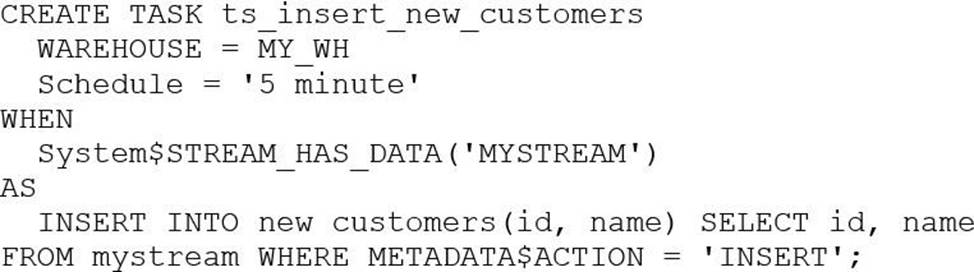
Assuming MY_WH is set to auto_suspend C 60 and used exclusively for this task, which statement is true?
- A . The warehouse MY_WH will be made active every five minutes to check the stream.
- B . The warehouse MY_WH will only be active when there are results in the stream.
- C . The warehouse MY_WH will never suspend.
- D . The warehouse MY_WH will automatically resize to accommodate the size of the stream.
B
Explanation:
The warehouse MY_WH will only be active when there are results in the stream. This is because the task is created based on a stream, which means that the task will only be executed when there are new data in the stream. Additionally, the warehouse is set to auto_suspend – 60, which means that the warehouse will automatically suspend after 60 seconds of inactivity. Therefore, the warehouse will only be active when there are results in the stream.
Reference: [CREATE TASK | Snowflake Documentation]
[Using Streams and Tasks | Snowflake Documentation]
[CREATE WAREHOUSE | Snowflake Documentation]
The following DDL command was used to create a task based on a stream:
Assuming MY_WH is set to auto_suspend C 60 and used exclusively for this task, which statement is true?
- A . The warehouse MY_WH will be made active every five minutes to check the stream.
- B . The warehouse MY_WH will only be active when there are results in the stream.
- C . The warehouse MY_WH will never suspend.
- D . The warehouse MY_WH will automatically resize to accommodate the size of the stream.
B
Explanation:
The warehouse MY_WH will only be active when there are results in the stream. This is because the task is created based on a stream, which means that the task will only be executed when there are new data in the stream. Additionally, the warehouse is set to auto_suspend – 60, which means that the warehouse will automatically suspend after 60 seconds of inactivity. Therefore, the warehouse will only be active when there are results in the stream.
Reference: [CREATE TASK | Snowflake Documentation]
[Using Streams and Tasks | Snowflake Documentation]
[CREATE WAREHOUSE | Snowflake Documentation]
A user can change object parameters using which of the following roles?
- A . ACCOUNTADMIN, SECURITYADMIN
- B . SYSADMIN, SECURITYADMIN
- C . ACCOUNTADMIN, USER with PRIVILEGE
- D . SECURITYADMIN, USER with PRIVILEGE
C
Explanation:
According to the Snowflake documentation, object parameters are parameters that can be set on individual objects such as databases, schemas, tables, and stages. Object parameters can be set by users with the appropriate privileges on the objects. For example, to set the object parameter AUTO_REFRESH on a table, the user must have the MODIFY privilege on the table. The ACCOUNTADMIN role has the highest level of privileges on all objects in the account, so it can set any object parameter on any object. However, other roles, such as SECURITYADMIN or SYSADMIN, do not have the same level of privileges on all objects, so they cannot set object parameters on objects they do not own or have the required privileges on. Therefore, the correct answer is C. ACCOUNTADMIN, USER with PRIVILEGE.
Reference: Parameters | Snowflake Documentation
Object Parameters | Snowflake Documentation
Object Privileges | Snowflake Documentation
What is the MOST efficient way to design an environment where data retention is not considered critical, and customization needs are to be kept to a minimum?
- A . Use a transient database.
- B . Use a transient schema.
- C . Use a transient table.
- D . Use a temporary table.
A
Explanation:
Transient databases in Snowflake are designed for situations where data retention is not critical, and they do not have the fail-safe period that regular databases have. This means that data in a transient database is not recoverable after the Time Travel retention period. Using a transient database is efficient because it minimizes storage costs while still providing most functionalities of a standard database without the overhead of data protection features that are not needed when data retention is not a concern.
Which of the below commands will use warehouse credits?
- A . SHOW TABLES LIKE ‘SNOWFL%’;
- B . SELECT MAX(FLAKE_ID) FROM SNOWFLAKE;
- C . SELECT COUNT(*) FROM SNOWFLAKE;
- D . SELECT COUNT(FLAKE_ID) FROM SNOWFLAKE GROUP BY FLAKE_ID;
B, C, D
Explanation:
Warehouse credits are used to pay for the processing time used by each virtual warehouse in Snowflake. A virtual warehouse is a cluster of compute resources that enables executing queries, loading data, and performing other DML operations. Warehouse credits are charged based on the number of virtual warehouses you use, how long they run, and their size1.
Among the commands listed in the question, the following ones will use warehouse credits:
SELECT MAX(FLAKE_ID) FROM SNOWFLAKE: This command will use warehouse credits because it is a query that requires a virtual warehouse to execute. The query will scan the SNOWFLAKE table and return the maximum value of the FLAKE_ID column2. Therefore, option B is correct.
SELECT COUNT(*) FROM SNOWFLAKE: This command will also use warehouse credits because it is a query that requires a virtual warehouse to execute. The query will scan the SNOWFLAKE table and
return the number of rows in the table3. Therefore, option C is correct.
SELECT COUNT(FLAKE_ID) FROM SNOWFLAKE GROUP BY FLAKE_ID: This command will also use warehouse credits because it is a query that requires a virtual warehouse to execute. The query will scan the SNOWFLAKE table and return the number of rows for each distinct value of the FLAKE_ID column4. Therefore, option D is correct.
The command that will not use warehouse credits is:
SHOW TABLES LIKE ‘SNOWFL%’: This command will not use warehouse credits because it is a metadata operation that does not require a virtual warehouse to execute. The command will return the names of the tables that match the pattern ‘SNOWFL%’ in the current database and schema5. Therefore, option A is incorrect.
Reference: Understanding Compute Cost: MAX Function: COUNT Function: GROUP BY
Clause: SHOW TABLES