
SAS Institute A00-231 Practice Exams
Last updated on Oct 22,2026- Exam Code: A00-231
- Exam Name: SAS 9.4 Base Programming -- Performance-based exam
- Certification Provider: SAS Institute
- Latest update: Oct 22,2026
The SAS data set named WORK.SALARY contains 10 observations for each department, and is currently ordered byDepartment
The following SAS program is submitted:
data WORK.TOTAL;
set WORK.SALARY(keep=Department MonthlyWageRate); by Department;
if First.Department=1 then Payroll=0;
Payroll+(MonthlyWageRate*12);
if Last.Department=1; run;
Which statement is true? Select one:
- A . The BY statement in the DATA step causes a syntax error.
- B . The statement Payroll+(MonthlyWageRate*12); in the data step causes a syntax error.
- C . The values of the variable Payroll represent the annual total for each department in the WORK.SALARY data set.
- D . The values of the variable Payroll represent an annual total for all values of MonthlyWageRate in the WORK.SALARY data set.
What is the format for the variableNamein the data setBoth? Select one:
- A . no format defined
- B . $CHAR
- C . $CHAR10
- D . $CHAR15
SIMULATION
Scenario:
This project will use data set cert.input13. At any time, you may save your program as program13 in certprograms.
This data set contains 1001 observations and 2 variables:
o Date1, a numeric variable representing an unformatted SAS date value. Example: 12001.
o Charnum, a character variable representing a monetary
amount. Example: $50,000.
Write a SAS program that will:
o Save the new data set as results.output13.
o Create a new variable Chdate that converts the datel variable to a character variable that is in the format ddmonyyyy, such as 11NOV1992.
o Create a new variable num1 that converts the Charnum variable to a numeric variable.
What is the average (mean) of the num1 variable for the entire data set?
Enter your numeric answer in the space below (Round your answer to the nearest integer).
Explanation:
data results.output13;
set cert.input13;
Chdate=put(date 1,date9.);
num 1=input(Charnum,dollar7.);
run;
proc means data=results.output13;
var num 1;
run;
SIMULATION
Scenario:
This project will use data setcert.input04. At any time, you may save your program asprogram04incertprograms. Write a SAS program that will create the data setresults.output04.
In this program, complete the following mathematical actions, in the following order:
Round VAR1 and VAR2 to the nearest integer values.
Multiply the rounded VAR1b y the rounded VAR2 and assign the new value to VAR3.
Add VAR12 through VAR19 (8 variables) together, ignoring missing values. Assign the sum to VAR20.
For observation 16, what is the value ofVAR3? Enter your numeric answer in the space below:
Explanation:
SAS code that could be used to solve this project:
data results.output04;
set cert.input04;
var3=round(var1,1)*round(var2,1);
var20=sum(of var12-var19);
run;
proc print data=results.output04 (obs=16 firstobs=16);
var var3 var20;
run;
The ‘obs’ option controls the last observation SAS processes. If you set obs=16, SAS would read and process only up to the 16th observation in the data set.
The ‘firstobs’ option controls the starting observation. If you set firstobs=16, SAS would start reading and processing from the 16th observation.
The following SAS program is submitted:
proc means data=work.schools median;
<insert statement(s) here>
run;
Assume thatWork.Schoolshas two numeric variables and the following PROC MEANS report is produced:
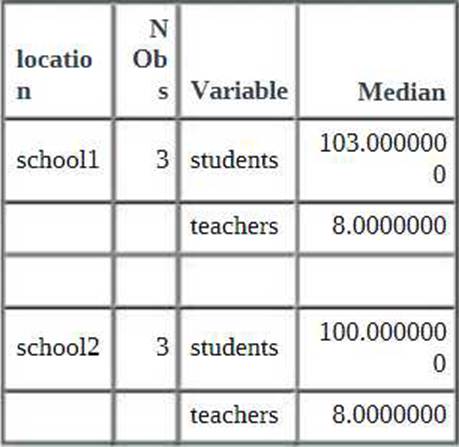
Which of the following SAS statements completes the program and creates the desired report? Select one:
- A . by location;
- B . class location;
- C . group by location;
- D . by location; id location;
Assume that Sasuser.One does not exist and that the following SAS program is submitted at the beginning of a new SAS session:
data sasuser.one;
x=1;
y=27;
output one; run;
Select one:
- A . The data set Sasuser.One is created with 2 variables and 3 observations.
- B . The data set Sasuser.One is created with 2 variables and 0 observations.
- C . The data set Work.One is created with 2 variables and 1 observation.
- D . The data set Sasuser.One is created with 2 variables and 1 observation.