
SAP P_SAPEA_2023 Practice Exams
Last updated on Nov 16,2026- Exam Code: P_SAPEA_2023
- Exam Name: SAP Certified Professional - SAP Enterprise Architect
- Certification Provider: SAP
- Latest update: Nov 16,2026
As the Chief Enterprise Architect of your company you have been asked by the CIO to apply agile principles instead of following the sequential phases of TOGAFS ADM.
How do you respond?
- A . The SAP EA Framework combines the sequential approach of the TOGAF® ADM with agile principles Agile principles are included and can be applied only to Application Architecture. Therefore, the SAP EA Framework is especially suitable for organizations that follow agile principles.
- B . It is reasonable to apply an agile methodology for the most urgent tasks and switch to the process as guided by the SAP EA Framework later, as long as the fundamental IT architecture is not affected Collecting "low-hanging fruit, and realizing instant value before using the SAP EA Framework, and ensuring an overall successful transformation is possible.
- C . It is essential to fully understand the business needs and to successfully review the business architecture with critical stakeholders before going to the next phase. In the implementation phase, agile approaches can naturally provide quick wins, constant progress, and the benefit of early validation. The phased approach, during architecture definition phases, avoids double work and will lead to overall better results.
- D . The TOGAF® ADM already embraces agile principles within and across phases and generally follows a cyclic approach. The SAP EA Framework builds on that and is especially suitable for organizations that follow agile principles.
Use the principles as guardrails for your subsequent activities.
Use the principles as guardrails for your subsequent activities.
Green Elk & Company is the world’s leading manufacturer of agricultural and forestry machinery. The former company slogan "Elk always runs has recently been changed to Elk feeds the world". One of
Green Elk’s strategic goals is to increase its revenue in the emerging markets of China, India, and other parts of Asia by 80 % within three years. This requires a new business model that caters to significantly smaller farms with limited budgets. You are the Chief Enterprise Architect and the CIO asks you to assess the new business model for smaller farms with smaller budgets.
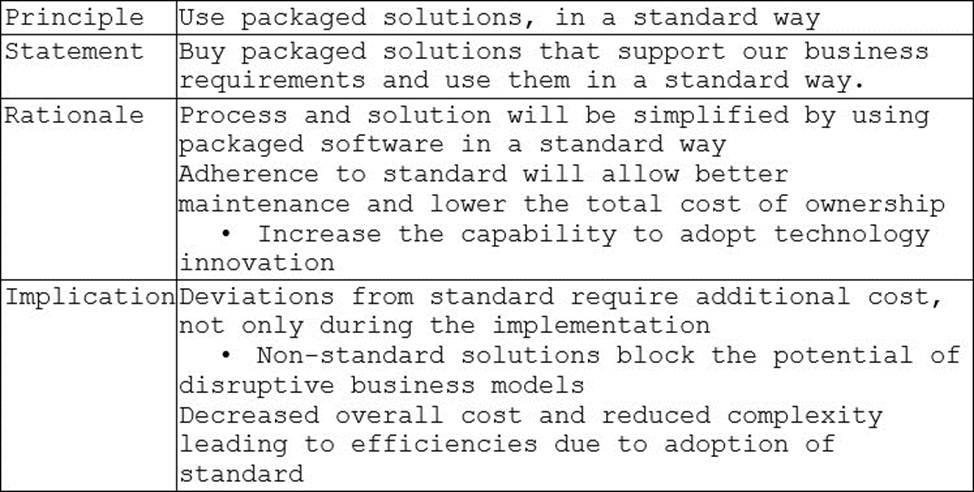
Given the principle and statement, which of the following combinations of rationale and implication do you consider well-defined?
- A . Green Elk & Company is the world’s leading manufacturer of agricultural and forestry machinery. The former company slogan "Elk always runs has recently been changed to Elk feeds the world". One of Green Elk’s strategic goals is to increase its revenue in the emerging markets of China, India, and other parts of Asia by 80 % within three years. This requires a new business model that caters to significantly smaller farms with limited budgets. You are the Chief Enterprise Architect and the CIO asks you to assess the new business model for smaller farms with smaller budgets. Given the principle and statement, which of the following combinations of rationale and implication do you consider well-defined?
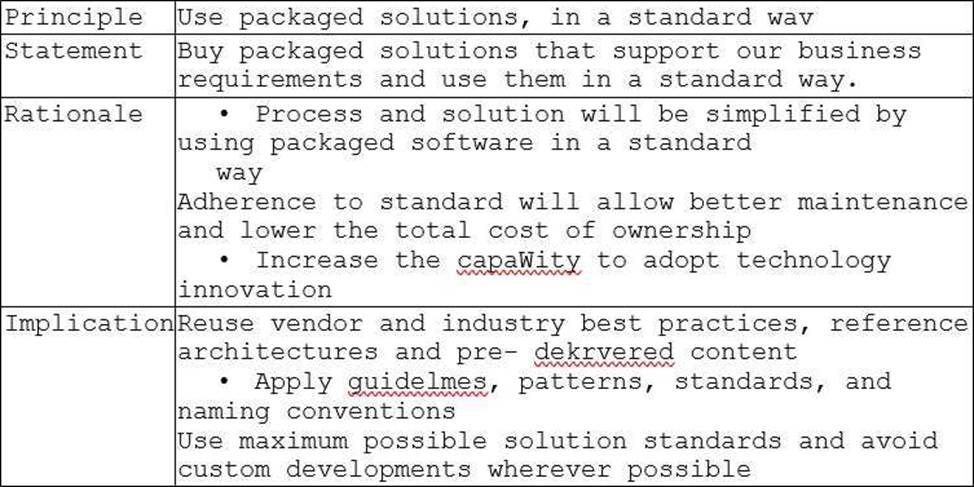
- B . Principle: Use packaged solutions, in a standard way. Statement: Buy packaged solutions that support our business requirements and use them in a standard way. Rationale: Process and solution will be simplified by using packaged software in a standard way./Adherence to standard will allow better maintenance and lower the total cost of ownership/Increase the capability to adopt technology innovation. Implication: Reuse vendor and industry best practices, reference architectures and pre- decreed content/Apply guideless, patterns, standards, and naming conventions/Use maximum possible solution standards and avoid custom developments wherever possible.
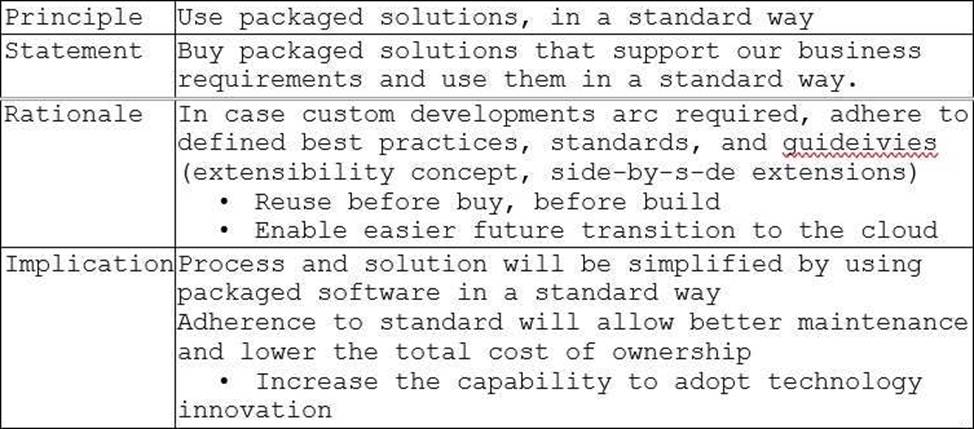
- C . Principle: Use packaged solutions, in a standard way. Statement: Buy packaged solutions that support our business requirements and use them in a standard way. Rationale: In case custom developments arc required, adhere to defined best practices, standards, and guide ivies (extensibility concept, side-by-s-de extensions)/Reuse before buy, before build/Enable easier future transition to the cloud. Implication: Process and solution will be simplified by using packaged software in a standard way/Adherence to standard will allow better maintenance and lower the total cost of ownership/Increase the capability to adopt technology innovation.
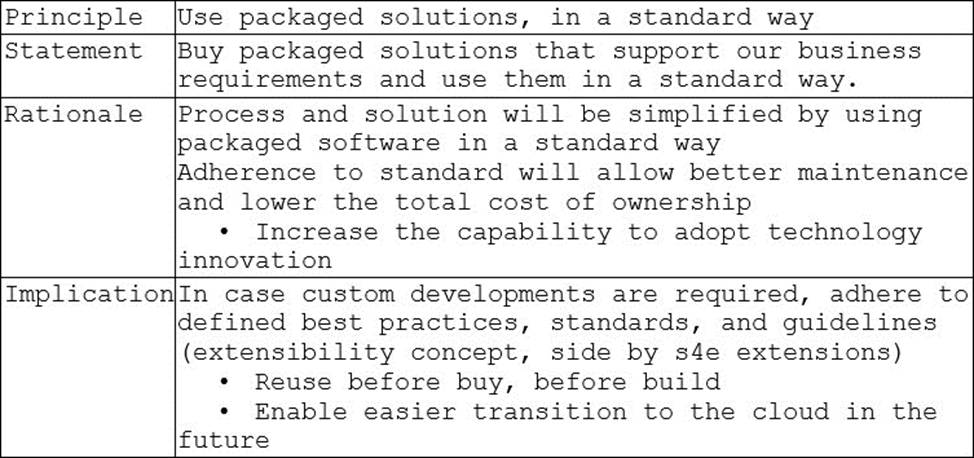
- D . Principle: Use packaged solutions, in a standard way. Statement: Buy packaged solutions that support our business requirements and use them in a standard way. Rationale: Process and solution will be simplified by using packaged software in a standard way/Adherence to standard will allow better maintenance and lower the total cost of ownership/Increase the capability to adopt technology innovation. Implication: In case custom developments are required, adhere to defined best practices, standards, and guidelines (extensibility concept, side by s4e extensions)/Reuse before buy, before build/Enable easier transition to the cloud in the future
Green Elk & Company is the world’s leading manufacturer of agricultural and forestry machinery. The former company slogan "Elk always runs has recently been changed to Elk feeds the world". One of
Green Elk’s strategic goals is to increase its revenue in the emerging markets of China, India, and other parts of Asia by 80 % within three years. This requires a new business model that caters to significantly smaller farms with limited budgets. You are the Chief Enterprise Architect and the CIO asks you to assess the new business model for smaller farms with smaller budgets.
Given the principle and statement, which of the following combinations of rationale and implication do you consider well-defined?
- A . Green Elk & Company is the world’s leading manufacturer of agricultural and forestry machinery. The former company slogan "Elk always runs has recently been changed to Elk feeds the world". One of Green Elk’s strategic goals is to increase its revenue in the emerging markets of China, India, and other parts of Asia by 80 % within three years. This requires a new business model that caters to significantly smaller farms with limited budgets. You are the Chief Enterprise Architect and the CIO asks you to assess the new business model for smaller farms with smaller budgets. Given the principle and statement, which of the following combinations of rationale and implication do you consider well-defined?
- B . Principle: Use packaged solutions, in a standard way. Statement: Buy packaged solutions that support our business requirements and use them in a standard way. Rationale: Process and solution will be simplified by using packaged software in a standard way./Adherence to standard will allow better maintenance and lower the total cost of ownership/Increase the capability to adopt technology innovation. Implication: Reuse vendor and industry best practices, reference architectures and pre- decreed content/Apply guideless, patterns, standards, and naming conventions/Use maximum possible solution standards and avoid custom developments wherever possible.
- C . Principle: Use packaged solutions, in a standard way. Statement: Buy packaged solutions that support our business requirements and use them in a standard way. Rationale: In case custom developments arc required, adhere to defined best practices, standards, and guide ivies (extensibility concept, side-by-s-de extensions)/Reuse before buy, before build/Enable easier future transition to the cloud. Implication: Process and solution will be simplified by using packaged software in a standard way/Adherence to standard will allow better maintenance and lower the total cost of ownership/Increase the capability to adopt technology innovation.
- D . Principle: Use packaged solutions, in a standard way. Statement: Buy packaged solutions that support our business requirements and use them in a standard way. Rationale: Process and solution will be simplified by using packaged software in a standard way/Adherence to standard will allow better maintenance and lower the total cost of ownership/Increase the capability to adopt technology innovation. Implication: In case custom developments are required, adhere to defined best practices, standards, and guidelines (extensibility concept, side by s4e extensions)/Reuse before buy, before build/Enable easier transition to the cloud in the future
For the next Architecture Board meeting, you need to determine the next steps required after the business, application/data and technology architecture designs have been created.
What do you recommend?
- A . Reviewing Business Application/Data and Technology Architecture artifacts with stakeholders and signing off on first versions. Using Transition Architectures to build the Architecture Roadmap. Creating first drafts of the required work packages and the Project/Rollout plan.
- B . Finalizing the Business, Application/Data, and Technology Architecture artifacts. Building an Architecture Roadmap. Creating a first draft of the Project/Rollout Project plan.
- C . Establishing change management processes for the management of the business application/data and technology artifacts Handing over the artifacts to the implementation partner and rolling out the project
Which of the following lists of SAP Enterprise Architecture artifacts support making informed Target Application Architecture decisions that are aligned with the strategic direction of a company?
- A . Stakeholder Map/Business Strategy Map/Solution Strategy/Architecture Roadmap
- B . Principles Standards, Guidelines/Solution Context/Baseline Business and Solution Architecture
- C . Solution Context/Solution Concept/Stakeholder Map/Baseline Business and Solution Architecture