
Salesforce marketing cloud intelligence Practice Exams
Last updated on Nov 16,2026- Exam Code: marketing cloud intelligence
- Exam Name: Marketing Cloud Intelligence Accredited Professional Exam
- Certification Provider: Salesforce
- Latest update: Nov 16,2026
Your client provided the following sources:
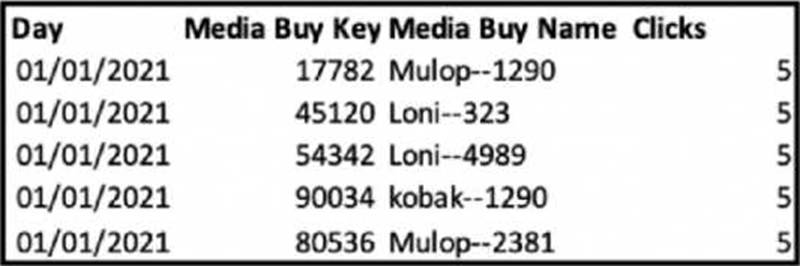
Source 1:
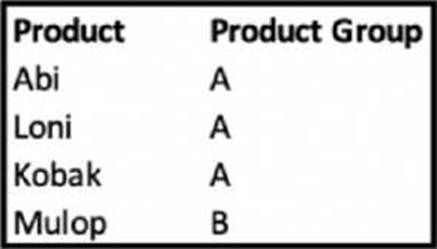
Source 2:
Source 3:
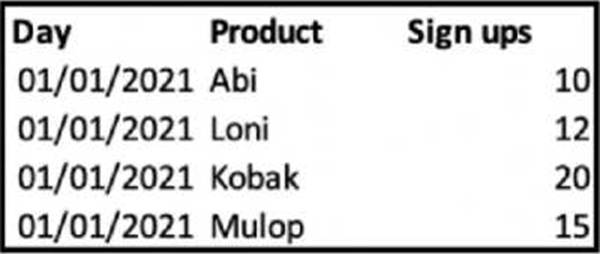
As can be seen, the Product values present in sources 2 and 3 are similar and can be linked with the first extraction from ‘Media Buy Name’ in source1
The end goal is to achieve a final view of Product Group alongside Clicks and Sign Ups, as described below:
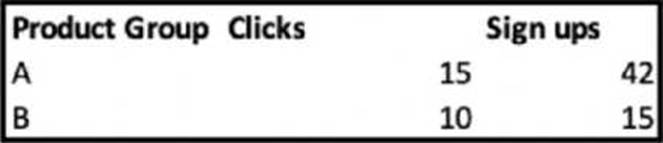
Which two options will meet the client’s requirement and enable the desired view?
- A . Custom Classification: 1
Source 1: Custom Classification key will be populated with the extraction of the Media Buy Name.
Source 2: ‘Product’ will be mapped to Custom Classification key and ‘Product Group’ to a Custom Classification level. Exam Timer
Source 3: ‘Product will be mapped to Custom Classification key. Came - B . Overarching Entities:
Source 1: custom classification key will be populated with the extraction of the Media Buy Name.
Source 2: ‘Product’ will be mapped to Product field and ‘Product Group’ to Product Name.
Source 3: ‘Product’ will be mapped to Product field. - C . Parent Child:
All sources will be uploaded to the same data stream type – Ads. The setup is the following:
Source 1: Media Buy Key ―- Media Buy Key, extracted product value ― Media Buy Attribute.
Source 2: Product ― Media Buy Key, Product Group ―- Media Buy Attribute.
Source 3: Product ― Media Buy Key. - D . Harmonization Center:
Patterns from sources 1 and 3 generate harmonized dimension ‘Product’. Data Classification rule, using source 2, is applied on top of the harmonized dimension
A client’s data consists of three data streams as follows:
Data Stream A:
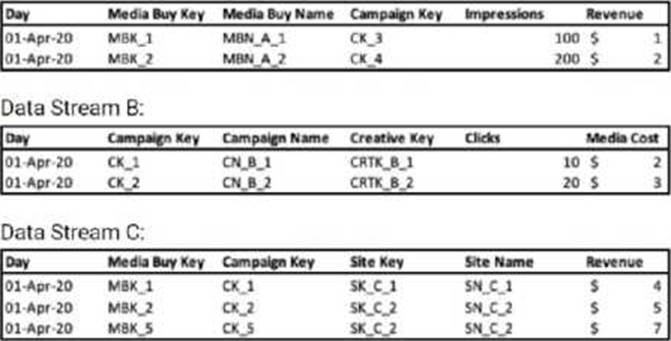
* The data streams should be linked together through a parent-child relationship.
* Out of the three data streams, Data Stream C is considered the source of truth for both the dimensions and measurements.
Assuming the data was ingested properly and the Parent Child was created correctly according to the client’s requirements, what is the total
Impressions value for Campaign Key ‘CK_3’?
- A . N-A
- B . 100
- C . 300
- D . 150
A client’s data consists of three data streams as follows:
Data Stream A:
* The data streams should be linked together through a parent-child relationship.
* Out of the three data streams, Data Stream C is considered the source of truth for both the dimensions and measurements.
Assuming the data was ingested properly and the Parent Child was created correctly according to the client’s requirements, what is the total
Impressions value for Campaign Key ‘CK_3’?
- A . N-A
- B . 100
- C . 300
- D . 150
Which two statements are correct regarding the Parent-Child configuration?
- A . Parent-Child configurations can cause performances issues
- B . A Parent-Child cannot be configured between an Ads data stream type and a Conversion Tag one.
- C . Parent-Child links different tables based on shared key values
- D . Parent-Child allows sharing both dimensions and measurements
An implementation engineer has been asked to perform QA for a standard file ingestion, done by the client.
The source file that was ingested can be seen below:

The number of rows added to this data stream is 3.
What could have led to this discrepancy?
- A . All fields are mapped except for the Media Buy Key.
- B . All fields are mapped except for the Creative Name
- C . All fields are mapped except for the Media Buy Name.
- D . All fields are mapped except for the Campaign Key
What are unstable measurements?
- A . Measurements for which Aggregation Settings are set as ‘Auto’ and Granularity is set as ‘None’.
- B . Measurements that are set with the LIFETIME aggregation function
- C . Measurements for which Aggregation Settings are set as ‘Not Auto’ and Granularity is set as ‘None’.
- D . Measurements for which Aggregation Settings are set as ‘Not Auto’ and Granularity is set as ‘Not Empty’.
Which two statements are correct regarding LiteConnect?
- A . It does not require any identification of entities, keys or any other categorization.
- B . The dataset does not conform to the standard data model
- C . All of the dimensions mapped within a LiteConnect data stream are considered overarching entities.
- D . Data coming from LiteConnect cannot be harmonized with the rest of the workspace data via the harmonization center at a later step.
An implementation engineer is requested to integrate the following files:
File A:

File B:

The client would like to link the two files in order to view the two KPIS (Tasks Completed’ and ‘tasks Assignmed’) alongside’Employee Name’ and/or ‘Squard’.
A Parent-Child configuration was set between the two.
Which two statements are correct?
- A . The two files cannot be Joined as they hold different measurements
- B . The two files cannot be joined as they hold different dates
- C . The join can be successful even if "empjd’ isn’t mapped and employee.name’ is mapped to the same entity name in both data streams
- D . Any one of the files can potentially be set as the Parent data stream
- E . The two files were uploaded to a different Generic type
Ina workspace that contains one hundred data streams and a lot of data, what is the biggest downside of using calculated dimensions?
- A . Performance
- B . Ease of setup
- C . Ease of maintenance
- D . Scalability
An Implementation engineer is requested to create a new harmonization field ‘Offer’ and apply the following logic:
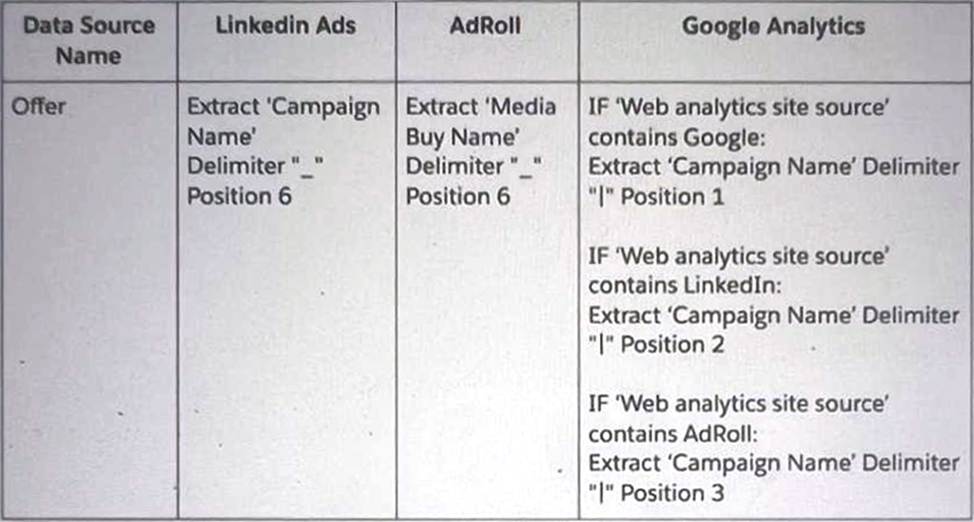
The implementation engineer to use the Harmonization Center.
Which of the below actions can help implement the new dimension ‘Offer?
- A . Two separate patterns (filtered by Linkedin or AdRoll sources)
Within Google Analytics’ mapping A formula that reflects the logic above will be populated within a Web Analytics Site custom attribute
Another pattern to be created for the newly Web Analytics Site custom attribute (filtered by Google Analytics source).
A total of 3 patterns. - B . Two separate patterns (filtered by Linkedin or AdRoll sources)
Within Google Analytics’ mapping: A formula that reflects the logic above will be populated within a Campaign custom attribute.
Another pattern to be created for the newly campaign attribute (filtered by Google Analytics source). A total of 3 patterns - C . Two separate patterns (filtered by Linkedin or AdRoll sources).
Another single pattern for Campaign Name (filtered by Google Analytics source).
A total of 3 patterns. - D . Two separate patterns (filtered by Linkedln or AdRoll sources).
Another single pattern for Web Analytics Site Source (filtered by Google Analytics source), extracting all three positions A total of 3 patterns.