
Salesforce marketing cloud intelligence Practice Exams
Last updated on Nov 16,2026- Exam Code: marketing cloud intelligence
- Exam Name: Marketing Cloud Intelligence Accredited Professional Exam
- Certification Provider: Salesforce
- Latest update: Nov 16,2026
Which three entities and/or functions can be used in an expression when building a calculated dimension?
- A . The VLOOKUP function
- B . Mapped dimensions
- C . The EXTRACT function
- D . Calculated dimensions
- E . Mapped measurements
A client’s data consists of three data streams as follows:
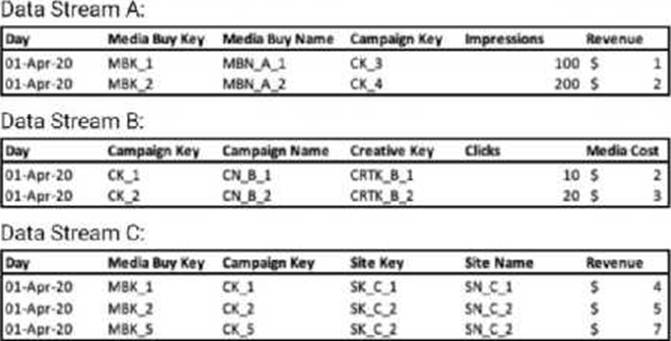
* The data streams should be linked together through a parent-child relationship.
* Out of the three data streams, Data Stream C is considered the source of truth for both the dimensions and measurements.
Which data stream should be set as a parent?
- A . Data Stream A
- B . Data Stream C
- C . Any of the data streams can technically be the parent
- D . Data Stream B
A client’s data consists of three data streams as follows:
* The data streams should be linked together through a parent-child relationship.
* Out of the three data streams, Data Stream C is considered the source of truth for both the dimensions and measurements.
Which data stream should be set as a parent?
- A . Data Stream A
- B . Data Stream C
- C . Any of the data streams can technically be the parent
- D . Data Stream B
What are two potential reasons for performance issues (when loading a dashboard) when using the CRM data stream type?
- A . When a data stream type ”CRM – Leads’ is created, another complementary ‘CRM – Opportunity’ is created automatically.
- B . Pacing – daily rows are being created for every lead and opportunity keys
- C . No mappable measurements – all measurements are calculated
- D . The data is stored at the workspace level.
A client would like to integrate the following two sources:
Google Campaign Manager:

IAS:

After configuring a Parent-Child relationship between the files, which query should an implementation engineer run in order to QA the setup?
- A . Media Buy Type, Media Buy Name, Impressions, Analyzed Impressions
- B . Creative Name, Impressions, Analyzed Impressions
- C . Media Buy Name, Impressions
- D . Media Buy Type, Analyzed Impressions
Your client would like to create a new harmonization field – Exam Topic.
The below table represents the harmonization logic from each source.
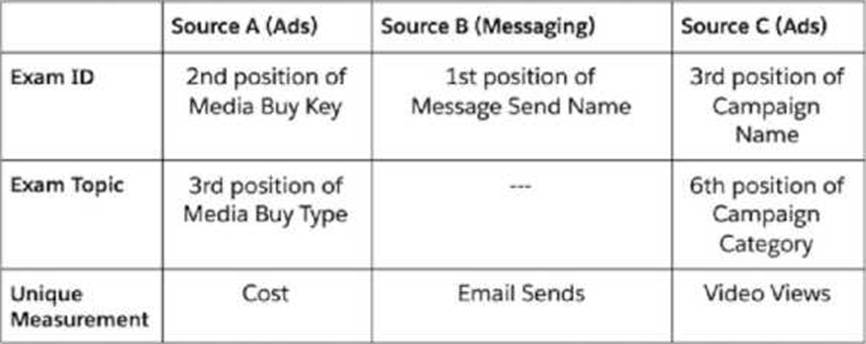
As can be seen from the table, there are in fact two fields that hold a certain connection: Exam ID and Exam Topic. The connection indicates that where an Exam ID is found – a single Exam Topic value is associated with it.
The client has a requirement to be able to view measurements from all data sources sliced by Exam Topic values, as seen in the following example:

The client suggested to create, without any mapping manipulations, several patterns via the harmonization center that will generate two
Harmonized Dimensions:
Exam ID
Exam Topic
Given the above information, which statement is correct regarding the ability to implement this request with the above suggestion?
- A . The above Patterns setup will not work for this use case.
- B . The solution will work – the client will be able to view Exam Topic with Email Sends.
- C . Only if 5 different Patterns are created, from 5 different fields – the solution will work.
- D . The Harmonized field for Exam ID is redundant. One Harmonized dimension for Exam Topic is enough for a sustainable and working solution
A technical architect is provided with the logic and Opportunity file shown below:
The opportunity status logic is as follows:
For the opportunity stages “Interest”, “Confirmed Interest” and “Registered”, the status should be “Open”.
For the opportunity stage “Closed”, the opportunity status should be closed Otherwise, return null for the opportunity status.
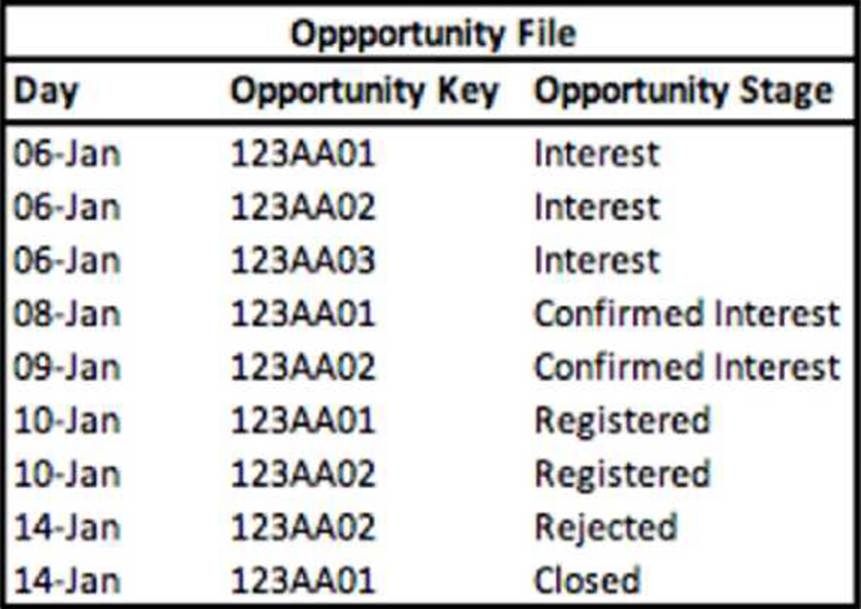
Given the above file and logic and assume that the file is mapped in the OPPORTUNITIES Data Stream type with the following mapping:
“Day” ― “Created Date”
“Opportunity Key” + Opportunity Key
“Opportunity Stage” ― Opportunity Stage
A pivot table was created to present the count of opportunities in each stage. The pivot table is filtered on Jan 11th.
What is the number of ‘opportunities in the Confirmed Interest stage?
- A . 2
- B . 1
- C . 3
- D . 0
Salesforce Marketing Cloud
The link between these sources is on the following two fields:
Message Send Key
A portion of: web_site_source_key
Below is the logic the client would like to have implemented in Datorama:
For ‘web site medium’ values containing the word “email” (in all of its forms), the section after the “_” delimiter in ‘web_site_source_key’ is a 4 digit number, which matches the ‘Message Send Key’ values from the Salesforce Marketing Cloud file.
Possible examples of this can be seen in the following table:
Google Analytics:
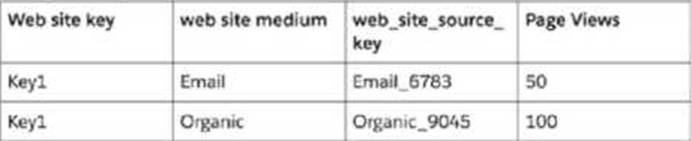
Salesforce Marketing Cloud:

The client’s objective is to visualize the mutual key values alongside measurements from both files in a table.

In order to achieve this, what steps should be taken?
- A . Within both files, map the desired value to Custom Classification Key as follows Salesforce Marketing Cloud: map entire Message Key to Custom Classification Key. Google Analytics: map the extraction logic to Custom Classification Key.
- B . Create a Web Analytics Site custom attribute and populate it with the extraction logic. Create a Data Fusion between the newly created attribute and the Message Send Key.
- C . Upload the two files and create a Parent-Child relationship between them. The Override Media Buy Hierarchy checkbox is checked in Google Analytics.
- D . Create a Web Analytics Site Source custom attribute and populate it with the extraction logic.
Create a Data Fusion between the newly created attribute and the Message Send Key.
Your client is interested in ingesting the below file:
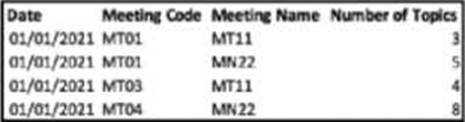
The client decided to upload the file to a new generic data stream type and map ‘Date’ to ‘Day’ and ‘Number of Topics’ to a generic custom metric.
In regards to the fields ‘Meeting Code’ and ‘Meeting Name’, your client is debating several options.
Which two options would you recommend in order to avoid data loss?
- A . ‘Meeting Code’ will be mapped to ‘Main Generic Entity Key’.
‘Meeting Name’ will be mapped to ‘Main Generic Entity custom attribute’. - B . ‘Meeting Code’ will be mapped to ‘Main Generic Entity Key’.
‘Meeting Name’ will be mapped to ‘Generic Entity 2 Key’. - C . ‘Meeting Code’ will be mapped to ‘Main Generic Entity Attribute 1’.
‘Meeting Name’ will be mapped to ‘Main Generic Entity Attribute 2’. - D . ‘Meeting Code’ will be mapped to ‘Main Generic Entity custom attribute’.
‘Meeting Name’ will be mapped to ‘Generic Entity Key’ - E . Concatenation of both ‘Meeting Code’ and ‘Meeting Name’ will be mapped to ‘Main Generic Entity Key’.
‘Meeting Code’ will be mapped to ‘Main Generic Entity Attribute 1’.
‘Meeting Name’ will be mapped to ‘Main Generic Entity Attribute 2’.
A client wants to integrate their data within Marketing Cloud Intelligence to optimize their marketing Insights and cross-channel marketing activity analysis. Below are details regarding the different data sources and the number of data streams required for each source.
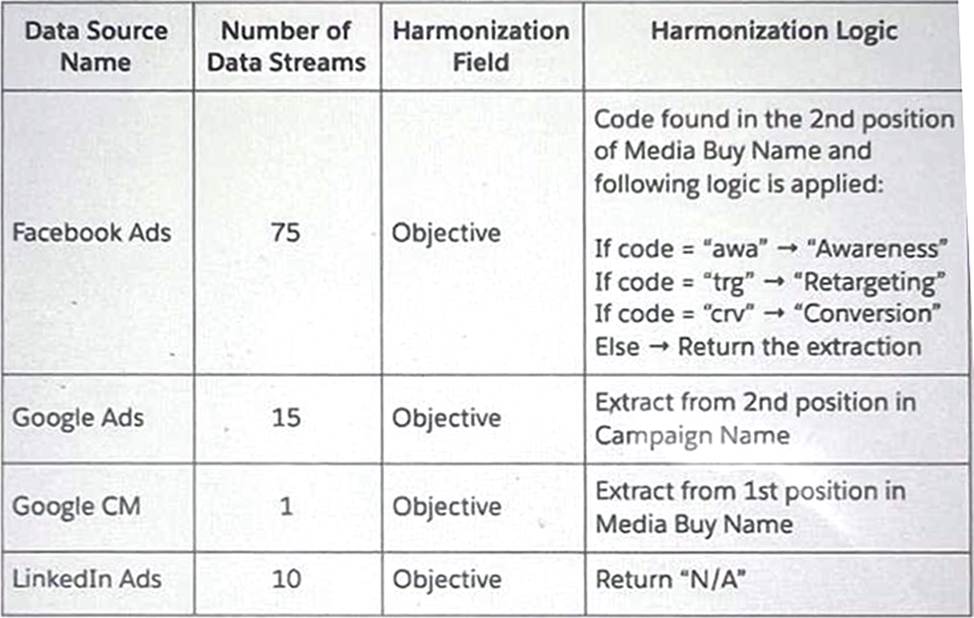
Which three advantages does a client gain from using Calculated Dimensions as the harmonization method for creating the Objective field?
- A . Scalability – future data streams that will follow similar logic will be automatically harmonized.
- B . Data model restrictions – Calculated Dimensions do not need to adhere to Marketing Cloud Intelligence’s data model
- C . Processing – creation of Calculated Dimensions will ease the processing time of the data streams it relates to
- D . Ease of Maintenance – the logic is written and populated in one centralized place
- E . Performance (Performance when loading a dashboard page) should be optimized as the values of calculated dimensions are stored within the database.