
PMI PMP Practice Exams
Last updated on Oct 22,2026- Exam Code: PMP
- Exam Name: Project Management Professional
- Certification Provider: PMI
- Latest update: Oct 22,2026
A project manager is managing multiple teams. One team member complains to the project manager about the favoritism shown by a team lead to another team member and cites multiple instances.
Risk Response Strategies Analyze if someone else could contribute Record the observations and move ahead Check for options to exclude the stakeholder
What should the project manager do to resolve the team member’s concerns?
- A . Use the withdraw/avoid technique to allow the individuals to resolve the issue between themselves.
- B . Use a problem-solving approach and set up a discussion with the team lead and team member.
- C . Establish guidelines for team leads to ensure that all team members are appropriately treated.
- D . Provide direction to the team lead on how to resolve the issue with the team member directly.
B
Explanation:
The project manager should address the team member’s concerns by using a problem-solving approach, which involves identifying the root cause of the conflict, generating and evaluating alternative solutions, and implementing the best option. The project manager should set up a discussion with the team lead and the team member to facilitate open and honest communication, listen to both sides of the story, and help them reach a mutually acceptable resolution. This is consistent with the principle of leading with empathy and respect, which is part of the PMI Talent Triangle®.
Reference: PMBOK Guide 7th Edition, page 133
Agile Practice Guide, page 48
PMI Talent Triangle® 1
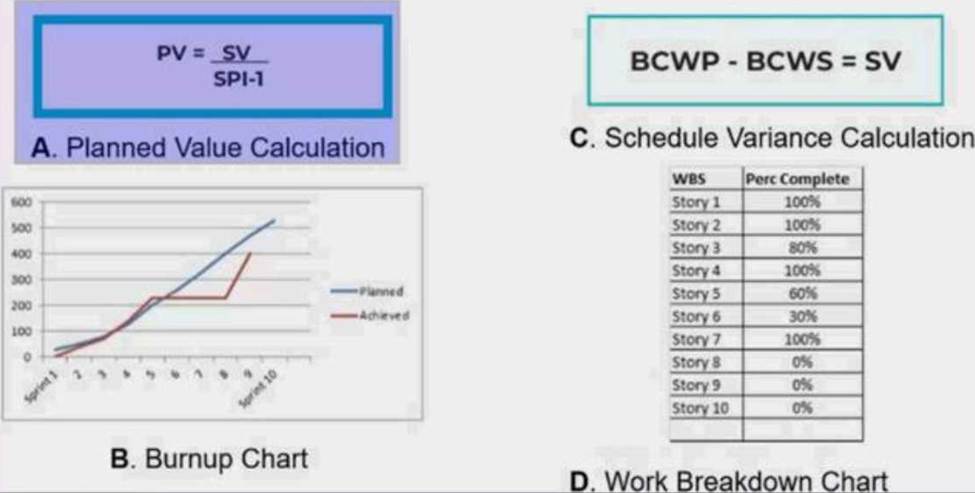
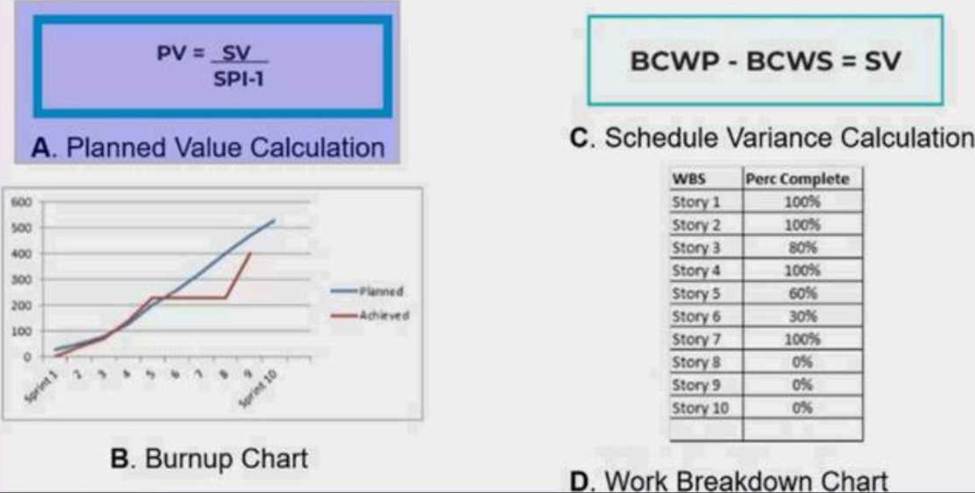
HOTSPOT
An agile project manager is evaluating the method that will be used to display the value of the work performed to date.
Which method will they select to display to the project stakeholder?
A project manager is leading a project that is in the execution phase. Due to a company reorganization, some key project team members are likely to leave the project.
What should the project manager do next?
- A . Discuss this issue with the affected team members and support them during the transition.
- B . Start looking for replacements as soon as possible to help prevent any schedule slippage.
- C . Engage with the project sponsor to ensure that this change does not affect the project execution.
- D . Determine the impact to the project and implement mitigations per the project management plan.
D
Explanation:
When facing the potential departure of key project team members, a project manager should first evaluate the situation’s impact on the project’s scope, schedule, cost, and quality. The next step is to refer to the project management plan, which should include a risk management plan with predefined mitigation strategies for such scenarios. Implementing these mitigations will help to manage the changes effectively and keep the project on track.
Reference: The response is based on general project management principles as outlined in the PMBOK Guide and the standard practices of risk and change management that are part of the PMP’s body of knowledge.
In an attempt to streamline project communications, a project manager established a shared portal for all stakeholders to get project information. The sponsor complained about this system and says that it is ineffective.
What should the project manager have done to prevent this situation from occurring?
- A . Analyzed the sponsor’s communication requirements.
- B . Confirmed that the portal is providing adequate information.
- C . Verified that the project team is following the communications management plan.
- D . Ensured the sponsor had the necessary skills to use the portal.
A
Explanation:
According to the PMBOK Guide1, project communication management includes the processes of planning, managing, and monitoring project communications. The first process, plan communications management, involves determining the information and communication needs of the project stakeholders, such as the sponsor. The project manager should have analyzed the sponsor’s communication requirements, such as the type, format, frequency, and level of detail of the information they need, as well as their preferred communication channels and methods. By doing so, the project manager could have designed and implemented a communication system that meets the sponsor’s expectations and needs, and avoids any dissatisfaction or complaints. The other options are not the best preventive actions, as they are either reactive or irrelevant. Confirming that the portal is providing adequate information, verifying that the project team is following the communications management plan, and ensuring the sponsor had the necessary skills to use the portal are all actions that could be taken after the situation has occurred, but they do not address the root cause of the problem, which is the lack of alignment between the communication system and the sponsor’s requirements.
Reference: A Guide to the Project Management Body of Knowledge (PMBOK® Guide) C Sixth Edition Project Communication Management – Five Steps | PMI ProjectManagement.com – Project Communication Management
A project manager is managing a project with team members who are working all over the globe.
The project manager notices that each team member’s deliverables do not meet the requirements.
What should the project manager do first?
- A . Assemble the project team via conference call to tell them that disciplinary action will be taken if any more noncompliant deliverables are submitted.
- B . Discuss the process used to create the noncompliant deliverables with the project team to see if there was a potential misunderstanding.
- C . Schedule time with the project sponsor to inform them that the project schedule is slipping due to the time it will take to rework the deliverables.
- D . Meet with the project team to explain that noncompliant deliverables must be reworked and submitted immediately to avoid project delays.
B
Explanation:
When deliverables do not meet requirements, it is essential to understand the root cause of the issue. The first step should be to engage with the project team to discuss the processes used and identify any misunderstandings or gaps in knowledge. This approach aligns with the PMBOK® Guide’s emphasis on communication and stakeholder engagement as key aspects of project management. It also reflects the principles of collaboration and continuous improvement found in business analysis practices.
Reference: PMBOK® Guide1, PMI Professional in Business Analysis (PMI-PBA)® reference materials2.
A hybrid project has just deployed, and the project manager is planning project closure with lessons learned workshops. A key stakeholder informs the project manager that having the Scrum team in the workshops is a waste of time because the project was delivered successfully.
What should the project manager do?
- A . Ask the Scrum team members to share retrospectives.
- B . Ask the scrum master to attend the workshops.
- C . Invite the Scrum team members as optional participants.
- D . Invite the Scrum team members as mandatory participants.
D
Explanation:
The importance of involving the Scrum team in lessons learned workshops, even after a successful project delivery, is emphasized in project management methodologies. Lessons learned are a vital part of project closure, as they provide documented information that reflects both the positive and negative experiences of a project. They are crucial for the team, the organization, and for the success of future projects. The Scrum team’s involvement ensures that insights and retrospectives are comprehensive, covering all aspects of the project’s execution123. Moreover, in Scrum, every sprint is considered a project, and the framework is designed to maximize value and control risk through continuous feedback, which includes lessons learned from each sprint4.
Reference: Lessons learned are an integral part of project management excellence and are strongly encouraged by the project manager from the beginning of the project1. The Project Management Body of Knowledge (PMBOK) also highlights the significance of project closure and lessons learned review as they help finalize project deliverables, evaluate project performance, document project outcomes, and capture project learnings3. Additionally, Scrum.org emphasizes that Scrum does not include “closing a project” but rather retiring a product, and the continuous improvement and learning from each sprint are fundamental to the Scrum process4.
A project manager is leading a project which shows a trend to exceed the cost baseline.
What should the project manager do first to manage the budget?
- A . Ask the project sponsor for assistance in getting the budget back on track
- B . Meet with the project team to analyze the actual cost to determine deviations
- C . Inform the stakeholders that the project will be finished over budget.
- D . Issue a change request including the analysis to increase the budget
B
Explanation:
The project manager should do first to manage the budget is to meet with the project team to analyze the actual cost to determine deviations. This is the first step in the control cost process, which involves monitoring the status of the project to update the project costs and manage changes to the cost baseline2. By analyzing the actual cost, the project manager can identify the causes and sources of the cost variance, and evaluate the impact and implications on the project performance and objectives. The project manager can also use various tools and techniques, such as earned value analysis, forecasting, and variance analysis, to measure and report the cost performance and status2. Based on the analysis, the project manager can then decide on the appropriate actions and responses to bring the project back on track, such as requesting additional funds, reducing scope, adjusting resources, or implementing corrective or preventive actions2.
Option A is not a good choice, because it is premature and passive. The project manager should not ask the project sponsor for assistance in getting the budget back on track before analyzing the actual cost and determining the deviations. The project manager should first understand the nature and extent of the cost variance, and then present the facts and data to the project sponsor, along with possible solutions and recommendations. The project manager should also demonstrate their own initiative and responsibility in managing the budget, rather than relying on the project sponsor to solve the problem.
Option C is not a good choice, because it is pessimistic and irresponsible. The project manager should not inform the stakeholders that the project will be finished over budget before analyzing the actual cost and determining the deviations. The project manager should first assess the situation and explore the options to improve the cost performance and meet the budget expectations. The project manager should also communicate the cost status and issues to the stakeholders in a timely and transparent manner, and seek their feedback and support, rather than delivering bad news without any justification or action plan.
Option D is not a good choice, because it is hasty and presumptuous. The project manager should not issue a change request including the analysis to increase the budget before analyzing the actual cost and determining the deviations. The project manager should first verify the accuracy and validity of the cost data, and evaluate the feasibility and necessity of increasing the budget. The project manager should also consider the impact of the change request on the project scope, schedule, quality, and stakeholder satisfaction, and obtain the approval of the change control board before implementing the change2.
Reference: 1: Project Management Professional (PMP)® Certification 2: A Guide to the Project Management Body of Knowledge (PMBOK® Guide) C Seventh Edition
A project manager is leading a new agile project. The requirements for the first sprint have been
defined and the work is about to start.
What should the project manager do next?
- A . Assign the tasks to the resources based on their expertise.
- B . Ensure that the priority of each task is clear to the team.
- C . Ask the team to self-organize and manage the work assigned.
- D . Tell the team which task to focus on at the next daily standup.
C
Explanation:
In an agile project, the project manager does not assign tasks to the team members, but rather facilitates the team’s self-organization and empowerment. The team decides how to plan, execute, monitor, and control the work within the sprint, based on the agreed-upon requirements and priorities. The project manager supports the team by removing impediments, providing feedback, and ensuring alignment with the project vision and goals. The daily standup is a short meeting where the team members share their progress, challenges, and plans for the next 24 hours, not a place where the project manager instructs the team what to do.
Reference: Agile Practice Guide, page 37
PMBOK Guide 7th Edition, page 97
A large organization decided to adopt an agile methodology based on the trends
seen in the industry. The organization invested a large amount of money in adopting it, but after a few months, the implementation failed.
What should the project manager have done differently to avoid the implementation failure?
- A . Conducted agile training for all employees ranging from the project teams through mid-level to upper-level management.
- B . Conducted a postmortem and captured the learning in organizational process assets
(OPAs) for future use. - C . Assessed the organization’s culture, performed a suitability analysis, and determined the future state.
- D . Hired a third-party agile delivery team to do the implementation.
C
Explanation:
According to the PMBOK® Guide, the project manager is responsible for tailoring the project management processes and practices to suit the project context and environment. Therefore, the project manager should have assessed the organization’s culture, performed a suitability analysis, and determined the future state before adopting an agile methodology. This would have helped to identify the readiness, gaps, and risks of implementing agile in the organization, and to plan for the necessary changes and support. Conducting agile training for all employees may be a good practice, but it is not sufficient to avoid the implementation failure. Training alone does not guarantee the adoption or success of agile, as there may be other factors such as resistance, misalignment, or misunderstanding that hinder the agile transformation. Conducting a postmortem and capturing the learning in OPAs may be a useful activity, but it is not a preventive measure. It is a reactive action that occurs after the implementation failure, and it does not address the root causes or the solutions for the failure. Hired a third-party agile delivery team to do the implementation may not be the best option, as it may create dependency, communication, or integration issues. The project manager should have involved the internal project team and stakeholders in the agile implementation, and ensured that they have the skills, knowledge, and commitment to adopt agile.
Reference: PMBOK® Guide, Sixth Edition, Chapter 1, Section 1.2.4 (Tailoring) and Chapter 3, Section 3.2 (Project Management Process Groups)
A supplier was supposed to mobilize a government-issued, licensed piece of equipment two days ago, but did not. The procurement manager was informed that the supplier failed to check the validity of the license, which expired last week. The supplier had already submitted an application to the authorities, but it generally takes one to three weeks to process the application, which will affect the critical path.
Which action should the project manager take?
- A . Update the project team on the delay so that resources can be utilized elsewhere.
- B . Analyze the schedule and look for fast tracking and crashing alternatives.
- C . Review the terms of the contract in order to determine next steps.
- D . Update the lessons learned register to serve as an input for future material transactions.
C
Explanation:
The project manager should review the terms of the contract in order to determine the next steps. This is part of the Control Procurements process, which involves managing procurement relationships, monitoring contract performance, and making changes and corrections as appropriate1. The project manager should check if the contract has any clauses or penalties for the supplier’s delay or breach of contract, and take appropriate actions to protect the project’s interests and minimize the impact on the schedule. Updating the project team on the delay so that resources can be utilized elsewhere (A) is not a sufficient action since it does not address the root cause of the problem or prevent it from happening again. Analyzing the schedule and looking for fast tracking and crashing alternatives (B) is also not a good option since it may increase the project risk and cost without resolving the issue with the supplier. Updating the lessons learned register to serve as an input for future material transactions (D) is a good practice, but it is not the most urgent action in this situation.
Reference: 1: A Guide to the Project Management Body of Knowledge (PMBOK® Guide) C Seventh Edition, Chapter 12, Section 12.3.3.1