PMI PMP Practice Exams
Last updated on Oct 21,2026- Exam Code: PMP
- Exam Name: Project Management Professional
- Certification Provider: PMI
- Latest update: Oct 21,2026
A project manager is working on a highly complex project. During the execution of the project, the local government changed certain environmental regulations, which could potentially delay the project.
What immediate action should the project manager take?
- A . Update the issue log.
- B . Update the project baseline.
- C . Update the risk management plan.
- D . Update the change request log.
A
Explanation:
According to the PMBOK Guide, an issue is “a point or matter in question or in dispute, or a point or matter that is not settled and is under discussion or over which there are opposing views or disagreements” (p. 720). Issues can arise from any aspect of the project, such as changes, risks, quality, stakeholders, etc. The issue log is a project document that records and tracks the issues that affect the project, along with their status, resolution, and ownership. The issue log is updated throughout the project as new issues are identified, analyzed, and resolved.
In this question, the change in environmental regulations is an external factor that could affect the project scope, schedule, cost, quality, or other aspects. Therefore, it is an issue that needs to be documented and tracked in the issue log. The project manager should update the issue log as an immediate action to ensure that the issue is properly addressed and communicated to the relevant stakeholders. Updating the issue log will also help the project manager to monitor and control the project performance and take corrective or preventive actions as needed.
Updating the project baseline, the risk management plan, or the change request log are not immediate actions that the project manager should take in this situation. The project baseline is the approved version of the project scope, schedule, and cost that serves as a reference for measuring and reporting the project performance. The project baseline can only be changed through the formal change control process, which requires a change request. The risk management plan is a subsidiary plan of the project management plan that describes how risk management activities will be planned, implemented, and monitored throughout the project. The risk management plan can also be changed through the change control process, if necessary. The change request log is a project document that records and tracks the change requests that are submitted, reviewed, approved, or rejected during the project. A change request is a formal proposal to modify any document, deliverable, or baseline of the project.
The project manager may need to update the project baseline, the risk management plan, or the change request log later, after analyzing the impact of the issue and determining the appropriate response. However, these are not immediate actions that the project manager should take before updating the issue log.
Reference: PMBOK Guide, 6th edition, Project Management Institute, 2017, pp. 123, 129, 152, 456, 720.
PMP Sample Test Questions, Project Management Institute, 2019, p. 15.
A project manager has established daily standup meetings with the team during the execution phase of the project. The project manager has been successful in removing 75% of the obstacles reported, but the timeline continues to deviate further each day with no signs of improvement.
What should the project manager have done to avoid this issue?
- A . Prioritized blockers on the critical path
- B . Distributed the daily standup meeting agenda beforehand
- C . Followed the quality control measurements
- D . Developed the team members’ competences:
A
Explanation:
The project manager should have prioritized blockers on the critical path. The critical path is the sequence of activities that must be completed on schedule for the entire project to be completed on schedule. It is the longest path of planned activities to the end of the project, and it has the least amount of slack or float. So, if an obstacle or blocker occurs on the critical path, the project schedule will be directly impacted. Therefore, prioritizing these blockers would have been the most effective way to avoid further timeline deviations.
Reference: Project Management Professional (PMP) Reference Materials, PMBOK Guide, Chapter 6: Schedule Management. Professional in Business Analysis Reference Materials, Chapter 4: Elicitation and Collaboration.
A project manager is assigned to a new project that will launch the digital version of a current product. Even though the product is well known, the vision for its digital version is not clear to the stakeholders.
What should the project manager do to increase value delivery?
- A . Use spikes to dig deeper into the technical challenges of the new product, thus reducing the technical risk.
- B . Create a visual task board with all of the relevant stakeholders to support backlog prioritization.
- C . Work with the team on the definition of a minimum viable product (MVP) and present it to the stakeholders.
- D . Gather the team to create a comprehensive product roadmap but only commit to requirements for the next quarter.
C
Explanation:
Defining a minimum viable product (MVP) is a core concept in delivering value early and continuously, which aligns with the agile principles of project management. An MVP allows the project manager and stakeholders to understand the product’s vision more clearly by focusing on the core functionalities that will meet the customer’s needs and provide immediate value. This approach also facilitates early feedback, which is crucial for iterative development and continuous improvement.
Reference: The answer is verified using the PMP Examination Content Outline, which emphasizes the importance of delivering value and involving stakeholders1. Additionally, the PMBOK Guide standards highlight the need for project managers to engage stakeholders and meet project objectives2. The Professional in Business Analysis Reference Materials also support the use of an MVP as part of the business analysis process to maximize value delivery and stakeholder engagement3.
A project manager is leading a project that is at 90% completion. One of the key stakeholders requests a certification program to be included as part of the project. Another stakeholder disagrees and informs the project team that there should be no change to the project management plan since the project is nearing completion.
What should the project manager do?
- A . Update the project management plan and adjust the project budget with this change request.
- B . Raise a change request to the change control board (CCB) and inform the project sponsor about the change.
- C . Ask the key stakeholder to take the lead in handling the request since they are more knowledgeable.
- D . Request a meeting with the stakeholders and their team members to inform them about this change.
B
Explanation:
According to the Project Management Body of Knowledge (PMBOK) Guide, when a stakeholder requests a change, especially when the project is nearing completion, the project manager should first raise a change request to the Change Control Board (CCB). The CCB is responsible for reviewing and approving or rejecting change requests. Informing the project sponsor about the change is also important as they need to be aware of potential impacts on the project’s objectives and deliverables. This process ensures that changes are managed in a controlled manner, minimizing the risk of scope creep and maintaining the integrity of the project management plan.
Reference: Project Management Professional (PMP) Reference Materials, PMBOK Guide, Chapter 4: Integration Management.
A project manager has been assigned with initiating a large project to deliver complex equipment. Part of the project will be the result of a long research process, but once this is completed, the other part of the project must be incrementally delivered to the customer.
Which approach should the project manager choose for this project?
- A . Agile
- B . Waterfall
- C . Predictive
- D . Hybrid
D
Explanation:
The project manager should choose a hybrid approach for this project, as this is a combination of predictive and adaptive (or agile) approaches that can be tailored to suit the project’s characteristics and requirements. A hybrid approach allows the project manager to apply different methods and practices to different phases or deliverables of the project, depending on the level of uncertainty, complexity, and change involved. For example, the project manager can use a predictive approach for the research part of the project, where the scope, schedule, and cost are well-defined and stable, and an agile approach for the delivery part of the project, where the scope, schedule, and cost are flexible and iterative, and the customer feedback is incorporated frequently. The other options are not the best choices for this project, as they do not reflect the diversity and variability of the project’s nature and context.
Reference: [PMBOK Guide], 7th edition, pages 14-15, 18-19, 22-23.
[Agile Practice Guide], pages 8-9, 12-13, 16-17.
A new project manager is assigned to an ongoing agile innovation project that started 2 weeks ago. After reviewing the project, the new project manager discovered that the previous project manager was planning to use a predictive approach. The previous project manager planned to present the first major deliverable to the client when the project was completely finished in 8 months.
What should the new project manager do?
- A . Meet with the team to review the backlog and create small iterations that can deliver incremental value to the client,
- B . Continue working with the predictive approach to deliver the value at the end of the project.
- C . Use a hybrid approach in which agile practices are used but the value is provided to the client at the end of the project.
- D . Submit a change request to the project board to adjust the delivery date to 2 months earlier than planned.
A
Explanation:
Agile project management emphasizes the delivery of value to the client in small, incremental stages rather than waiting until the end of the project. This approach allows for more flexibility and adaptability, as changes can be made more easily in response to feedback from the client or changes in the project environment. Therefore, the new project manager should meet with the team to review the backlog and create small iterations that can deliver incremental value to the client.
Reference: Project Management Institute. (2021). A Guide to the Project Management Body of Knowledge (PMBOK® Guide)CSeventh Edition. Project Management Institute.
DRAG DROP
During a project’s planning session, the project team discussed selecting the required information to be included in the monthly progress report. This report will be produced in the Executing and Monitor and Controlling phases and will be used when communicating project progress to the client Match the scenario on the left with the action on the right.
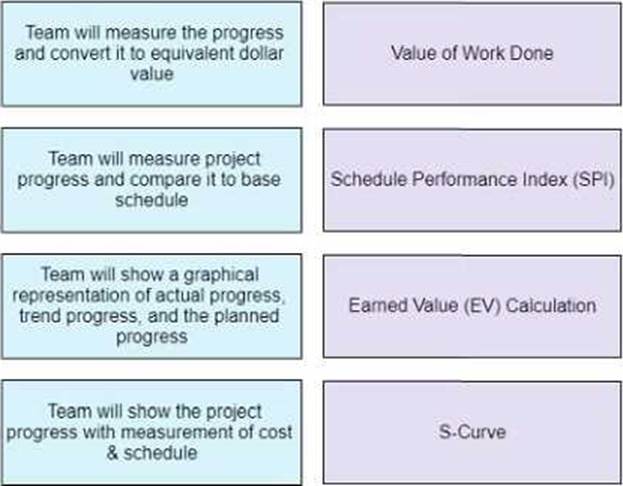
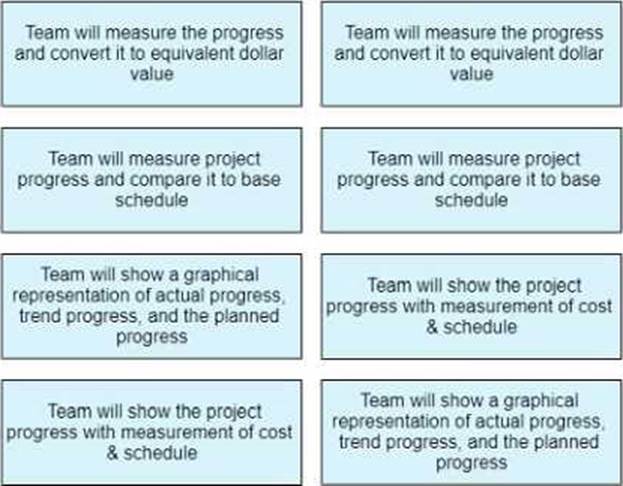
A project manager is managing a hybrid project. There is software in place to access the repository of project artifacts However a few stakeholders are reporting that they are unable to find the latest project schedule
What should the project manager do?
- A . Advise the project management office (PMO) that there is a resource gap for sharing project artifacts effectively
- B . Escalate the issue to the steering committee and ask them to deal with the stakeholders’ lack of training
- C . Make sure all stakeholders have access to the system and know where to find project artifacts
- D . Send the project schedule via email to the stakeholders who need that information
C
Explanation:
According to the PMBOK Guide, 7th edition, one of the principles of project management is to engage stakeholders1. This means that the project manager should communicate effectively with all stakeholders, provide them with relevant information, and address their needs and expectations. In a hybrid project, where some aspects of the project follow a predictive approach and others follow an adaptive approach, the project manager should use a combination of tools and techniques to manage the project artifacts2. One of these tools is a repository or a system that stores and organizes the project artifacts, such as the project schedule, for easy access and retrieval3. The project manager should ensure that all stakeholders have access to the repository and know how to use it to find the project artifacts they need. This will help to avoid confusion, duplication, and inconsistency of information, and to foster collaboration and transparency among the project team and other stakeholders. Therefore, the best answer is C.
Reference: 1: PMBOK Guide, 7th edition, page 9
2: PMBOK Guide, 7th edition, page 19
3: PMBOK Guide, 7th edition, page 97
: PMBOK Guide, 7th edition, page 98
A newly appointed product owner is working with a project team that is using agile for the first time. The product owner is constantly disrupting various team members throughout the day to discuss progress. This has resulted in the team feeling micromanaged and frustrated because of the constant disruptions.
How should the project manager proceed?
- A . Invite the product owner to attend daily standup meetings so they can assess progress.
- B . Set up a feedback session with the product owner once a week so they can assess progress.
- C . Instruct the team to refer the product owner to the project manager for information.
- D . Invite the product owner’s functional manager to a feedback session to escalate the issue.
A
Explanation:
The project manager should invite the product owner to attend daily standup meetings so they can assess progress. This is the best option because it allows the product owner to stay informed and involved in the project without disrupting the team members throughout the day. Daily standup meetings are a common agile practice that provide a brief and focused update on the project status, issues, and plans1. By inviting the product owner to these meetings, the project manager can address their concerns and expectations, as well as foster collaboration and trust between the product owner and the team. This option also aligns with the agile principle of "business people and developers must work together daily throughout the project"2.
The other options are not as effective as option A.
Option B is not frequent enough to satisfy the product owner’s need for information and involvement.
Option C is not collaborative and may create conflict between the product owner and the project manager.
Option D is not appropriate and may damage the relationship between the product owner and the team.
Reference: 1: PMBOK® Guide, 6th edition, page 540 2: Agile Manifesto, [Principles behind the Agile Manifesto]
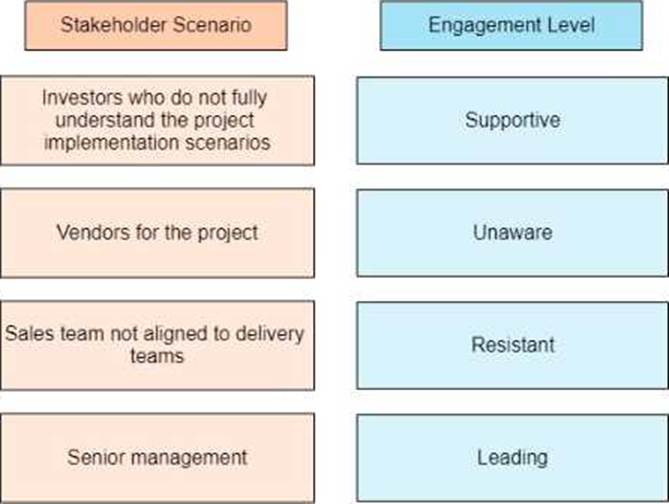
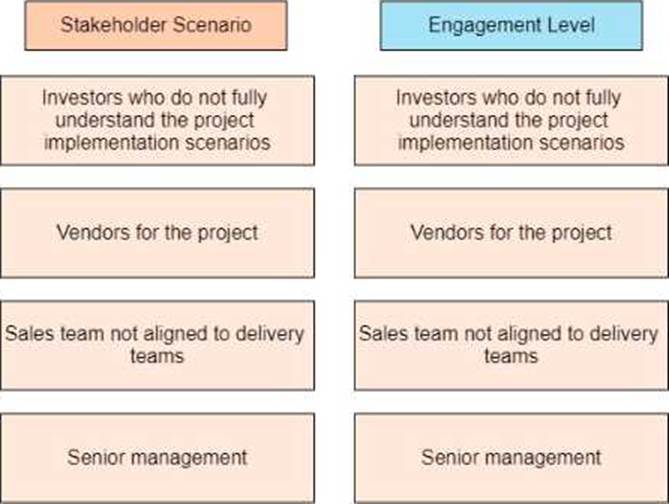
DRAG DROP
A project manager of a large company needs to categorize the stakeholders’ involvement at the beginning of a project initiated by the board of directors. The sales and delivery teams are internal teams.
Drag each stakeholder scenario on the left to the correct engagement level on the right.