
PMI PMP Practice Exams
Last updated on Oct 21,2026- Exam Code: PMP
- Exam Name: Project Management Professional
- Certification Provider: PMI
- Latest update: Oct 21,2026
A project manager is part of a team that is launching a series of features to comply with a new regulation. The team has only 6 weeks to release the features to the legacy applications. During the standup meeting, a software engineer indicated that the development of an important feature is on hold until the assigned designer completes a specific task. This delay is a serious road block to meeting the release date.
What should the project manager do?
- A . Contact the design team manager and ask to reconsider the priority list based on the latest situation,
- B . Meet with the designer to share the current status and develop a solution to complete the task.
- C . Meet with the design team manager to inform them of the current status and request an additional designer.
- D . Ask the software engineer to move forward without completing the important feature.
B
Explanation:
According to the Project Management Professional (PMP) principles, a project manager should actively engage with team members to identify and resolve issues. In this scenario, the project manager should meet with the designer to understand the challenges and work collaboratively to find a solution. This approach promotes open communication, problem-solving, and maintains the momentum of the project.
Reference: PMBOK® Guide C Sixth Edition, Section 9.5.2.1: Manage Team
A project manager has been assigned to a project where the budget is very tight. Incurring extra costs is not an option.
What should the project manager do to manage this situation?
- A . File a change request to make the customer billable for all extra costs incurred for the project.
- B . Ask the accounting department to forward all project expenses to the project manager’s email.
- C . Monitor the budget for the project continually and anticipate any issues if possible.
- D . Ask the project resources to finish their assignments in less time than originally planned.
C
Explanation:
In a situation where the budget is very tight, the best course of action for a project manager is to continuously monitor the project’s budget and anticipate potential issues. This proactive approach allows the project manager to identify and address any financial concerns early on, preventing them from escalating into more significant problems. It aligns with the PMBOK® Guide’s principles of cost management, which emphasize the importance of planning, estimating, budgeting, and controlling costs to ensure that the project can be completed within the approved budget1.
Reference: PMBOK® Guide C Sixth Edition and other standards within the Project Management Institute’s foundational standards1.
A project manager holds periodic progress review meetings to discuss issues.
What should the project manager do first on the agenda?
- A . Produce lessons learned documentation.
- B . Elaborate the risk mitigation strategy and risk register.
- C . Formulate project management plan integration.
- D . Update resolution approaches and action assignments.
D
Explanation:
In a progress review meeting, the primary focus is typically on assessing the current status of the project, including task updates, schedule status, budget status, quality/scope status, and any current or anticipated issues. The first item on the agenda should be to review the project’s status, milestones achieved, and challenges faced, as this sets the stage for the rest of the discussion.
Therefore, the most appropriate first agenda item from the given options would be:
D. Update resolution approaches and action assignments.
This choice aligns with the need to assess current project status and address any immediate actions that need to be taken to keep the project on track.
Reference: The information provided is in alignment with the general guidelines found within the PMBOK Guide and best practices for project management meetings. Specific Reference to the PMBOK Guide or Professional in Business Analysis materials cannot be provided.
A project manager is part of a balanced matrix project organization. The project manager will receive all work performance updates directly from the new sourcing department head who has no time to spare to give the project manager the information.
What should the project manager do?
- A . Request information directly from the sourcing department team members.
- B . Present the situation to the manager of the sourcing department head.
- C . Discuss the situation with the company project sponsor for advice.
- D . Work out a resolution in consultation with the sourcing department head.
D
Explanation:
In a balanced matrix organization, the project manager and the functional managers (such as the sourcing department head) share responsibility and authority. The project manager should work directly with the sourcing department head to find a solution that allows for the necessary information to be communicated in a way that fits within the constraints of the department head’s time. This collaborative approach is consistent with the principles of a balanced matrix organization, where both project and functional managers must work together to ensure project success.
Reference: This approach aligns with the PMBOK® Guide’s emphasis on the project manager’s role in communication and stakeholder engagement within a matrix organization12. It also reflects the project manager’s responsibilities to manage project communications effectively and to address issues proactively34.
The customer’s project manager changes during the final stage of a project.
How can the project manager avoid a project closure delay’
- A . Update the stakeholder engagement plan
- B . Review the latest project status report and update the stakeholders
- C . Escalate the case to the customer’s management team
- D . Issue the project payment invoice to the customer in advance
B
Explanation:
According to the PMBOK Guide, 7th edition, one of the principles of project management is to collaborate with stakeholders. This means that the project manager should maintain effective communication and engagement with the project stakeholders throughout the project life cycle, especially during changes and transitions. When the customer’s project manager changes during the final stage of a project, the project manager should review the latest project status report and update the stakeholders, including the new customer’s project manager, on the project progress, deliverables, issues, risks, and closure activities. This will help to ensure a smooth handover, alignment of expectations, and timely completion of the project closure process. The project manager should also seek feedback and confirmation from the stakeholders on the project outcomes and satisfaction.
Reference: PMBOK Guide, 7th edition, page 9, Principle 2: Collaborate with Stakeholders; page 31, Section 2.3.1, Project Stakeholders; page 41, Section 2.5.2.1, Project Status Report.
A project stakeholder complained that they did not receive an important delivery that was stated in the schedule. The team member responsible for this deliverable explained that they sent an email to the stakeholder, advising them that the deliverable would not be delivered on time.
What should the project manager have done to avoid this situation?
- A . Ensured that the team member did not communicate directly with the project stakeholder.
- B . Confirmed that the stakeholder was made aware of the delivery delay.
- C . Told the team member to send the unfinished deliverable to the stakeholder and finalize it later.
- D . Communicated with the stakeholder directly regarding the delivery delay.
D
Explanation:
According to the PMBOK® Guide, effective communication is crucial for project success. The project manager should ensure timely and appropriate generation, collection, dissemination, storage, and ultimate disposition of project information. This includes direct communication with stakeholders about any changes or delays in the project schedule. By communicating directly, the project manager can manage stakeholders’ expectations and maintain trust12.
Reference: Project Communications Management According to the PMBOK1; Project communicationCfoundation for project success2.
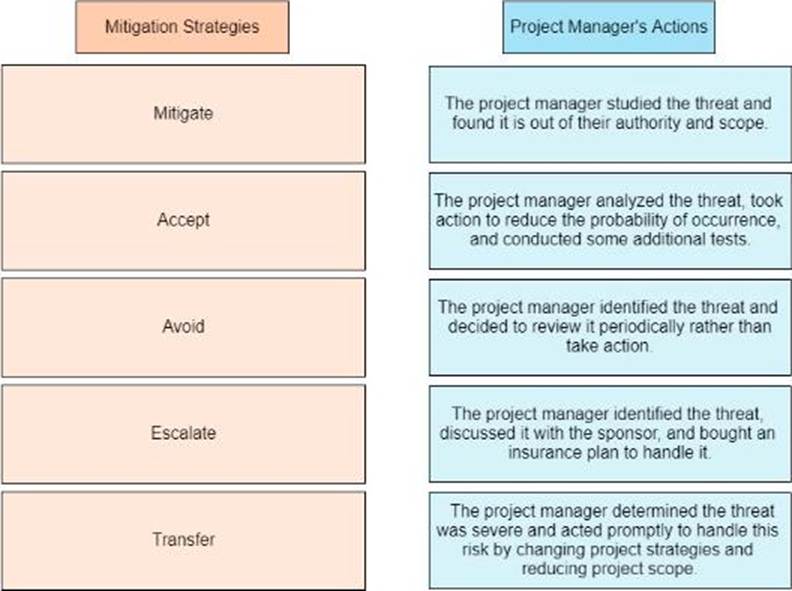
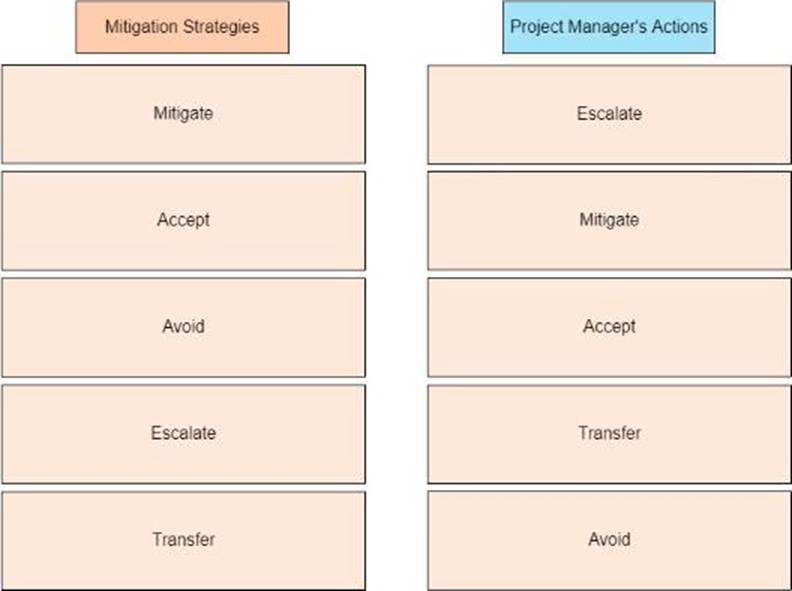
DRAG DROP
An experienced project manager is overseeing a merger and acquisition project. The project manager reacted differently to different threats identified on the project
Drag the mitigation strategy on the left to the project manager’s actions on the right
An agile project is in the seventh iteration with multiple changes being accommodated from the project start due such as regulatory changes technological innovations market competition and other changes.
What should the project manager do to manage these continuous changes coming into the project?
- A . Ask the product owner to stop accommodating further changes to the scope
- B . Leverage the product owner to monitor the external environment
- C . Accommodate the critical and urgent changes in the current iteration
- D . Suggest to the product owner to execute the changes in a separate project
C
Explanation:
Agile project management is designed to handle continuous changes. The agile approach allows for flexibility and adaptability, making it well-suited to projects where the environment is dynamic and changes are frequent2. In an agile project, changes are not seen as disruptions but as opportunities for improvement1. Therefore, the project manager should accommodate critical and urgent changes in the current iteration. This approach allows the team to respond to changes in a timely manner and ensures that the product or service being developed remains relevant and valuable1.
Reference: Agile Change Management: Overview, Principles, Best Practices, 10 Steps to Introduce Change Management into Agile Projects
A company has a transformation project in progress. During a planning session, several stakeholders are in constant disagreement and often use personal arguments to support their position. Team members are getting frustrated with the situation.
What should the project manager have done to avoid this situation?
- A . Established ground rules before the discussion had started.
- B . Asked stakeholders not to voice their opinions during the meeting.
- C . Invited a high-level sponsor to the meeting to reduce the level of disagreement.
- D . Reinforced that higher-level management has the decision power.
A
Explanation:
The project manager should have established ground rules before the discussion started. Ground rules are essential in any meeting to ensure that everyone understands the expectations and guidelines for the meeting. They help to manage the behavior of the participants and prevent personal arguments. Ground rules could include respecting others’ opinions, avoiding personal attacks, and focusing on the issue at hand. By setting these rules, the project manager could have prevented the situation where stakeholders were in constant disagreement and using personal arguments to support their position1234.
Reference: https://www.apm.org.uk/blog/secrets-of-successful-stakeholder-management-as-a-project-manager/
https://www.teamgantt.com/guide/stakeholder-management
A new project manager is managing a hybrid project. The project manager wants to be a servant leader to support the team by removing impediments but is not receiving feedback from the team about the issues and risks they are facing.
What should the project manager do?
- A . Implement daily standups where the team can share their impediments, risks, and issues.
- B . Review the communications management plan and implement changes.
- C . Schedule weekly risk review meetings with the team to review project risks and concerns.
- D . Distribute a copy of the communications management plan to the scrum master.
A
Explanation:
According to the PMBOK Guide, servant leadership is a key aspect of agile project management. It is a leadership style where the leader, rather than seeking to be served, prioritizes the needs and development of their team members1. Servant leaders help their teams to self-organize, collaborate, and adapt to changing requirements and environments2. One of the practices that support servant leadership in agile project management is the daily standup, also known as the daily scrum. It is a short, time-boxed meeting where the team members synchronize their work and plan for the next 24 hours. The daily standup also provides an opportunity for the team members to share their impediments, risks, and issues, and for the servant leader to facilitate the removal of those obstacles34. By implementing daily standups, the project manager can foster a culture of transparency, feedback, and continuous improvement among the team members, and help them achieve their project goals more effectively and efficiently5.
Reference: 1: PMBOK Guide, 7th edition, page 55 2: A Little Bit of Both1 3: Guide on Servant Leadership in Agile Project Management3 4: 7 Traits of Servant Leadership in Agile Project Management4 5:
How to create a project management communication plan5