
PMI PMP Practice Exams
Last updated on Oct 22,2026- Exam Code: PMP
- Exam Name: Project Management Professional
- Certification Provider: PMI
- Latest update: Oct 22,2026
A project manager has recently been assigned to an agile project and discovers that a contractor for the project does not have any experience with agile.
What should the project manager do?
- A . Ask the project sponsor to replace the contractor since they do not have agile experience
- B . Issue a formal notice to the contractor to obtain an agile certification
- C . Consult the project team to understand the extent of the training needs for the contractor
- D . Instruct the contractor to receive agile training since the project has already started
C
Explanation:
The project manager should consult the project team to understand the extent of the training needs for the contractor. This is consistent with the agile value of individuals and interactions over processes and tools1. The project manager should also collaborate with the contractor to provide them with the necessary guidance and coaching on the agile principles and practices2. Asking the project sponsor to replace the contractor since they do not have agile experience (A) is not a good option since it may cause unnecessary delays and costs for the project. Issuing a formal notice to the contractor to obtain an agile certification (B) is also not appropriate since it may create a sense of distrust and resentment in the contractor. Instructing the contractor to receive agile training since the project has already started (D) is not a sufficient action since it does not address the specific needs and expectations of the project team and the contractor.
Reference: 1: Agile Practice Guide, Chapter 1, Section 1.2.1
2: Agile Practice Guide, Chapter 2, Section 2.3.2.2
A company has always acquired very specialized services from local companies for its projects. During the planning stage for a regulatory project, the project manager is informed that local vendors would not be able to operate due to an unexpected major event. There is an option to hire the same services from companies in other countries.
What should the project manager do in this situation?
- A . Plan to execute the procurement tasks in a virtual environment.
- B . Review organizational process assets (OPAs) for similar projects.
- C . Create a change request to extend the duration of the project.
- D . Ask the project sponsor to put the project on hold.
A
Explanation:
According to the PMBOK Guide, a project manager should plan to execute the procurement tasks in a virtual environment, when faced with the situation of local vendors being unavailable and having the
option to hire the same services from companies in other countries. This is part of the plan procurement management process, which involves determining the project procurement strategy, the types of contracts, the procurement documents, the source selection criteria, and the procurement management plan. A virtual environment is one where the project team and the vendors communicate and collaborate using technology, such as online platforms, video conferencing, cloud computing, etc. A virtual environment can enable the project manager to access a wider pool of potential vendors, reduce travel costs and time, and increase flexibility and efficiency. However, a virtual environment also poses some challenges, such as cultural differences, legal issues, security risks, communication barriers, and quality control. Therefore, the project manager should plan the procurement tasks carefully, considering the project objectives, the stakeholder expectations, the project risks, and the best practices for managing virtual teams and vendors.
Reference: PMBOK Guide, 6th edition, pages 459-460, 471-472.
A stakeholder is requesting that the project manager share project status updates on a regular basis. This stakeholder is not included in the regular distribution list.
What should the project manager do?
- A . Start sending status updates to this stakeholder based on the request.
- B . Ask the stakeholder’s manager if the stakeholder can be added to the list.
- C . Review the stakeholder engagement and communications management plans.
- D . Escalate the stakeholder’s request to the project sponsor.
C
Explanation:
According to the PMBOK Guide, the stakeholder engagement plan and the communications management plan are two key project documents that guide the project manager on how to manage stakeholder expectations and communicate project information. The stakeholder engagement plan identifies the stakeholder needs, interests, and level of engagement, and defines the strategies and actions to increase their support and minimize their resistance. The communications management plan specifies the communication requirements, methods, frequency, and formats for each stakeholder or stakeholder group. The project manager should review these plans to determine if the stakeholder requesting the status updates is appropriately engaged and informed, and if any changes are needed to accommodate the request. Reviewing the stakeholder engagement and communications management plans is the best action that the project manager should take in this situation. Starting to send status updates to this stakeholder based on the request (A) may not be appropriate or feasible, as it may violate the communication protocols, overload the stakeholder with unnecessary information, or create inconsistencies with other stakeholders. Asking the stakeholder’s manager if the stakeholder can be added to the list (B) may not be necessary or effective, as it may bypass the stakeholder’s own preference, authority, or influence, or create conflict with the stakeholder’s manager. Escalating the stakeholder’s request to the project sponsor (D) may not be warranted or advisable, as it may indicate a lack of project management skills, create unnecessary involvement of the project sponsor, or damage the relationship with the stakeholder.
Reference: PMBOK Guide, 6th edition, pages 513-514, 537-538.
A project manager has begun a complex oil refinery project. Although the project is in the initiation phase, the sponsor keeps asking for concrete dates for the most important project milestones.
When will the project manager be able to provide the requested information?
- A . During the planning phase, when processes for scope definition and activity duration and sequencing will be performed
- B . As soon as possible, as project delays can be significantly avoided when a schedule is developed early
- C . Close to the end of the project, as the forecasts will be more accurate and most risks will already be mitigated
- D . In the initiation process, as it happens concurrently with the project contract and project charter creation
A
Explanation:
The planning phase is the stage where detailed project planning occurs, including the development of schedules, timelines, and milestones. According to the PMBOK® Guide, during the initiation phase, the project manager works with stakeholders to define the project at a high level. Concrete dates for the most important project milestones are typically established during the planning phase, as this is when the project’s scope, activities, resources, and timelines are defined in detail12.
Reference: Project Management Institute. (2017). A Guide to the Project Management Body of Knowledge (PMBOK® Guide) C Sixth Edition.
Project Management Articles. (2023). 5 Phases of Project Management Life Cycle | Complete Guide2.
During the sprint planning of a project, the team members have a disagreement about the comparative size of the backlog items and if they would fit into the next sprint.
Considering a hybrid approach, what should the project manager do?
- A . Ask an external technical leader to provide input and plan the sprint.
- B . Remove the items from the product backlog since the size couldn’t be estimated.
- C . Make the decision about the backlog items based on what makes more sense.
- D . Facilitate the discussion so that the team members can reach a consensus.
D
Explanation:
A hybrid approach in project management is a technique that combines elements from different project management frameworks, such as waterfall and agile, to tailor the methodology to best suit the project at hand12. By merging various methods, organizations can capitalize on the strengths of each approach while mitigating their weaknesses3. A hybrid approach allows for a more detailed and nuanced approach to the work, and requires the project manager to facilitate the collaboration and communication among the team members45. Therefore, the best option for the project manager in this scenario is to facilitate the discussion so that the team members can reach a consensus on the comparative size of the backlog items and if they would fit into the next sprint. This way, the project manager can ensure that the team is aligned on the approach, the customer needs are met, and the project goals are achieved.
During an agile team retrospective, a project team member mentions that the code quality is degrading, which might result in future rework that
could become unmanageable with time.
What should the project manager do?
- A . Help the team create the definition of done (DoD) to improve delivery quality.
- B . Add testing items to the backlog to assess quality periodically.
- C . Expand the team in order to improve the quality of the project.
- D . Compare the cost of improving quality against the cost of failure and adjust the budget.
A
Explanation:
In an agile team retrospective, when a concern about degrading code quality is raised, it is essential for the project manager to address this issue proactively to prevent future rework and maintain the project’s manageability. The most effective action the project manager can take is to help the team create or refine the Definition of Done (DoD). The DoD is a clear and concise list of criteria that outlines when a task, user story, or feature is considered complete. It ensures that all team members have a shared understanding of what is required for a piece of work to be ready for delivery, which includes meeting the quality standards.
By focusing on the DoD, the team can improve its delivery quality by making sure that all aspects of code quality are addressed before a task is marked as done. This approach promotes better quality assurance practices and reduces the likelihood of defects and technical debt accumulating over time, which aligns with the core agile principles of transparency, learning, and iteration. It also encourages continuous improvement and helps the team to deliver high-quality increments consistently.
Reference: (Based on best practices in agile methodologies and the importance of a well-defined DoD as part of the agile framework.)
A company is transitioning from a predictive to agile delivery of projects. Based on the requirements, the project team estimates the budget and decides to use a fixed-price contract with its vendor. However, during the execution of the project, the requirements evolve and priorities start to change constantly, which puts the project and the estimate at completion (EAC) off by 40%.
What should the project manager do next?
- A . Send a detailed status report highlighting the issue with funding to all of the stakeholders.
- B . Submit a change request to the financial manager to increase the funding and continue as is.
- C . Meet with the stakeholders to recommend the use of a time and materials (T&M) contract to address the problem.
- D . Wait until the next gate review meeting to highlight the risk of low funds to the stakeholders.
C
Explanation:
The project manager should meet with the stakeholders to recommend the use of a time and materials (T&M) contract to address the problem, as this type of contract is more suitable for agile projects that have changing requirements and priorities. A T&M contract allows the buyer to pay the seller based on the actual hours of work and the cost of materials, rather than a fixed price. This can provide more flexibility and adaptability for the project, and reduce the risk of budget overrun. The other options are not as effective or appropriate as recommending a T&M contract. Sending a detailed status report may inform the stakeholders of the issue, but it does not propose a solution.
Submitting a change request may increase the funding, but it does not address the root cause of the problem, which is the mismatch between the contract type and the project approach. Waiting until the next gate review meeting may delay the resolution of the problem, and increase the likelihood of further deviation from the EAC.
Reference: PMBOK Guide, 7th edition, page 163
PMI-PBA Exam Content Outline, 2018, page 10
PMP question 391
According to this burnup chart for the last 7-day sprint, what should the project lead address with the product owner and team?
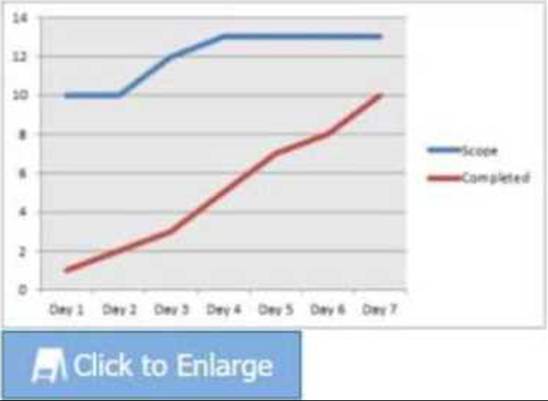
- A . The product owner should not ask the team to change their sprint commitments.
- B . The team is accepting too much work in the sprint after it has started.
- C . The team is not meeting the expectations of the product owner.
- D . The team should have stopped on day 4 and started a new sprint.
C
Explanation:
The burnup chart indicates that the “Completed” work is trailing behind the “Scope,” suggesting that the team is not meeting the expectations set by the product owner. This discrepancy can be due to various factors such as underestimation of tasks, unforeseen challenges, or scope changes. It’s important for the project lead to address this with the product owner and team to realign expectations, reassess the workload, and implement corrective actions to ensure that project goals are met within the sprint timeframe.
Reference: A Guide to the Project Management Body of Knowledge (PMBOK® Guide)
The PMI Guide to Business Analysis
Business Analysis for Practitioners: A Practice Guide12345.
A project manager and project team are developing a strategic approach to engage the internal and external stakeholders.
Which approach should be followed?
- A . Schedule status meetings with all stakeholders to allow their participation in all project discussions and reports.
- B . Analyze both internal and external stakeholders and develop a customized engagement strategy for each stakeholder.
- C . Involve only the internal stakeholders, as the external stakeholders should not have access to confidential information.
- D . Classify all high-risk stakeholders and request that the project sponsor communicate directly with them.
B
Explanation:
The best approach to engage stakeholders in a project is to analyze both internal and external stakeholders and then develop a tailored engagement strategy for each one. This is because stakeholders have varying levels of interest, influence, and impact on the project, which necessitates a customized approach to ensure effective engagement and communication. The PMBOK® Guide emphasizes the importance of identifying stakeholders and understanding their needs and expectations as a foundation for developing an appropriate engagement strategy. This strategy should be designed to involve stakeholders in a manner that is aligned with their level of interest and influence over the project outcomes.
Effective stakeholder engagement is crucial for project success as it helps in building trust, ensuring clear communication, and fostering collaboration among all parties involved. It also aids in managing expectations and mitigating potential risks associated with stakeholder interactions. By engaging stakeholders appropriately, the project manager and team can leverage their support and contributions, which can be vital for the successful delivery of the project.
Reference: Based on the principles outlined in the PMBOK® Guide and the standards for stakeholder engagement as described in PMI’s resources1234.
While developing a new product, a key stakeholder expresses concern about insufficient information on product feature requirements. The product team disagrees and mentions that detailed requirements have been provided.
What should the project manager do to handle this situation?
- A . Organize a discussion with the product team to clarify the missing information.
- B . Redirect the stakeholder to discuss this request with the functional manager.
- C . Record the new requirements and ask the product team to develop them.
- D . Conduct new risk and scope analyses, identifying the missing information.
A
Explanation:
The project manager should organize a discussion with the product team to clarify the missing information and resolve the discrepancy between the stakeholder’s expectations and the product team’s deliverables. The project manager should facilitate effective communication and collaboration among the project team and the stakeholder, and ensure that the product feature requirements are clear, complete, and consistent. Redirecting the stakeholder to discuss this request with the functional manager may not be helpful, as it may create confusion and conflict among the project parties. Recording the new requirements and asking the product team to develop them may not be feasible or appropriate, as it may introduce unnecessary changes and rework to the project scope. Conducting new risk and scope analyses, identifying the missing information may not be necessary or sufficient, as it may not address the root cause of the stakeholder’s concern and the product team’s disagreement.
Reference: A Guide to the Project Management Body of Knowledge (PMBOK® Guide) C Seventh Edition, Chapter 13: Stakeholder Engagement, Section 13.3: Manage Stakeholder Engagement, Section 13.4: Monitor Stakeholder Engagement
Professional in Business Analysis (PMI-PBA)® Handbook, Section 2.3: Domains and Tasks, Domain 4: Analysis, Task 8: Manage Solution Scope
Professional in Business Analysis (PMI-PBA)® Examination Content Outline, Domain 4: Analysis, Task 8: Manage Solution Scope