
PMI PMP Practice Exams
Last updated on Oct 22,2026- Exam Code: PMP
- Exam Name: Project Management Professional
- Certification Provider: PMI
- Latest update: Oct 22,2026
Two functional managers disagree on key features of one deliverable during the planning of a project. The project manager discovers that each manager included requirements that contradict each other. The functional managers do not want to meet with each other to find a solution This situation has been escalated to the sponsor who requests a meeting with them
What strategy should the project manager use to resolve this conflict in the meeting?
- A . Explain to the managers that the contradicting requirements are being considered for implementation in the project
- B . Explain to the managers that only one of the two requirements can be implemented, and submit a change request,
- C . Ensure that both managers understand the requirements and search for a solution that best satisfies this deliverable
- D . Request that the managers explain why each requirement must be implemented and decide by considering the cost and benefits
C
Explanation:
The project manager should use a collaborative or problem-solving strategy to resolve this conflict in the meeting. This strategy involves finding a solution that fully satisfies the concerns of both parties and results in a win-win outcome. The project manager should ensure that both managers understand the requirements and the impact of their contradiction on the project scope, quality, and schedule. The project manager should also facilitate a constructive dialogue between the managers and help them identify and evaluate alternative solutions that can meet the project objectives and satisfy the stakeholders. The project manager should avoid imposing a decision or favoring one side over the other, as this may lead to resentment, resistance, or further conflict.
Option A is not a good choice, because it does not address the root cause of the conflict or seek a resolution. It may also create confusion, ambiguity, or inconsistency in the project deliverable, as well as increase the project risk and complexity.
Option B is not a good choice, because it does not involve the managers in finding a solution or consider their interests and needs. It may also create dissatisfaction, frustration, or hostility among the managers, as well as affect the project quality and stakeholder satisfaction.
Option D is not a good choice, because it does not foster a cooperative or integrative approach to resolving the conflict. It may also create a competitive or adversarial atmosphere in the meeting, as well as ignore the non-monetary or intangible factors that may influence the managers’ pReference and expectations.
Reference: 1: Project Management Professional (PMP)® Certification 2: A Guide to the Project Management Body of Knowledge (PMBOK® Guide) C Seventh Edition
What should an agile lead do lo ensure their team is set up for success?
- A . Pay attention to team dynamics and understand that coaching is done simultaneously at an individual and whole-team level
- B . Schedule sprint meetings and coaching sessions to discuss project-related information
- C . Plan quarterly informal meetings or team bonding sessions to encourage the team to work together
- D . Document team tasks and challenges in order to understand when to step in and help a member of the team
A
Explanation:
In Agile project management, the Agile lead, often referred to as the Scrum Master, plays a crucial role in ensuring the success of the team. This involves paying close attention to team dynamics and understanding that coaching is done simultaneously at an individual and whole-team level. The Agile lead needs to be aware of the strengths and weaknesses of each team member, as well as the team as a whole, to effectively guide them towards achieving their goals. This approach allows for continuous improvement and adaptation, which are key principles of Agile methodologies.
Reference: Project Management Professional (PMP) Reference Materials and
Professional in Business Analysis Reference Materials
HOTSPOT
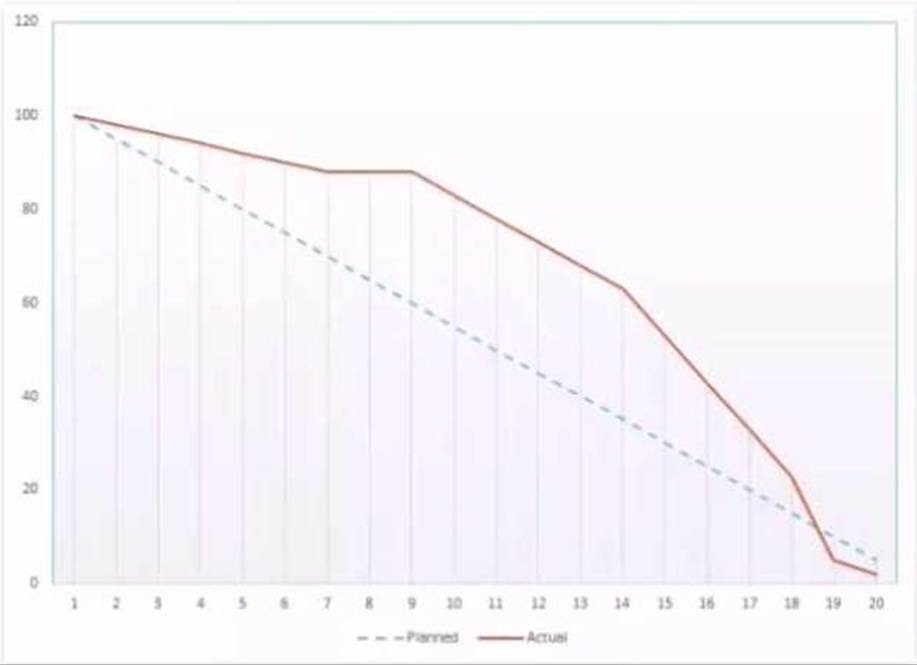
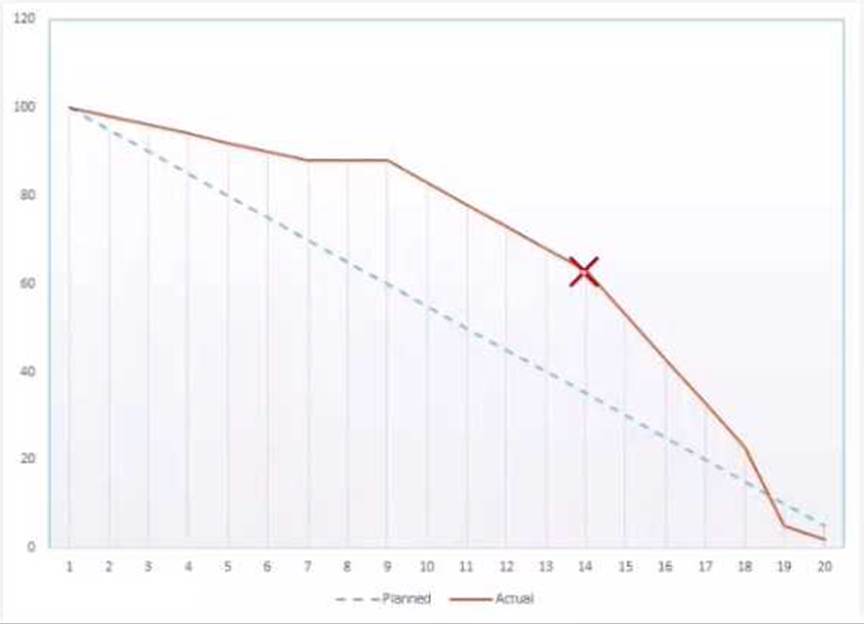
An agile team is conducting a sprint retrospective and wants to focus on the practices that allowed them to recover after a bad start Please click on the area of the burndown chart that the team should focus on.
A critical project milestone was missed because one of the team members did not complete their tasks on time. This resulted in a heated discussion during a demonstration for the end users.
What should the project manager do next?
- A . Discuss the issue with the team member in a one-on-one meeting.
- B . Ask the team member to justify the delay during a team meeting.
- C . Review the human resources (HR) policies for relevant corrective actions.
- D . Escalate the performance issue to the team member’s functional manager.
A
Explanation:
When a project milestone is missed due to a team member not completing their tasks on time, it is important for the project manager to address the issue directly with the individual involved. A one-on-one meeting allows for a private discussion where the project manager can understand the reasons behind the delay, provide feedback, and work with the team member to develop a plan to prevent future issues. This approach is aligned with the best practices for project human resource management, which emphasize the importance of clear communication and problem-solving within the project team.
Reference: The PMP Examination Content Outline1 and the PMBOK Guide2 highlight the importance of project communication and human resource management. The Professional in Business Analysis Reference Materials also suggest direct engagement with team members to address project challenges3.
A project manager is working as a servant leader for a pilot project to adopt agile practices. After three sprints, the team demos the product to the main stakeholders, but receives negative feedback about the product’s features. The team feels that all the features met the acceptance criteria defined by the product owner and does not understand what went wrong.
How should the project manager mitigate the product rejection?
- A . Share the product backlog for the main stakeholders to review in advance.
- B . Engage the main stakeholders in the upcoming sprint review sessions.
- C . Create dedicated sprints to implement feature fixes for the rejected ones.
- D . Ask the project sponsor to evaluate the assignment of a new product owner.
B
Explanation:
Engaging the main stakeholders in the sprint review sessions is a key agile practice to ensure continuous collaboration and feedback. It allows stakeholders to provide input and clarifications, ensuring that the product evolves to meet their needs and expectations. This approach aligns with the agile principle of customer collaboration over contract negotiation and promotes transparency and adaptability.
Reference: The PMI Guide to Business Analysis1, which includes. The Standard for Business Analysis, and the PMBOK® Guide2 both emphasize the importance of stakeholder engagement and collaboration throughout the project lifecycle.
A project manager is leading a project team composed of members with varying levels of knowledge and experience. Some are experts and some have less than 1 year of experience. The project schedule was approved by the steering committee.
What should the project manager do?
- A . Ask the less-experienced members to perform tasks exactly as they are instructed by the experienced members.
- B . Ask each experienced member to be the mentor to one of the less-experienced members.
- C . Ask the more experienced members to review all of the tasks performed by the less-experienced members.
- D . Ask the resource manager to replace the less-experienced members with more experienced team members.
B
Explanation:
Mentoring is a recognized approach for enhancing the skills of less-experienced team members. It allows for knowledge transfer and provides the less-experienced members with guidance and support as they grow into their roles. This approach aligns with the PMI’s emphasis on team development and the value of leveraging the collective knowledge of the team. By pairing less-experienced members with mentors, the project manager can foster a collaborative environment where all team members can contribute effectively while learning from one another.
Reference: The answer is supported by best practices in team management and development, which are part of the PMI’s standards for project management and business analysis. While the PMI does not prescribe a specific action in this scenario, the principles of team development and knowledge sharing are consistent with PMI’s guidance on effective project management and business analysis practices12.
A company’s leadership team has decided to invest in a new product using an agile approach. The commercial and product teams have started the planning activity for this new venture.
Which three key factors does the project manager need in order to deliver this product? (Choose 3)
- A . High-level product backlog
- B . Key performance indicators (KPls)
- C . Product vision
- D . Schedule performance indexes (SPIs)
- E . Product roadmap
A C E
Explanation:
According to the PMBOK Guide, when using an agile approach, the project manager needs to have a clear understanding of the product vision, the product roadmap, and the product backlog1. The product vision is a brief statement that describes the desired outcome of the project and the value it will deliver to the customers and stakeholders2. The product roadmap is a high-level overview of the product features and deliverables, along with the planned timeline and milestones3. The product backlog is a prioritized list of the product requirements, user stories, and other work items that need to be completed by the project team. These three factors help the project manager to align the project objectives with the customer needs, plan and execute the project iteratively and incrementally, and deliver value early and often1. The other options are not relevant for an agile approach, as they are more suitable for a predictive or waterfall approach. Key performance indicators (KPIs) are metrics that measure the performance of the project against the project objectives. Schedule performance index (SPI) is a ratio of the earned value to the planned value, indicating how well the project is progressing according to the schedule. These factors are not essential for delivering a product using an agile approach, as they focus more on the adherence to the plan rather than the delivery of value.
Reference: 1: PMBOK Guide, 6th edition, page 18
2: PMBOK Guide, 6th edition, page 156
3: PMBOK Guide, 6th edition, page 157
: PMBOK Guide, 6th edition, page 158
: PMBOK Guide, 6th edition, page 33
: PMBOK Guide, 6th edition, page 267
The vendor for a new IT data center project failed to follow the required cabling standards as stated in the requirements specification. The infrastructure manager and vendor were involved in an argument about the issue.
What should the project manager do to resolve and prevent additional arguments?
- A . Monitor the interactions between the vendor and infrastructure manager going forward.
- B . Host a meeting with the vendor and infrastructure manager to help resolve their disagreement.
- C . Escalate the issue to the sponsor so appropriate action can be taken.
- D . Instruct the vendor to correct the problem without additional arguments.
B
Explanation:
According to the PMBOK Guide, 6th edition, section 13.3.2.4, the project manager should use interpersonal and team skills to manage conflicts and foster collaboration among stakeholders. Hosting a meeting is an example of such a skill, as it allows the project manager to facilitate communication, negotiation, and problem-solving between the parties involved. The project manager should also use the requirements traceability matrix, the project management plan, and the project documents to clarify the expectations and responsibilities of the vendor and the infrastructure manager. The PMI-PBA Guide, section 6.2.3.1, also supports this approach, as it states that the business analyst should use collaboration techniques to resolve issues and conflicts related to requirements.
Reference: PMBOK Guide, 6th edition, section 13.3.2.4
PMI-PBA Guide, section 6.2.3.1
A project manager receives a voicemail from a business analyst on the project team. The business analyst indicates that an internal stakeholder is upset that they were not included before the project began. The stakeholder is asking for an addition to the requirements traceability matrix
What should the project manager do to improve the stakeholder relationship?
- A . Consult the project scope document to make sure the addition is in scope.
- B . Update the stakeholder engagement plan to ensure the stakeholder is included in the project stakeholder list
- C . Initiate a project change request so the change control board (CCB) can decide if it is in scope.
- D . Engage the stakeholder to solicit more information before responding to the request
D
Explanation:
In an agile environment, integration is not a separate phase that happens at the end of the project, but rather a continuous activity that happens throughout the project. Integration involves combining the work of different teams or individuals into a coherent whole that meets the customer needs and expectations. Frequent and continuous integration of work allows the project team to obtain early feedback, identify and resolve issues, and learn from the results. This helps to improve the quality, performance, and value of the product, and to reduce the risk of rework, delays, and defects. Therefore, the project manager should have ensured frequent and continuous integration of work to avoid the integration issues and the decline in the product release progress. The other options are not as effective or appropriate as frequent and continuous integration. Forming a separate quality assurance team to test all items at the end of each sprint would create silos, delays, and dependencies, and would not foster collaboration and ownership among the teams. Performing a Scrum of Scrums on a regular basis to help the teams remove impediments would be a good practice, but it would not address the integration issues directly, and it would depend on the frequency and quality of the communication and coordination among the teams. Arranging an online session on the integration concept and suggesting tools to the teams would be helpful, but it would not ensure that the teams actually integrate their work frequently and continuously, and it would not provide feedback and learning opportunities.
Reference: Agile Practice Guide, 1st edition, Chapter 3.4.2, 3.5.2, PMBOK Guide, 6th edition, Chapter 4.4.2, 4.6.2