
PMI PMP Practice Exams
Last updated on Oct 22,2026- Exam Code: PMP
- Exam Name: Project Management Professional
- Certification Provider: PMI
- Latest update: Oct 22,2026
A project manager has been assigned to a high-visibility project that has been identified as having medium complexity, based on previous similar projects. The project needs to be delivered to the customer as a ready-to-use product.
Based on this scenario, what should the project manager focus on throughout the project life cycle?
- A . Resource management and lessons learned
- B . Time management and stakeholder engagement
- C . Cost management and risk management
- D . Stakeholder engagement and lessons learned
B
Explanation:
A high-visibility project with medium complexity requires careful time management to ensure that the project is delivered on schedule. The project manager should focus on planning, setting deadlines, and monitoring project progress1. Stakeholder engagement is also crucial in this scenario. The project manager needs to communicate effectively with all stakeholders to understand their expectations and keep them informed about the project’s progress23. This includes initiating regular status meetings and developing a clear communication protocol4.
Reference: Coursera,. The Digital Project Manager, Adobe, Project Central, Microsoft
DRAG DROP
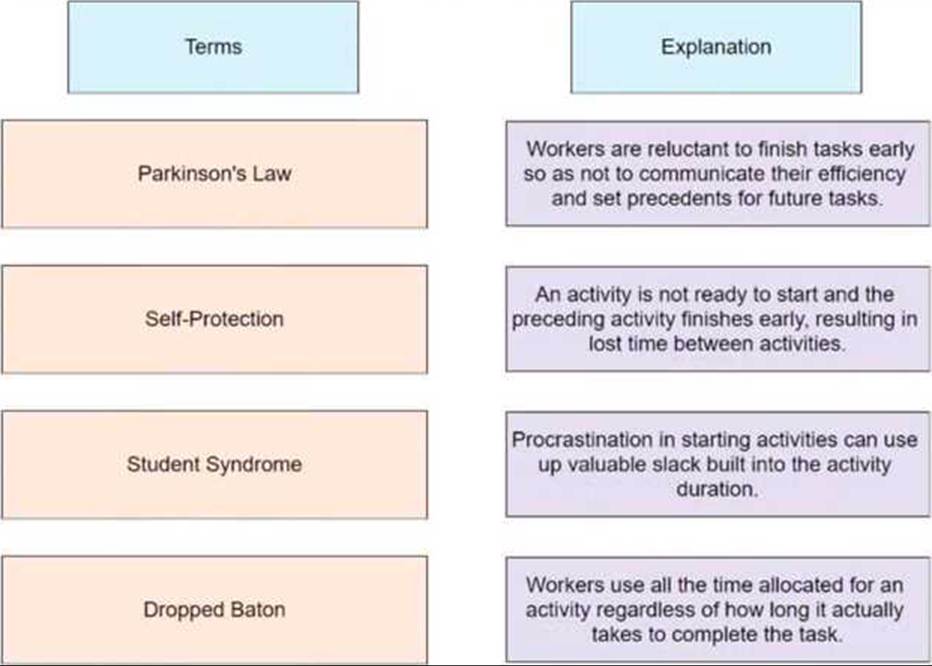
A project team has developed the initial schedule using a network diagramming method and has arrived at the overall project duration. Upon examining the schedule, the project manager finds that there are several activities that may require buffers to mitigate or eliminate potential scheduling conflicts.
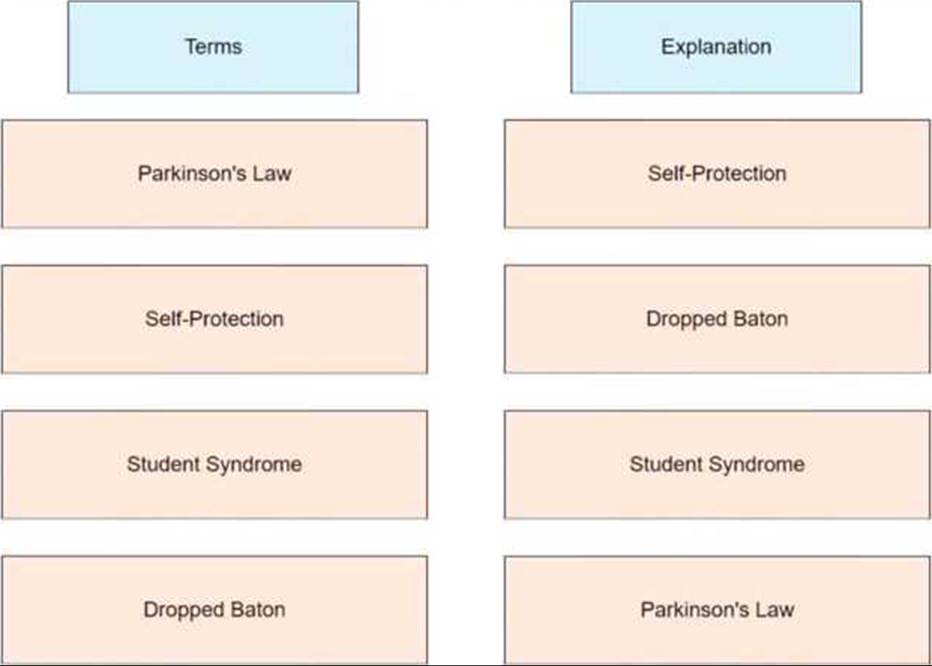
Match the following common terms with their explanations that evaluate the buffers or constraints.
Explanation:
1- Self Protection
2- Dropped Baton
3- Student Syndrome
4- Pankinsons law
A project manager has been assigned to lead a project to deploy a new system. The stakeholders disagree on the project objectives and approach.
What should the project manager do?
- A . Create a roles and responsibilities matrix based on the project charter and ask the sponsor to share it with all stakeholders to provide credible authority
- B . Conduct scoping workshops with the project team to create a work breakdown structure (WBS), assign tasks to various entities share this with all stakeholders, and ask the team to complete their tasks as scheduled
- C . Conduct a general meeting with all stakeholders and review and address a list of activities for each of them
- D . Breakdown the situation to identify the root causes for the disagreement and then work with each stakeholder and participating entity on their exact roles and responsibilities
D
Explanation:
The correct answer is D. According to the PMBOK® Guide, the project manager should manage stakeholder expectations and engagement by applying appropriate tools and techniques, such as stakeholder analysis, communication management, conflict resolution, and negotiation1. The project manager should also use the project charter as a reference document to clarify the project objectives, scope, and deliverables2. By breaking down the situation and identifying the root causes for the disagreement, the project manager can address the underlying issues and concerns of each stakeholder and align them with the project vision and goals. The project manager can then work with each stakeholder and participating entity on their exact roles and responsibilities, and ensure that they are committed and supportive of the project.
Reference: 1: PMBOK® Guide, page 513-514; 2: PMBOK® Guide, page 77-78
As a result of the first iteration review, the stakeholders’ feedback indicated that they saw more technical features than business ones.
What should the project manager do?
- A . Include this topic in the next iteration retrospective
- B . Review this topic with the product owner before the next iteration planning
- C . Discuss this topic with the team in the next daily meeting
- D . Ask the product owner to review this topic in the next iteration planning
B
Explanation:
When stakeholders’ feedback indicates that they saw more technical features than business ones, it’s important for the project manager to review this topic with the product owner before the next iteration planning12. The product owner is responsible for maximizing the value of the product resulting from the work of the development team2. They are the ones who understand the needs of the stakeholders and can prioritize the features accordingly2. By discussing the feedback with the product owner, the project manager can ensure that the next iteration focuses more on the business features that the stakeholders want to see12.
Reference:
How to Collect Feedback from Stakeholders Effectively | Mural, 11 Effective Stakeholder Management Strategies – Float
In a construction project for a new building, the project manager decides to apply agile principles for the building foundation phase While evaluating the project schedule with the team, the project manager believes that the estimates are inaccurate.
How should the project manager address this issue?
- A . Create a product backlog
- B . Perform sprint reviews with the team
- C . Assess the previous project velocity
- D . Reduce the story size by splitting stories
D
Explanation:
According to the Agile Practice Guide, one of the agile principles is to deliver working software frequently, from a couple of weeks to a couple of months, with a preference to the shorter timescale1. To achieve this, the project manager should break down the work into small and manageable pieces, called stories, that can be completed within a short iteration, called a sprint. This will help to improve the accuracy of the estimates, the quality of the deliverables, and the feedback from the customer. Therefore, the project manager should reduce the story size by splitting stories that are too large or complex into smaller and simpler ones. Creating a product backlog may be a good practice, but it is not the best answer. The product backlog is a list of features or requirements that the customer wants in the final product. It does not address the issue of inaccurate estimates or large stories. Performing sprint reviews with the team may be a useful activity, but it is not a preventive measure. The sprint review is a meeting at the end of each sprint where the team demonstrates the completed stories to the customer and collects their feedback. It does not address the issue of inaccurate estimates or large stories before the sprint starts. Assessing the previous project velocity may be helpful, but it is not sufficient to address the issue. The project velocity is a measure of how much work the team can complete in a sprint. It can be used to plan and monitor the project progress, but it does not address the issue of inaccurate estimates or large stories for the current sprint.
Reference: Agile Practice Guide, Chapter 3, Section 3.2.1 (Product Backlog), Section 3.2.4 (Sprint Review), and Section 3.2.5 (Velocity)
A project manager is managing a project in the execution phase, which was agreed upon with the sponsor. However, the sponsor is constantly micromanaging and requesting iterations that are affecting the team’s effectiveness. The sponsor indicates that as long as the project scope is not affected, these iterations are needed to simplify the project.
How should the project manager handle the situation?
- A . Review validation and control procedures.
- B . Discuss reducing interruptions with the sponsor.
- C . Perform stakeholder requirements activities.
- D . Approach the sponsor about using an agile approach.
B
Explanation:
When dealing with a micromanaging sponsor, it’s essential for the project manager to address the situation effectively.
Here are some strategies for handling this type of sponsor:
A team member has indicated their user story will not be finished until the end of the iteration as their functional manager has requested they assist in resolving a high-priority production issue.
What should the project manager do?
- A . Discuss with the product owner that the user story will not be completed this iteration.
- B . Meet with the team member’s functional manager to try to remove the impediment.
- C . Tell the project team member not to work on the production issue and to inform their manager.
- D . Escalate the issue to the project sponsor to resolve and adjust the project burndown chart.
B
Explanation:
The project manager should meet with the team member’s functional manager to try to remove the impediment that is preventing the team member from completing their user story. The project manager should explain the impact of the delay on the project scope, schedule, and quality, and negotiate a solution that would allow the team member to resume their work on the user story as soon as possible. This approach is consistent with the agile principle of removing impediments and enabling self-organizing teams12.
Reference: 1: PMBOK Guide, 6th Edition, Chapter 5: Project Scope Management 2: Agile Practice Guide, Chapter 2: An Agile Mindset
A project manager acquired information from the market that would reduce the business value being delivered by an ongoing protect Based on that information, the project manager believes the project should be stopped
How should the project manager handle the situation?
- A . Remove the items no longer applicable from the backlog and present the backlog to the project team
- B . Continue working on the defined scope and review the risk matrix
- C . Have a discussion with the project sponsor and cancel the project
- D . Have a discussion with the sponsor and recommend the project business value be reassessed
D
Explanation:
According to the PMBOK Guide, the project manager is responsible for ensuring that the project delivers the expected business value and benefits. If the project manager acquires information that indicates a significant reduction in the business value of the project, they should communicate this information to the project sponsor and other key stakeholders, and recommend a reassessment of the project business case and viability. The project sponsor is the ultimate authority to decide whether to continue, cancel, or change the project based on the updated information and analysis. Removing items from the backlog, continuing with the defined scope, or canceling the project without consulting the sponsor are not appropriate actions for the project manager to take in this situation.
Reference: PMBOK Guide, 7th edition, page 23; PMI, Project Management Professional (PMP) Examination Content Outline, 2021, page 6.
A project manager has been assigned to take over an existing software project. The project manager inherited a lean team comprised of key stakeholders, subject matter experts (SMEs), and senior developers. While reviewing the project status with the team, the project manager observes that the team seems to lack direction and enthusiasm.
What should the new project manager do?
- A . Ensure everyone performs their assigned tasks as planned.
- B . Organize frequent team building sessions and update the risk register.
- C . Meet with the project sponsor and propose a corrective action for the project.
- D . Encourage participation in decision making and empower the team.
D
Explanation:
The new project manager should encourage participation in decision making and empower the team to improve their motivation and engagement. This is a key aspect of managing human resources in a project, as it fosters trust, collaboration, and ownership among the team members. The project manager should also communicate the project vision, goals, and expectations clearly and regularly to align the team and provide feedback and recognition. These actions can help the project manager to build a high-performing team and enhance the project performance.
The other options are not the best choices for the new project manager. Ensuring everyone performs their assigned tasks as planned may not address the root cause of the team’s lack of direction and enthusiasm. It may also imply a micromanagement style that can demoralize the team further. Organizing frequent team building sessions and updating the risk register are good practices, but they are not sufficient to improve the team’s morale and commitment. They should be complemented by other actions that involve and empower the team. Meeting with the project sponsor and proposing a corrective action for the project may be necessary if the project is facing serious issues, but it does not directly address the team’s situation. The project manager should first try to understand and resolve the team’s concerns before escalating them to the sponsor.
Reference: PMBOK® Guide, 6th Edition, Chapter 9, Section 9.4, “Manage Project Team”
PMBOK® Guide, 6th Edition, Chapter 9, Section 9.4.2.3, “Interpersonal and Team Skills”
PMP Project Management Professional Exam Study Guide: 2021 Exam Update, 10th Edition, Chapter 8, Section 8.3, “Managing Resources” 1