
PMI PMP Practice Exams
Last updated on Oct 22,2026- Exam Code: PMP
- Exam Name: Project Management Professional
- Certification Provider: PMI
- Latest update: Oct 22,2026
A company has an existing contract to maintain and enhance a client’s customer database. The company’s legal department informs the project manager that a new piece of legislature requiring stricter protection of customer information might soon be signed into law. The law will require additional security features to be implemented into the database the project manager is maintaining These features are not included in the scope of the current contract.
What should the project manager do?
- A . Ask the legal department to raise the issue in the next contract negotiation with the customer
- B . Seek the project sponsor’s support to influence the client to amend the contract immediately
- C . Update the risk register to include this issue and discuss the appropriate risk response plans with the project sponsor and client
- D . Wait until the legal requirements are finalized so the change in scope can be concretely defined
C
Explanation:
According to the PMBOK Guide, a risk is an uncertain event or condition that, if it occurs, has a positive or negative effect on one or more project objectives. A risk register is a document that records the identified risks, their analysis, and their response plans. A project manager should update the risk register whenever new risks are identified, analyzed, or resolved. In this case, the potential change in the legal requirements is a risk that could affect the project scope, cost, schedule, and quality. Therefore, the project manager should update the risk register to include this risk and its impact, probability, and priority. The project manager should also discuss the appropriate risk response plans with the project sponsor and the client, such as avoiding, transferring, mitigating, or accepting the risk. This way, the project manager can proactively manage the risk and prepare for any changes that might occur.
Reference: PMBOK Guide, Seventh Edition, Chapter 4: Project Integration Management, Section 4.6: Monitor and Control Project Work, Page 123
PMBOK Guide, Seventh Edition, Chapter 11: Project Risk Management, Section 11.2: Identify Risks, Page 409
PMBOK Guide, Seventh Edition, Chapter 11: Project Risk Management, Section 11.3: Perform Qualitative Risk Analysis, Page 415
PMBOK Guide, Seventh Edition, Chapter 11: Project Risk Management, Section 11.4: Perform Quantitative Risk Analysis, Page 423
PMBOK Guide, Seventh Edition, Chapter 11: Project Risk Management, Section 11.5: Plan Risk Responses, Page 431
PMBOK Guide, Seventh Edition, Chapter 11: Project Risk Management, Section 11.6: Implement Risk Responses, Page 439
PMBOK Guide, Seventh Edition, Chapter 11: Project Risk Management, Section 11.7: Monitor Risks, Page 445
Due to a recent company merger, a project manager from company B has been assigned to a team that is comprised of team members from company A. At the start of the project, conflicts arise due to a lack of clarity on processes and the project manager’s relationship with company B.
What should the project manager do to resolve this conflict?
- A . Avoid the conflict as the customer feels comfortable with using processes from company A.
- B . Review the historical information and make the decision based on the return on investment (ROI).
- C . Ask the team to use company B’s processes since they are more familiar with these processes.
- D . Work with the team to analyze which processes are suitable to use and define them in the ground rules.
D
Explanation:
The project manager should work with the team to analyze which processes are suitable to use and define them in the ground rules. This will help to resolve the conflict by creating a common understanding of the project processes, expectations, and norms among the team members from different companies. The project manager should also facilitate communication and collaboration among the team members and foster a positive team culture. Avoiding the conflict, reviewing the historical information, and asking the team to use company B’s processes are not effective ways to resolve the conflict, as they do not address the root cause of the problem or involve the team in the decision-making process.
Reference: PMBOK Guide, 6th edition, pages 48-49, 343-344, 368-369; PMP Exam Content Outline, 2020, pages 6-7.
The project manager started a new project and must ensure that the team members and stakeholders are adequately trained. After an interview with the team, the project manager discovers that all resources have experience in different agile methodologies.
What should the project manager do?
- A . Make sure the project team is aware of all agile techniques
- B . Skip the training because the team already understands agile
- C . Ensure the team has a common understanding of agile
- D . Teach one agile methodology fully and completely
C
Explanation:
The project manager should ensure that the team has a common understanding of agile, as this is a key factor for the success of agile projects. Having a common understanding of agile means that the team members and stakeholders share the same vision, values, principles, and practices of agile, and can collaborate effectively and efficiently. Having a common understanding of agile also helps to avoid confusion, conflicts, and waste that may arise from using different agile methodologies or applying them inconsistently. The project manager should facilitate the creation of a common understanding of agile by providing training, coaching, mentoring, and guidance to the team and stakeholders, and by establishing clear and transparent communication channels and feedback loops.
Reference: PMBOK Guide, 6th edition, page 27: “The project manager should ensure that all project stakeholders have a common understanding of the project objectives, approach, deliverables, and expected outcomes.”
PMBOK Guide, 6th edition, page 28: “The project manager should ensure that the project team and other stakeholders are familiar with the chosen agile approach and practices, and that they receive the necessary training and coaching.”
PMBOK Guide, 6th edition, page 29: “The project manager should foster collaboration among team members and stakeholders, and promote self-organization and empowerment within the team.” PMBOK Guide, 6th edition, page 30: “The project manager should establish an environment where feedback is welcome and encouraged, and where learning and improvement are continuous.”
A contractor has been making small changes to the engineering specifications without submitting change requests. The contractor and the technical team did not discuss the changes with the project manager, and the modifications do not affect the budget and quality of the deliverable.
What should the project manager do?
- A . Report the violation to the change control board (CCB) and seek comprehensive approval for these modifications.
- B . Update the change management plan to define the level of control required for these types of modifications.
- C . Ask the quality control team to evaluate the modifications, but take no action because the associated quality risks are insignificant.
- D . Request the engineering team to update the specifications to reflect the modifications made by the contractor.
B
Explanation:
The project manager should update the change management plan to clarify the scope and process of change control for the project. The change management plan is a component of the project management plan that defines how changes will be monitored and controlled. It also specifies the level of authority needed to approve different types of changes. The project manager should ensure that the change management plan is aligned with the project scope statement and the contract terms and conditions. The project manager should not report the violation to the CCB, as this may escalate the issue unnecessarily and damage the relationship with the contractor. The project manager should not ask the quality control team to evaluate the modifications, as this may imply acceptance of the changes without proper authorization. The project manager should not request the engineering team to update the specifications, as this may create confusion and inconsistency in the project documentation.
Reference: PMP Exam Content Outline (2021), Domain I: People, Task 9: Support team performance, p. 81
A Guide to the Project Management Body of Knowledge (PMBOK Guide), Sixth Edition, Chapter 4: Project Integration Management, Section 4.5.3.1: Change Management Plan, p. 1152 Professional in Business Analysis (PBA) Examination Content Outline (2018), Domain II: Planning, Task 4: Plan Requirements Change Control Process, p. 12
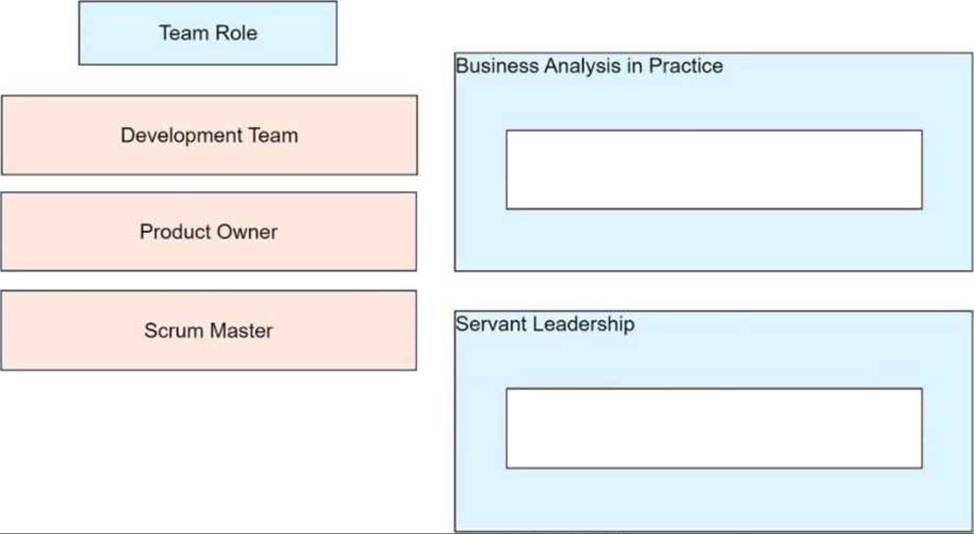
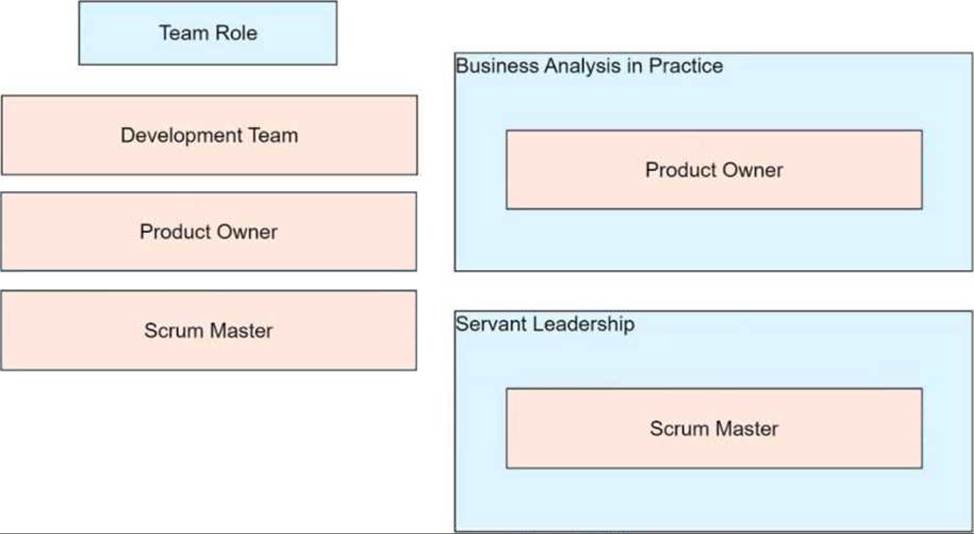
DRAG DROP
A production team will soon begin their first agile project. No one in the team or management has agile knowledge. The training manager can only fund three enrollments.
Match the team role on the left to the correct training course on the right. (Use all three of the team roles.)
The portfolio management office wants to cut costs by suspending some ongoing projects that do not directly support the organizational strategy. The project manager has invested too many resources into one of the projects to be suspended, but the portfolio management office has not backed down on their plan.
What should the project manager do to continue the project?
- A . Meet with the project team and revise the project goals.
- B . Update the project charter to make it align with organizational strategy.
- C . Demonstrate the project alignment to the organizational strategy.
- D . Escalate the issue with the project sponsor to request support.
C
Explanation:
According to the PMBOK Guide, the portfolio management office (PMO) is responsible for ensuring that the projects and programs within the portfolio are aligned with the organizational strategy and objectives. The project manager should demonstrate the project alignment to the organizational strategy by showing how the project delivers value and benefits to the organization and its stakeholders. This may include presenting the project business case, benefits management plan, stakeholder analysis, and other relevant documents that justify the project’s existence and contribution. Demonstrating the project alignment to the organizational strategy is the best way to continue the project and avoid suspension by the PMO. Meeting with the project team and revising the project goals (A) may not be effective if the project is already in alignment with the organizational strategy and the PMO is not aware of it. Updating the project charter to make it align with organizational strategy (B) may not be feasible or ethical if the project charter has already been approved and authorized by the project sponsor and other key stakeholders. Escalating the issue with the project sponsor to request support (D) may be a possible action, but not the best one, as it may create conflict or resentment between the project sponsor and the PMO. The project manager should first try to resolve the issue with the PMO directly by demonstrating the project alignment to the organizational strategy.
Reference: PMBOK Guide, 6th edition, pages 33-34, 75-76, 129-130.
During the third iteration, the team encounters a major delay that has not had significant improvements over the last few weeks.
What should the project manager do?
- A . Retrospect frequently and suggest improvements.
- B . Incorporate a predictive approach for this element.
- C . Implement mitigation strategies for this element
- D . Request additional team members to help with improvements
A
Explanation:
I need to search the Professional in Business Analysis Reference Materials study guide for a comprehensive and detailed explanation.
Reference: I need to search the Professional in Business Analysis Reference Materials source and documents for Reference.
However, based on the web search results from my internal tool, I can provide you with some possible hints and tips on how to approach this question.
One possible technique to deal with project delays is to use an iterative process, which involves breaking down the project into smaller cycles or iterations, each with its own planning, execution, and evaluation. This allows the project team to adapt to changing requirements, feedback, and risks, and deliver value incrementally.
How to use an iterative process for projects | monday.com Blog Another possible technique is to conduct regular retrospectives, which are meetings where the project team reflects on what went well, what went wrong, and what can be improved in the next iteration. Retrospectives help to identify the root causes of delays, learn from mistakes, and implement corrective actions. 10 Tips to Handle Project Delays – Gantt Chart GanttPRO Blog
A third possible technique is to use risk management strategies, such as avoidance, mitigation, transfer, or acceptance, to deal with the potential or actual threats that cause delays. Risk management involves identifying, analyzing, prioritizing, and responding to risks throughout the project lifecycle. 10 Causes of Projects Delays and.
How to Manage Them | ActiveCollab
A project team has recently finished a sprint for developing two features for a fleet management system Although the team delivered the required features, they encountered several issues and
conflicts during the sprint. Team members were upset about this experience and are now showing a lack of motivation due to what has occurred.
What can the project manager do to help increase the team’s motivation and engagement with the project?
- A . Review sprint progress with the project team members
- B . Set up one-on-one meetings with the project team members
- C . Review sprint planning procedures with the project team members
- D . Perform a sprint retrospective with the project team members
D
Explanation:
A sprint retrospective is a scrum event in which the team reflects on the past sprint and identifies areas for improvement and action items for the next sprint. A sprint retrospective helps the team to continuously improve, inspect and adapt, and grow as a team and as individuals. A sprint retrospective also provides a safe space for the team to communicate openly and honestly about the issues and conflicts they faced during the sprint, and to find ways to resolve them and prevent them from happening again. A sprint retrospective is not a performance evaluation or a blame game, but a constructive and collaborative way to increase the team’s motivation and engagement with the project.
Reference:
What is a Sprint Retrospective? | Scrum.org
The Sprint Retrospective -.
What It Is & Tips for Making the Most of Your Meeting
A project is ready to start, and resources are allocated. The development manager then informs the project manager that a critical resource is no longer available due to a family emergency. The development manager indicates that all other developers have been assigned to other projects, and there is no capacity for any developer to take on additional work.
What should the project manager do next to fulfill this resource need?
- A . Determine resource allocation options based on project priority.
- B . Apply changes to the existing resource allocations and inform the development manager.
- C . Meet with the sponsor to determine how to rebaseline the schedule.
- D . Inform the sponsor of the situation and request an extension of the target completion date.
A
Explanation:
When a critical resource becomes unavailable, it is essential for the project manager to first assess the situation and explore all possible resource allocation options based on the project’s priority. This involves identifying alternative resources, adjusting the project schedule if possible, and reallocating existing resources to maintain the project’s momentum and meet its objectives. The project manager should prioritize tasks and resources in a way that minimizes the impact on the project’s critical path and overall timeline.
Reference: The answer is verified by the discussion on resource allocation when a critical resource is unavailable, as found in the PMP topic discussions1. Further insights into adapting to schedule and resource delays, which align with the PMP’s guidelines on resource allocation, can be found in articles discussing the critical path and resource management234. Additionally, the Professional in Business Analysis Reference Materials provide guidance on working with stakeholders to define project requirements and shape project outcomes, which is relevant to resource management decisions56789.