
PECB ISO-IEC-27001 Lead Auditor Practice Exams
Last updated on Oct 21,2026- Exam Code: ISO-IEC-27001 Lead Auditor
- Exam Name: PECB Certified ISO/IEC 27001 Lead Auditor exam
- Certification Provider: PECB
- Latest update: Oct 21,2026
Which two of the following statements are true?
- A . The role of a certification body auditor involves evaluating the organisation’s processes for ensuring compliance with their legal requirements
- B . Curing a third-party audit, the auditor evaluates how the organisation ensures that 4 6 made aware of changes to the legal requirements
- C . As part of a certification body audit the auditor is resporable for verifying the organisation’s legal compliance status
AB
Explanation:
The following statements are true:
The role of a certification body auditor involves evaluating the organization’s processes for ensuring compliance with their legal requirements. This is part of the auditor’s responsibility to assess the effectiveness and conformity of the organization’s ISMS against the ISO/IEC 27001:2022 standard and the applicable legal and regulatory requirements.
During a third-party audit, the auditor evaluates how the organization ensures that they are made aware of changes to the legal requirements. This is part of the auditor’s responsibility to verify that the organization has established and maintained a process for identifying and updating their legal and other requirements related to information security.
The following statement is false:
As part of a certification body audit, the auditor is responsible for verifying the organization’s legal compliance status. This is not true, as the auditor is not authorized or qualified to provide legal advice or judgment on the organization’s compliance status. The auditor can only report on the evidence of compliance or noncompliance observed during the audit, but the ultimate responsibility for ensuring legal compliance lies with the organization.
Reference: CQI & IRCA ISO 27001:2022 Lead Auditor Course Handbook, page 66. : CQI & IRCA ISO 27001:2022 Lead Auditor Course Handbook, page 67. : ISO/IEC 27001 LEAD AUDITOR – PECB, page 22.
Scenario 3: NightCore is a multinational technology company based in the United States that focuses on e-commerce, cloud computing, digital streaming, and artificial intelligence. After having an information security management system (ISMS) implemented for over 8 months, they contracted a certification body to conduct a third party audit in order to get certified against ISO/IEC 27001.
The certification body set up a team of seven auditors. Jack, the most experienced auditor, was assigned as the audit team leader. Over the years, he received many well known certifications, such as the ISO/IEC 27001 Lead Auditor, CISA, CISSP, and CISM.
Jack conducted thorough analyses on each phase of the ISMS audit, by studying and evaluating every information security requirement and control that was implemented by NightCore. During stage 2 audit. Jack detected several nonconformities. After comparing the number of purchased invoices for software licenses with the software inventory, Jack found out that the company has been using the illegal versions of a software for many computers. He decided to ask for an explanation from the top management about this nonconformity and see whether they were aware about this. His next step was to audit NightCore’s IT Department. The top management assigned Tom, NightCore’s system administrator, to act as a guide and accompany Jack and the audit team toward the inner workings of their system and their digital assets infrastructure.
While interviewing a member of the Department of Finance, the auditors discovered that the company had recently made some unusual large transactions to one of their consultants. After gathering all the necessary details regarding the transactions. Jack decided to directly interview the top management.
When discussing about the first nonconformity, the top management told Jack that they willingly decided to use a copied software over the original one since it was cheaper. Jack explained to the top management of NightCore that using illegal versions of software is against the requirements of ISO/IEC 27001 and the national laws and regulations. However, they seemed to be fine with it. Several months after the audit, Jack sold some of NightCore’s information that he collected during the audit for a huge amount of money to competitors of NightCore. Based on this scenario, answer the following question:
Does ISO/IEC 27001 require organizations to comply with national laws and regulations?
- A . Yes, but relevant legal and contractual requirements do not need to be explicitly identified
- B . No, there is no clear indication in the standard as to whether the organization should comply with the national laws and regulations
- C . Yes, complying with the applicable legislation is a requirement of ISO/IEC 27001
C
Explanation:
ISO/IEC 27001 requires organizations to comply with applicable legal, statutory, regulatory, and contractual requirements, including those pertaining to information security. These requirements must be identified, documented, and kept up to date as part of the organization’s ISMS.
Reference: ISO/IEC 27001:2013 Standard, Clause 6.1.3 (Information security requirements)
Which two of the following phrases would apply to "plan" in relation to the Plan-Do-Check-Act cycle for a business process?
- A . Retaining documentation
- B . Retaining documentation
- C . Organising changes
- D . Setting objectives
- E . Training staff
- F . Providing ICT assets
DE
Explanation:
The Plan-Do-Check-Act (PDCA) cycle is a four-step method for implementing and improving processes, products, or services. The “plan” phase involves establishing the objectives and processes necessary to deliver the desired results. This may include setting SMART goals, identifying resources, defining roles and responsibilities, conducting risk assessments, and developing plans for training, communication, and monitoring.
Reference: ISO/IEC 27001:2022 Lead Auditor (Information Security Management Systems) objectives and content from Quality.org and PECB
ISO 19011:2018 Guidelines for auditing management systems [Section 5.3.1]
DRAG DROP
Select the correct sequence for the information security risk assessment process in an ISMS.
To complete the sequence click on the blank section you want to complete so that it is highlighted in red, and then click on the applicable text from the options below. Alternatively, you may drag and drop the options to the appropriate blank
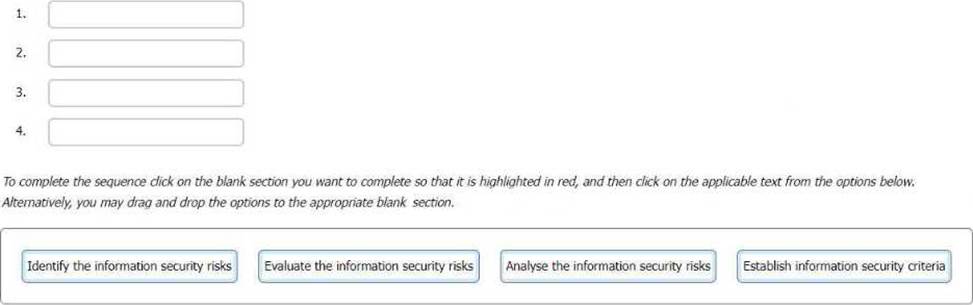
Explanation:
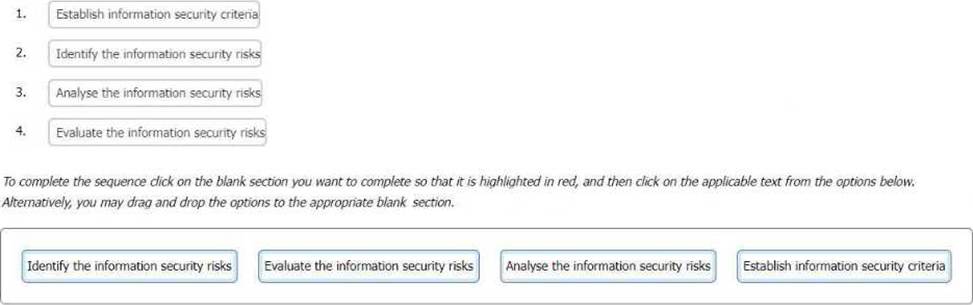
According to ISO 27001:2022, the standard for information security management systems (ISMS), the correct sequence for the information security risk assessment process is as follows: Establish information security criteria
Identify the information security risks
Analyse the information security risks
Evaluate the information security risks
The first step is to establish the information security criteria, which include the risk assessment methodology, the risk acceptance criteria, and the risk evaluation criteria. These criteria define how the organization will perform the risk assessment, what level of risk is acceptable, and how the risks will be compared and prioritized.
The second step is to identify the information security risks, which involve identifying the assets, threats, vulnerabilities, and existing controls that are relevant to the ISMS. The organization should also identify the potential consequences and likelihood of each risk scenario.
The third step is to analyse the information security risks, which involve estimating the level of risk for each risk scenario based on the criteria established in the first step. The organization should also consider the sources of uncertainty and the confidence level of the risk estimation.
The fourth step is to evaluate the information security risks, which involve comparing the estimated risk levels with the risk acceptance criteria and determining whether the risks are acceptable or need treatment. The organization should also prioritize the risks based on the risk evaluation criteria and the objectives of the ISMS.
Reference: ISO 27001:2022 Clause 6.1.2 Information security risk assessment, ISO 27001 Risk Assessment & Risk Treatment: The Complete Guide – Advisera, ISO 27001 Risk Assessment: 7 Step Guide – IT Governance UK Blog
DRAG DROP
Select the correct sequence for the information security risk assessment process in an ISMS.
To complete the sequence click on the blank section you want to complete so that it is highlighted in red, and then click on the applicable text from the options below. Alternatively, you may drag and drop the options to the appropriate blank
Explanation:
According to ISO 27001:2022, the standard for information security management systems (ISMS), the correct sequence for the information security risk assessment process is as follows: Establish information security criteria
Identify the information security risks
Analyse the information security risks
Evaluate the information security risks
The first step is to establish the information security criteria, which include the risk assessment methodology, the risk acceptance criteria, and the risk evaluation criteria. These criteria define how the organization will perform the risk assessment, what level of risk is acceptable, and how the risks will be compared and prioritized.
The second step is to identify the information security risks, which involve identifying the assets, threats, vulnerabilities, and existing controls that are relevant to the ISMS. The organization should also identify the potential consequences and likelihood of each risk scenario.
The third step is to analyse the information security risks, which involve estimating the level of risk for each risk scenario based on the criteria established in the first step. The organization should also consider the sources of uncertainty and the confidence level of the risk estimation.
The fourth step is to evaluate the information security risks, which involve comparing the estimated risk levels with the risk acceptance criteria and determining whether the risks are acceptable or need treatment. The organization should also prioritize the risks based on the risk evaluation criteria and the objectives of the ISMS.
Reference: ISO 27001:2022 Clause 6.1.2 Information security risk assessment, ISO 27001 Risk Assessment & Risk Treatment: The Complete Guide – Advisera, ISO 27001 Risk Assessment: 7 Step Guide – IT Governance UK Blog
There was no nonconformity found during the firewall testing. The auditors tested the firewall configuration in order to determine the level of security provided by these services. They used a packet analyzer to test the firewall policies which enabled them to check the packets sent or received in real-time.
Based on this scenario, answer the following question:
Based on scenario 4, the auditors requested documentary evidence regarding the monitoring process of outsourced operations.
What does this indicate?
- A . The auditors demonstrated professional skepticism
- B . The auditors compromised the confidentiality of outsourced operations
- C . The auditors evaluated the evidence based on a risk-based approach
A
Based on the provided scenario, the auditors’ request for documentary evidence regarding the monitoring process of outsourced operations indicates that the auditors demonstrated professional skepticism. This is because professional skepticism involves a critical assessment of audit evidence and includes a questioning mind and a careful evaluation of the information provided by the auditee123.
Professional skepticism is an essential part of the auditing process, especially in the context of ISO/IEC 27001, which requires auditors to systematically examine an organization’s information security risks, including the management of outsourced processes4. The auditors’ request for evidence suggests that they were not satisfied with verbal assurances alone and sought to verify that SendPay had a formal, documented process for monitoring outsourced activities, which is a requirement for maintaining an effective Information Security Management System (ISMS)5. Therefore, the correct answer is:
Scenario 6: Sinvestment is an insurance company that offers home, commercial, and life insurance. The company was founded in North Carolina, but have recently expanded in other locations, including Europe and Africa.
Sinvestment is committed to complying with laws and regulations applicable to their industry and preventing any information security incident. They have implemented an ISMS based on ISO/IEC 27001 and have applied for ISO/IEC 27001 certification.
Two auditors were assigned by the certification body to conduct the audit. After signing a confidentiality agreement with Sinvestment. they started the audit activities. First, they reviewed the documentation required by the standard, including the declaration of the ISMS scope, information security policies, and internal audits reports. The review process was not easy because, although Sinvestment stated that they had a documentation procedure in place, not all documents had the same format.
Then, the audit team conducted several interviews with Sinvestment’s top management to understand their role in the ISMS implementation. All activities of the stage 1 audit were performed remotely, except the review of documented information, which took place on-site, as requested by Sinvestment.
During this stage, the auditors found out that there was no documentation related to information security training and awareness program. When asked, Sinvestment’s representatives stated that the company has provided information security training sessions to all employees. Stage 1 audit gave the audit team a general understanding of Sinvestment’s operations and ISMS.
The stage 2 audit was conducted three weeks after stage 1 audit. The audit team observed that the marketing department (which was not included in the audit scope) had no procedures in place to control employees’ access rights. Since controlling employees’ access rights is one of the ISO/IEC 27001 requirements and was included in the information security policy of the company, the issue was included in the audit report. In addition, during stage 2 audit, the audit team observed that Sinvestment did not record logs of user activities. The procedures of the company stated that "Logs recording user activities should be retained and regularly reviewed," yet the company did not present any evidence of the implementation of such procedure.
During all audit activities, the auditors used observation, interviews, documented information review, analysis, and technical verification to collect information and evidence. All the audit findings during stages 1 and 2 were analyzed and the audit team decided to issue a positive recommendation for certification.
According to scenario 6, the marketing department employees were not following the access control policy.
Which option is correct in this case?
- A . The marketing department is not included in the audit scope, so the issue should only be communicated to Sinvestment’s representatives
- B . The employees’ access right control is included in Sinvestment’s information security policy, so the issue must be communicated to Sinvestment’s representatives and included in the audit report
- C . Sinvestment is not controlling the employees’ access rights, which represents a potential information security risk and should be reported as a major nonconformity
B
Explanation:
Even though the marketing department was not included in the audit scope, the issue of employees’ access rights control must be communicated to Sinvestment’s representatives and included in the audit report because it is part of Sinvestment’s information security policy. It reflects on the overall adherence to the ISMS requirements.
Reference: ISO/IEC 27001:2013, Clause 9.2 (Internal audit)
Scenario 3: NightCore is a multinational technology company based in the United States that focuses on e-commerce, cloud computing, digital streaming, and artificial intelligence. After having an information security management system (ISMS) implemented for over 8 months, they contracted a
certification body to conduct a third party audit in order to get certified against ISO/IEC 27001. The certification body set up a team of seven auditors. Jack, the most experienced auditor, was assigned as the audit team leader. Over the years, he received many well known certifications, such as the ISO/IEC 27001 Lead Auditor, CISA, CISSP, and CISM.
Jack conducted thorough analyses on each phase of the ISMS audit, by studying and evaluating every information security requirement and control that was implemented by NightCore. During stage 2 audit. Jack detected several nonconformities. After comparing the number of purchased invoices for software licenses with the software inventory, Jack found out that the company has been using the illegal versions of a software for many computers. He decided to ask for an explanation from the top management about this nonconformity and see whether they were aware about this. His next step was to audit NightCore’s IT Department. The top management assigned Tom, NightCore’s system administrator, to act as a guide and accompany Jack and the audit team toward the inner workings of their system and their digital assets infrastructure.
While interviewing a member of the Department of Finance, the auditors discovered that the company had recently made some unusual large transactions to one of their consultants. After gathering all the necessary details regarding the transactions. Jack decided to directly interview the top management.
When discussing about the first nonconformity, the top management told Jack that they willingly decided to use a copied software over the original one since it was cheaper. Jack explained to the top management of NightCore that using illegal versions of software is against the requirements of ISO/IEC 27001 and the national laws and regulations. However, they seemed to be fine with it. Several months after the audit, Jack sold some of NightCore’s information that he collected during the audit for a huge amount of money to competitors of NightCore. Based on this scenario, answer the following question:
Based on audit principles, should Jack contact the certification body regarding the second nonconformity? Refer to scenario 3.
- A . Yes, auditors should contact the ethics committee members of the certification body to obtain advice on such situation
- B . Yes, auditors should communicate such situations to the certification body; however, the top management should not be informed
- C . No, situations that may indicate financial crime are not the focus of an ISMS audit
B
Explanation:
Yes, Jack should communicate such situations to the certification body. It is essential for auditors to report potential nonconformities and ethical breaches to the certification body to maintain the integrity and credibility of the audit process, without necessarily informing top management of these steps.
Reference: ISO 19011:2018, Guidelines for auditing management systems
Based on the identified nonconformities. Company A established action plans that included the detected nonconformities, the root causes, and a general statement regarding each action that would be taken.
Is this acceptable?
- A . No, the action plans should include information on the systems that will be installed and how these systems will eliminate the root causes
- B . No, the auditee is required to submit action plans that include detailed information on how every
corrective action will be implemented - C . Yes, the auditee is required to submit action plans that include a general statement regarding the actions that will be taken
B
Explanation:
The auditee is required to submit action plans that include detailed information on how every corrective action will be implemented. General statements are not sufficient; the action plans must specify the corrective actions in detail to ensure that the root causes of the nonconformities are addressed effectively.
Reference: ISO/IEC 27001:2013, Clause 10.1 (General) and ISO 19011:2018, Guidelines for auditing management systems.
There was no nonconformity found during the firewall testing. The auditors tested the firewall configuration in order to determine the level of security provided by these services. They used a packet analyzer to test the firewall policies which enabled them to check the packets sent or received in real-time.
Based on this scenario, answer the following question:
How do you evaluate the evidence obtained related to the monitoring process of outsourced operations? Refer to scenario 4.
- A . Irrelevant, monitoring the outsourced operations is not a requirement of the standard
- B . Not reliable. SendPay provided only verbal evidence regarding the monitoring of its outsourced operations
- C . Appropriate and sufficient, verbal confirmation from the SendPay’s representatives indicates that the they were aware that outsourced operations must be monitored
B
Explanation:
The evidence provided by SendPay, which is solely verbal confirmation about the monitoring of outsourced operations, is not considered reliable under ISO/IEC 27001. The standard requires documented evidence to support claims of effective monitoring and control over outsourced processes.
Reference: ISO/IEC 27001:2013 Standard, Clause A.15 (Supplier relationships)