
Payroll FPC-REMOTE Practice Exams
Last updated on Oct 22,2026- Exam Code: FPC-REMOTE
- Exam Name: Fundamental Payroll Certification
- Certification Provider: Payroll
- Latest update: Oct 22,2026
Under the CCPA, use the following information to calculate the MAXIMUM child support order deduction allowed for an employee supporting a second family and in arrears.

- A . $689.00
- B . $768.90
- C . $838.80
- D . $908.70
B
Explanation:
Under the Consumer Credit Protection Act (CCPA):
If the employee supports a second family and is in arrears, the maximum garnishment limit is 55% of disposable earnings.
Calculate Disposable Earnings:
Gross wages: $1,573.00
Less taxes withheld: $175.00
Disposable earnings = $1,573.00 – $175.00 = $1,398.00
Calculate Maximum Child Support Deduction (55% of disposable earnings):
$1,398.00 × 55% = $768.90
Thus, the correct answer is
B. $768.90.
Reference: U.S. Department of Labor C CCPA Garnishment Rules
Payroll.org C Child Support Withholding Guidelines
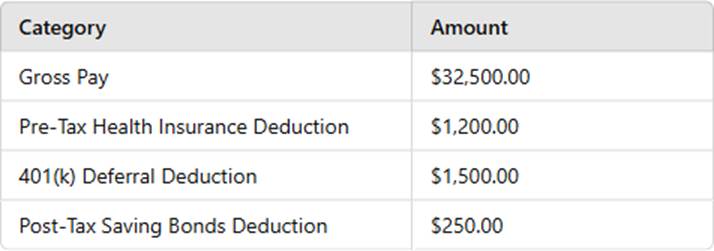
Using the following information from a payroll journal, calculate the total Social Security tax liability for the first payroll of the year:
- A . $3,664.20
- B . $3,695.20
- C . $3,881.20
- D . $4,788.90
C
Explanation:
Social Security tax is 6.2% for both the employer and employee, so total liability is 12.4% of Social Security taxable wages.
Calculate Social Security taxable wages:
Gross pay: $32,500.00
Less pre-tax deductions (Health Insurance & 401k do NOT reduce Social Security taxable wages):
Taxable Wages = $32,500.00 – $1,200.00 = $31,300.00
Calculate Social Security tax (12.4% total for employer & employee):
$31,300 × 12.4% = $3,881.20
Thus, the correct answer is
C. $3,881.20.
Reference: IRS Publication 15 C Employer’s Tax Guide
Payroll.org C Social Security and Medicare Tax Rules
To identify an out-of-balance general ledger account, all of the following documents should be used EXCEPT:
- A . General Ledger Account Details
- B . Bank Account Statements
- C . Payroll Register Totals
- D . Copies of Paychecks
D
Explanation:
To find discrepancies in a general ledger, the following documents should be reviewed:
General Ledger Account Details (A) C To track postings and adjustments.
Bank Account Statements (B) C To ensure transactions reconcile with payroll expenses.
Payroll Register Totals (C) C To compare wages and tax liabilities against general ledger accounts.
Option D (Copies of Paychecks) is incorrect because physical paycheck copies do not verify account balances or identify out-of-balance errors.
Reference: Payroll.org C Payroll Reconciliation Procedures
GAAP Accounting Standards C General Ledger Balancing
All of the following workflow mapping descriptions are correct EXCEPT:
- A . Logical thought processes must include every step with nothing assumed
- B . Depictions and descriptions of sequences of operations of connected steps
- C . Where each step follows the last without delay or gap and ends just prior to the next
- D . When specifications detail the quality and level to be performed by one group for another
D
Explanation:
Workflow mapping is a visual representation of payroll processes to ensure efficiency and accuracy.
Option A (Logical thought processes) ensures clarity and eliminates assumptions.
Option B (Depictions of sequences) accurately describes workflow design.
Option C (Steps follow without delay) ensures process efficiency.
Option D is incorrect because it describes Service Level Agreements (SLA), not workflow mapping.
Reference: Payroll.org C Payroll Workflow Mapping Guide
Process Improvement Standards C Payroll System Optimization
Where should a firm’s business transactions FIRST be recorded?
- A . Balance Sheet
- B . General Ledger
- C . Journal
- D . Trial Balance
C
Explanation:
A Journal (Option C) is the first place where transactions are recorded chronologically, before being posted to the General Ledger.
Option A (Balance Sheet) is incorrect because it is a financial statement, not a transaction log.
Option B (General Ledger) is incorrect because transactions must first be recorded in a journal before being posted.
Option D (Trial Balance) is incorrect because it is a summary of ledger balances used for reconciliation.
Reference: GAAP Accounting Principles C Transaction Recording
Payroll.org C Payroll Accounting Workflow
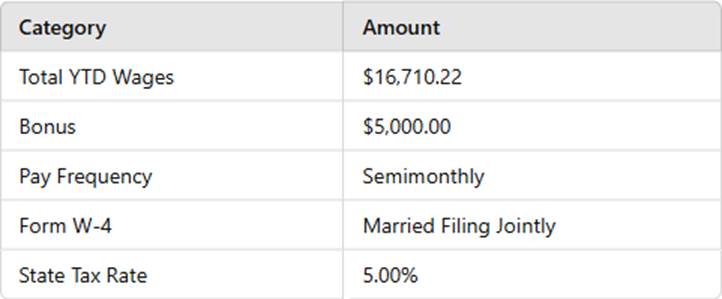
An exempt employee is being paid an annual discretionary bonus. The employee has submitted a 2020 W-4.
Calculate the net pay based on the following information:
- A . $3,117.50
- B . $3,267.50
- C . $3,603.40
- D . $3,932.83
B
Explanation:
Using the IRS Supplemental Wage Method, the flat tax rate of 22% applies to bonuses:
Federal Income Tax:
$5,000 × 22% = $1,100.00
Social Security Tax:
$5,000 × 6.2% = $310.00
Medicare Tax:
$5,000 × 1.45% = $72.50
State Income Tax:
$5,000 × 5.0% = $250.00
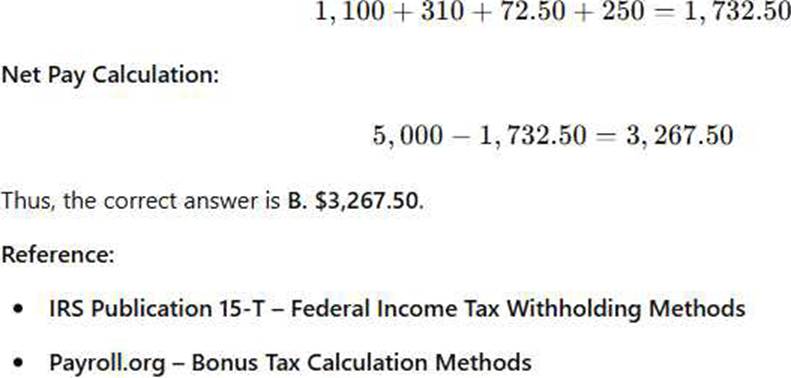
Total Taxes Withheld:
An employee hired on July 1, 2021, terminates employment on September 30, 2022.
What is the earliest date the employer may dispose of the Form I-9?
- A . July 1, 2023
- B . July 1, 2024
- C . September 30, 2023
- D . September 30, 2024
D
Explanation:
Under Form I-9 retention rules, an employer must retain the form for the later of:
Three years from the date of hire, or One year from the termination date.
Employee hired on July 1, 2021 → Three years from hire date = July 1, 2024
Employee terminated on September 30, 2022 → One year from termination = September 30, 2023
Since the latest date is September 30, 2024, that is the earliest date the employer may dispose of the Form I-9.
Reference: U.S. Citizenship and Immigration Services (USCIS) C Form I-9 Retention and Storage Guidelines Payroll.org C Employer Compliance for I-9 Forms
A non-exempt hospital employee works a 14-day period at $14.00 per hour under the 8/80 rule.
The employee worked the following hours during the two-week period:
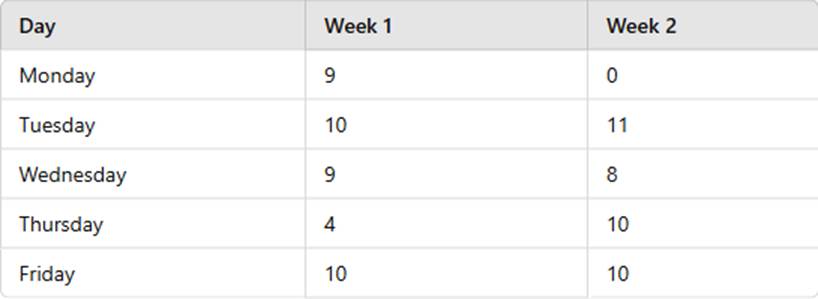
Calculate the employee’s biweekly gross pay.
- A . $1,134.00
- B . $1,141.00
- C . $1,148.00
- D . $1,225.00
C
Explanation:
Under the 8/80 rule, employees in hospital or healthcare settings are paid overtime if they work more than 8 hours in a day or 80 hours in a 14-day period.
Calculate Total Hours Worked:
Week 1: 9 + 10 + 9 + 4 + 10 = 42 hours
Week 2: 0 + 11 + 8 + 10 + 10 = 39 hours
Total Hours Worked = 81 hours
Identify Overtime:
Daily Overtime (More than 8 hours/day):
Monday (9 – 8) = 1 hour
Tuesday (10 – 8) = 2 hours
Wednesday (9 – 8) = 1 hour
Tuesday Week 2 (11 – 8) = 3 hours
Thursday Week 2 (10 – 8) = 2 hours
Total Daily Overtime = 9 hours
Biweekly Overtime:
Total worked: 81 hours (Over 80 hours) → 1 extra hour
Total Overtime Hours = 9 + 1 = 10 hours
Gross Pay Calculation:
Regular Hours (80) × $14 = $1,120.00
Overtime Hours (10) × ($14 × 1.5) = $210.00
Total Gross Pay = $1,120 + $210 = $1,148.00
Thus, the correct answer is C. $1,148.00.
Reference: Fair Labor Standards Act (FLSA) C 8/80 Rule for Healthcare Employees
Payroll.org C Overtime Calculation in Healthcare Settings
Which of the following record-keeping storage methods does NOT offer increased confidentiality?
- A . Paper
- B . Cloud
- C . Micromedia
- D . Media imaging
A
Explanation:
Paper records (A) pose a higher security risk due to physical access and loss potential. Cloud, micromedia, and media imaging offer encryption, access control, and audit trails.
Reference: Payroll Record Security Best Practices (Payroll.org)
The lowest priority is given to which of the following time management categories?
- A . Urgent and important
- B . Not urgent but important
- C . Urgent but not important
- D . Not urgent and not important
D
Explanation:
The Eisenhower Matrix is a time management framework that categorizes tasks by urgency and importance:
Urgent & Important: Must be done immediately (e.g., payroll processing).
Not Urgent but Important: Planning and strategic tasks (e.g., compliance training).
Urgent but Not Important: Tasks that may be delegated (e.g., responding to non-critical emails).
Not Urgent & Not Important: These tasks have the lowest priority as they do not contribute significantly to productivity (e.g., unnecessary meetings).
Reference: Eisenhower Matrix Time Management Framework
Payroll Management Best Practices (Payroll.org)