
Paloalto Networks PCCET Practice Exams
Last updated on Oct 21,2026- Exam Code: PCCET
- Exam Name: Palo Alto Networks Certified Cybersecurity Entry-level Technician
- Certification Provider: Paloalto Networks
- Latest update: Oct 21,2026
From which resource does Palo Alto Networks AutoFocus correlate and gain URL filtering intelligence?
- A . Unit 52
- B . PAN-DB
- C . BrightCloud
- D . MineMeld
B
Explanation:
When you enable URL Filtering, all web traffic is compared against the URL Filtering database, PAN-DB, which contains millions of URLs that have been grouped into about 65 categories.
Which Palo Alto Networks tools enable a proactive, prevention-based approach to network automation that accelerates security analysis?
- A . MineMeld
- B . AutoFocus
- C . WildFire
- D . Cortex XDR
D
Explanation:
Cortex XDR is a security analytics platform that converges logs from network, identity, endpoint, application, and other security relevant sources to generate high-fidelity behavioral alerts and facilitate rapid incident analysis, investigation, and response1. Cortex XDR uses machine learning algorithms to automate data analysis and apply modeling in real time, helping organizations to reduce analyst workloads and improve security1. Cortex XDR also integrates with Palo Alto Networks next-generation firewalls and other security tools to streamline and speed network security response2.
Reference: Security Analytics – Palo Alto Networks, Network Security Automation – Palo Alto Networks
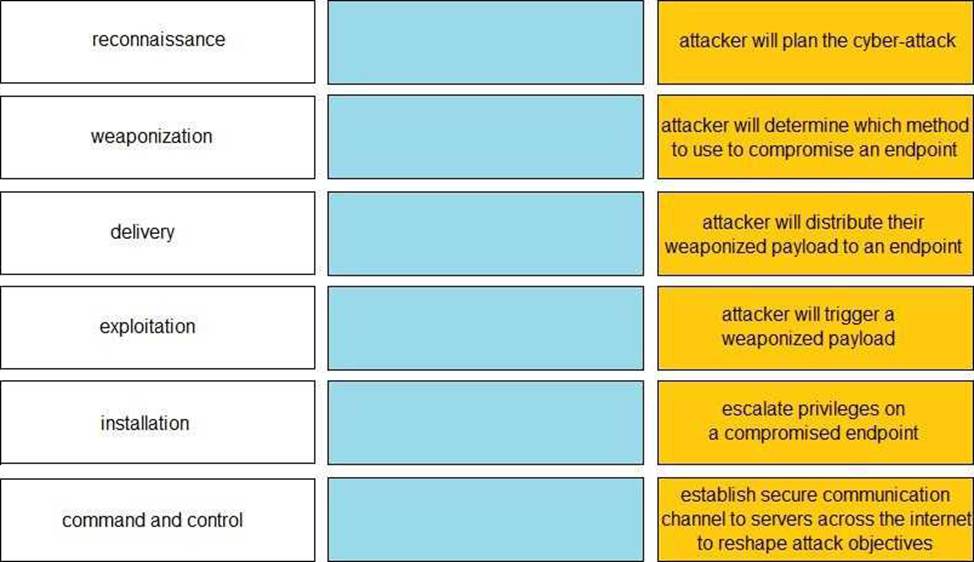
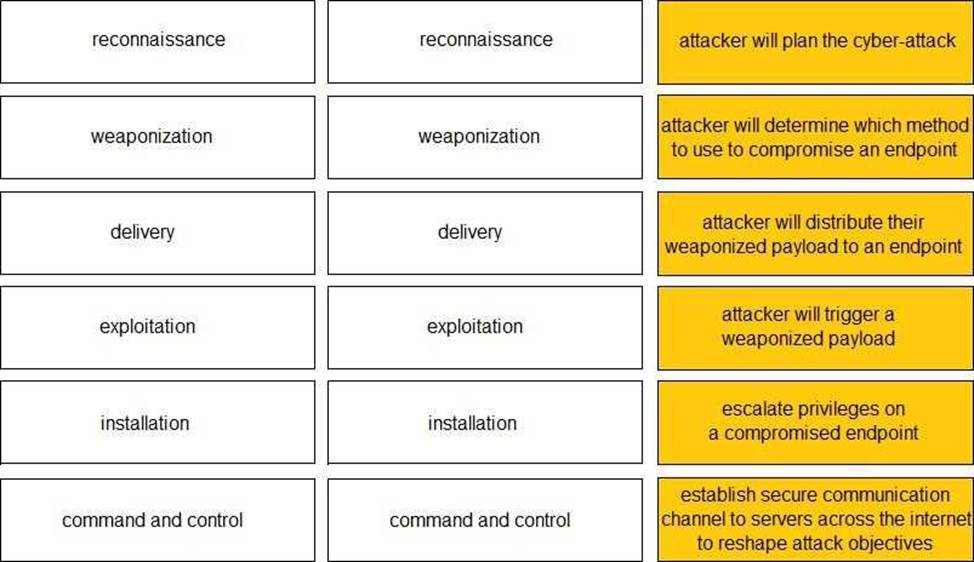
DRAG DROP
Given the graphic, match each stage of the cyber-attack lifecycle to its description.

What is the ptrpose of automation in SOAR?
- A . To provide consistency in response to security issues
- B . To give only administrators the ability to view logs
- C . To allow easy manual entry of changes to security templates
- D . To complicate programming for system administration –
A
Explanation:
Automation in SOAR (Security Orchestration, Automation, and Response) is the process of programming tasks, alerts, and responses to security incidents so that they can be executed without human intervention. Automation in SOAR helps security teams to handle the huge amount of information generated by various security tools, analyze it through machine learning processes, and take appropriate actions based on predefined rules and workflows. Automation in SOAR also reduces the manual effort and time required for security operations, improves the accuracy and efficiency of threat detection and response, and provides consistency in handling security issues across different environments and scenarios.
Reference: What is SOAR (security orchestration, automation and response)? | IBM, What Is SOAR? Technology and Solutions | Microsoft Security, Security orchestration – Wikipedia.
During the OSI layer 3 step of the encapsulation process, what is the Protocol Data Unit (PDU) called when the IP stack adds source (sender) and destination (receiver) IP addresses?
- A . Frame
- B . Segment
- C . Packet
- D . Data
C
Explanation:
The IP stack adds source (sender) and destination (receiver) IP addresses to the TCP segment (which now is called an IP packet) and notifies the server operating system that it has an outgoing message ready to be sent across the network.
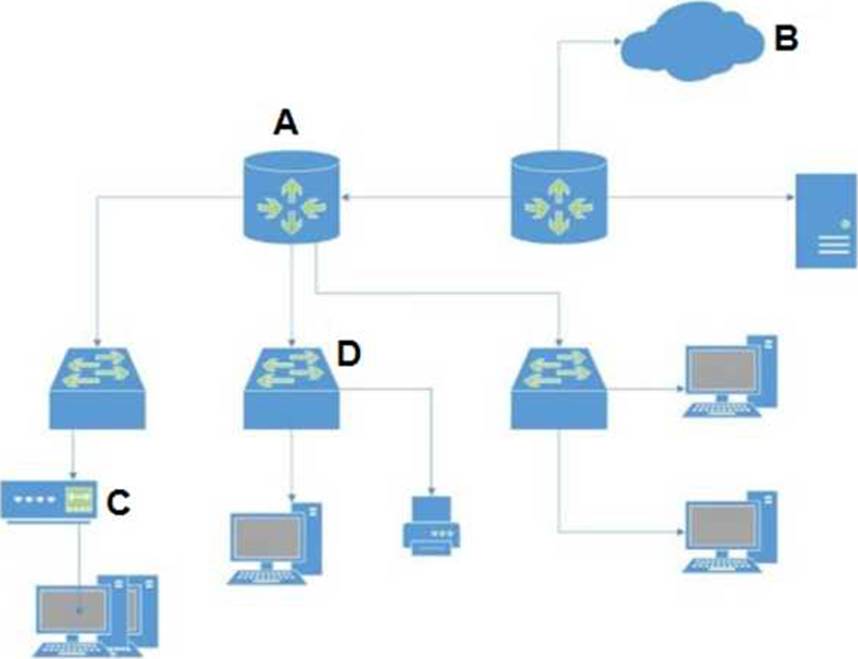
In the attached network diagram, which device is the switch?
- A . A
- B . B
- C . C
- D . D
D
Explanation:
A switch is a network device that connects multiple devices on a local area network (LAN) and forwards data packets between them. A switch can be identified by its icon, which is a rectangle with four curved lines on each side. In the attached network diagram, device D is the switch, as it matches the icon and connects three computers to device A, which is another network device.
Reference: [What is a Network Switch and How Does it Work?]
[Network Diagram Symbols and Icons | Lucidchart]
Organizations that transmit, process, or store payment-card information must comply with what standard?
- A . HIPAA
- B . CISA
- C . GDPR
- D . PCI DSS
D
Explanation:
PCI DSS stands for Payment Card Industry Data Security Standard, which is a set of requirements intended to ensure that all companies that process, store, or transmit credit card information maintain a secure environment1. The standard is administered by the Payment Card Industry Security Standards Council, and its use is mandated by the major card brands2. PCI DSS covers 12 requirements for compliance, organized into six control objectives, such as building and maintaining a secure network and systems, protecting cardholder data, and implementing strong access control measures3.
Reference: Payment Card Industry Security Standards, PCI Security Standards Council C Protect Payment Data with Industry-driven Security Standards, Training, and Programs, What is PCI Compliance? 12 Requirements & More – Digital Guardian
Which type of IDS/IPS uses a baseline of normal network activity to identify unusual patterns or levels of network activity that may be indicative of an intrusion attempt?
- A . Knowledge-based
- B . Signature-based
- C . Behavior-based
- D . Database-based
C
Explanation:
IDSs and IPSs also can be classified as knowledge-based (or signature-based) or behavior-based (or statistical anomaly-based) systems:
● A knowledge-based system uses a database of known vulnerabilities and attack profiles to identify intrusion attempts. These types of systems have lower false-alarm rates than behavior-based systems but must be continually updated with new attack signatures to be effective.
● A behavior-based system uses a baseline of normal network activity to identify unusual patterns or levels of network activity that may be indicative of an intrusion attempt. These types of systems are more adaptive than knowledge-based systems and therefore
may be more effective in detecting previously unknown vulnerabilities and attacks, but they have a much higher false-positive rate than knowledge-based systems
What does Palo Alto Networks Cortex XDR do first when an endpoint is asked to run an executable?
- A . run a static analysis
- B . check its execution policy
- C . send the executable to WildFire
- D . run a dynamic analysis
C
Explanation:
Palo Alto Networks Cortex XDR is an extended detection and response platform that provides endpoint protection, threat detection, and incident response capabilities. When an endpoint is asked to run an executable, Cortex XDR does the following steps1:
First, it sends the executable to WildFire, a cloud-based malware analysis and prevention service, to determine if it is malicious or benign. WildFire uses static and dynamic analysis, machine learning, and threat intelligence to analyze the executable and provide a verdict in seconds2.
Next, it checks the execution policy, which is a set of rules that define what actions are allowed or blocked on the endpoint. The execution policy can be configured by the administrator to enforce granular control over the endpoint behavior3.
Then, it runs a static analysis, which is a technique that examines the executable without executing it. Static analysis can identify malicious indicators, such as file signatures, hashes, strings, and embedded resources4.
Finally, it runs a dynamic analysis, which is a technique that executes the executable in a sandboxed environment and monitors its behavior. Dynamic analysis can detect malicious activities, such as network connections, registry changes, file modifications, and process injections4.
Reference: Cortex XDR Endpoint Protection Overview
WildFire Overview
[Execution Policy]
[Static and Dynamic Analysis]
Which technique uses file sharing or an instant messenger client such as Meebo running over Hypertext Transfer Protocol (HTTP)?
- A . Use of non-standard ports
- B . Hiding within SSL encryption
- C . Port hopping
- D . Tunneling within commonly used services
D
Explanation:
Tunneling is a method of transporting data across a network using protocols that are not supported by that network. Tunneling works by encapsulating packets: wrapping packets inside of other packets. Tunneling within commonly used services is a technique that uses file sharing or an instant messenger client such as Meebo running over HTTP to bypass firewalls or other network restrictions. The data packets are encapsulated within HTTP packets and sent as normal web traffic. This way, the data packets can reach their destination without being blocked or detected by the network.
Reference: What is tunneling? | Tunneling in networking | Cloudflare, What Is Network Tunneling & How Is It Used? | Traefik Labs, networking – What is HTTP tunneling? – Stack Overflow