
Nutanix NCP-CI-Azure Practice Exams
Last updated on Oct 07,2026- Exam Code: NCP-CI-Azure
- Exam Name: Nutanix Certified Professional - Cloud Integration - Azure (NCP-CI-Azure v6.7)
- Certification Provider: Nutanix
- Latest update: Oct 07,2026
The cluster has the following configuration:
A Transit VPC exists as Default, but is additionally configured with a overlay-external-subnet-nonat overlay subnet
The ERP for the Transit VPC is 10.1.1.0/25 A User VPC exists named User_VPC_Prod The ERP for the User VPC is 10.1.1.0/24 Outbound and inbound routes have been configured
A User VM NO-NAT subnet has been configured in the User VPC
The administrator has successfully created a VM and added the NIC associated with the NO-NAT subnet, but is not able to communication with other resources.
Which option will resolve this issue?
- A . The ERP in the User VPC must be from a different CIDR range than the ERP in the transit VPC.
- B . Ensure that the security groups associated with the VM allow traffic to and from the desired resources.
- C . Verify that the route table associated with the User VPC has appropriate routes to the Transit VPC.
- D . Check that the network ACLs for the NO-NAT subnet are not blocking the necessary traffic.
A
Explanation:
In this scenario, the issue arises from overlapping IP address ranges between the Transit VPC and the
User VPC.
Here’s a detailed breakdown:
Understanding ERPs (Elastic Routing Prefixes):
The ERP for the Transit VPC is 10.1.1.0/25, which covers IP addresses from 10.1.1.0 to 10.1.1.127. The ERP for the User VPC is 10.1.1.0/24, which covers IP addresses from 10.1.1.0 to 10.1.1.255. IP Address Overlap:
Since 10.1.1.0/25 is a subset of 10.1.1.0/24, there is a significant overlap in the IP address ranges of these two ERPs.
This overlap can cause routing issues because the same IP address range is being used in both VPCs, leading to ambiguity in routing and communication.
Communication Issue:
When a VM in the User VPC tries to communicate with other resources, the network cannot accurately determine the correct route due to the overlapping IP address ranges.
This overlap prevents proper routing and results in the VM being unable to communicate with other
resources as intended.
Resolution:
To resolve this issue, the ERPs must be in different CIDR ranges. This means the IP address ranges for the Transit VPC and the User VPC should not overlap.
For example, if the Transit VPC uses 10.1.1.0/25, the User VPC could use a different range such as 10.1.2.0/24 or any other range that does not overlap with 10.1.1.0/25.
By ensuring that the ERPs are in different CIDR ranges, the network can properly route traffic between the VPCs without any conflicts or ambiguities, thereby enabling the VM in the User VPC to communicate with other resources effectively.
What action is performed in Azure when an instance is reported as being in a terminated state, but NC2 expects it to be in a running state?
- A . NC2 restarts the AHV host.
- B . NC2 alerts the administrator that a manual replacement is required.
- C . NC2 automatically reconnects with the instance.
- D . NC2 condemns the host and triggers replacement of the host.
D
Explanation:
Instance Termination Detection: When an instance in Azure is reported as being in a terminated state but NC2 expects it to be running, the system will automatically take corrective actions.
Host Condemnation and Replacement:NC2 will condemn the host, marking it as unusable, and will then trigger the replacement process to ensure that the cluster maintains its required capacity and performance levels. This automatic handling ensures minimal disruption to the workloads running on the cluster.
Reference: Nutanix NC2 Automated Management Features
Azure Instance State Documentation
What is an available log module when configuring a syslog server in the Prism Central Admin Center?
- A . Prism
- B . Zookeeper
- C . API Audit
- D . Acropolis
D
Explanation:
Log Modules in Prism Central: When configuring a syslog server, different log modules can be selected to send logs to an external syslog server for centralized logging and analysis.
Acropolis Logs: The Acropolis module captures logs related to the Acropolis Hypervisor (AHV), including virtual machine operations, storage operations, and other critical functions within the Nutanix environment.
Reference: Nutanix Prism Central Administration Guide
Nutanix Acropolis Documentation
Which wen interface should be used to most efficiently terminate a Nutanix cloud cluster?
- A . AWS Console
- B . Prism Element Console
- C . NC2 Console
- D . Prism Central Console
C
Explanation:
To efficiently terminate a Nutanix cloud cluster, the NC2 (Nutanix Cloud Clusters) Console should be used. The NC2 Console provides the necessary tools and interface specifically designed for managing and terminating Nutanix clusters within cloud environments, ensuring a seamless and efficient process.
Reference: Nutanix Cloud Clusters Documentation
Exhibit.
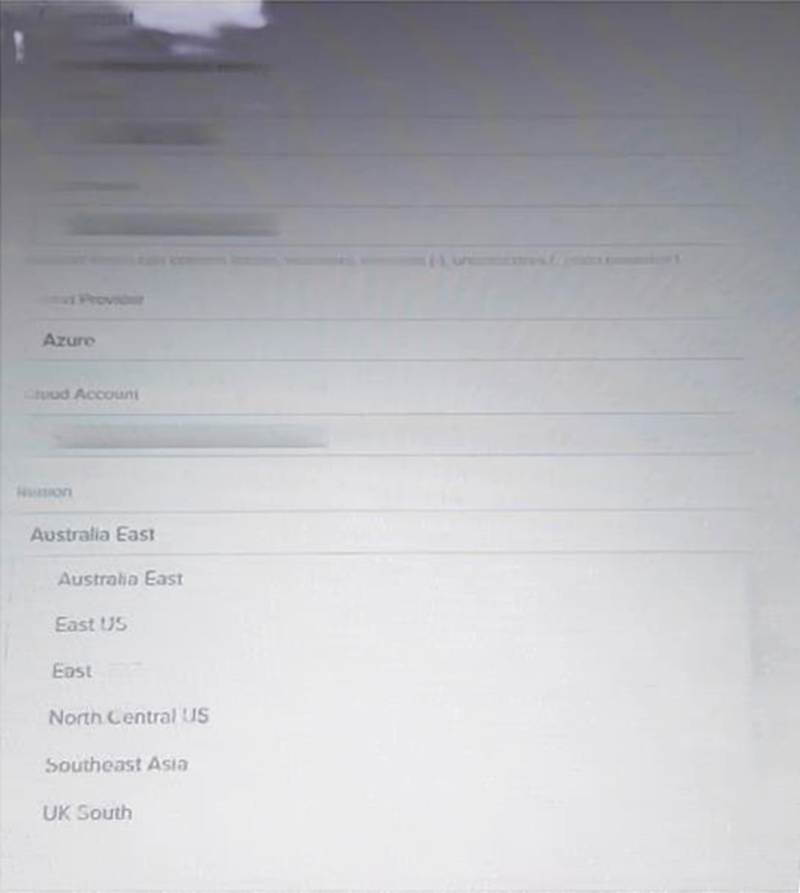
An administrator is trying to create an NC2 cluster in Azure, but does not see the required region in the drop-down list.
Which two steps could the administrator take to resolve this issue? (Choose two.)
- A . Check the Azure subscription is created in the correct region.
- B . Check the list of regions specified under the NC2 organization cloud account.
- C . Check the NC2 Billing console to ensure the region is listed.
- D . Ensure that the Azure region is whitelisted for use by Microsoft in the subscription.
B, D
Explanation:
Check the list of regions specified under the NC2 organization cloud account:The list of available regions in the NC2 console might be restricted based on the configuration of the cloud account associated with the NC2 organization. Verifying this list ensures that the desired region is included and available for cluster creation.
Ensure that the Azure region is whitelisted for use by Microsoft in the subscription:Sometimes, specific regions need to be explicitly enabled or whitelisted in the Azure subscription for certain services. This step ensures that the required region is permitted for use within the Azure subscription, allowing the NC2 cluster to be created in that region.
Reference: Azure Subscription and Service Limits Documentation Nutanix NC2 Configuration and Setup Guide
An NC2 on Azure environment requires that outside networks are allowed to be routed to a Nutanix User VPC from outside the cluster when using a No-Nat path.
Which configuration will satisfy this requirement?
- A . Internally routable network address which shares the same address space of the Nutanix set VPC
- B . Externally routable IP address which shares the same address space of the Native Azure Subnet
- C . Internally routable network address which shares the same address space of the Native Azure Subnet
- D . Externally routable IP address which shares the same address space of the Nutanix User VPC
D
Explanation:
No-NAT Path Requirement: For a No-NAT path to function, the external networks must be able to route traffic directly to the Nutanix User VPC without translation.
Externally Routable IP Address: The externally routable IP address ensures that traffic from outside networks can reach the Nutanix User VPC.
Address Space Compatibility: Sharing the same address space as the Nutanix User VPC allows for seamless integration and communication between the external network and the User VPC.
Reference: Azure Virtual Network Documentation on IP Addressing Nutanix NC2 Configuration Guide on No-NAT Networking
An administrator has noticed the company’s NC2 free trial expired 60 days ago.
What should the administrator do to continue using all of the NC2 features on existing clusters?
- A . Switch to a paid subscription plan.
- B . Nothing. The clusters will have full feature support.
- C . Contact the cloud vendor.
- D . Contact Nutanix support to redeploy the cluster.
A
Explanation:
Free Trial Expiration: Once the NC2 free trial period expires, the administrator needs to switch to a paid
subscription plan to continue using all the features and functionalities provided by Nutanix NC2. Paid Subscription Benefits: Transitioning to a paid subscription ensures uninterrupted access to NC2 features, support, and updates, maintaining the operational capabilities of the existing clusters.
Reference: Nutanix Subscription and Billing Documentation
Nutanix NC2 Support and Subscription Guide
A nutanix user VPC called servers has three subnets called Tier1, tier2 and Darren-Tier3. * Servers:10.0.0.0/16
* Tier1: 10.0.0.0/16
* Tier2: 10.0.0.0.128/25
* Darren-Tier3:10.0.4.0/24
An administrator wants to keep Darren-Tier3 isolated and not receive any outside traffic.
In order properly route for Tier1 and Tier2 coming from native subnets for Azure, what should the ERP be set to?
- A . Transit VPC ERP set to 10.0.0.0/20 and Servers ERP set to 10.0.0.0/24
- B . Transit VPC ERP set to 10.0.0.0/16 and Servers ERP set to 10.0.0.0/25
- C . Transit VPC ERP set to 10.0.0.0/24 and Servers ERP set to 10.0.0.0/24
- D . Transit VPC ERP set to 10.0.0.0/16 and Servers ERP set to 10.0.4.0/24
D
Explanation:
ERP Configuration: ERP (External Route Prefix) settings determine how traffic is routed between subnets and VPCs.
Objective: The goal is to isolate Darren-Tier3 while ensuring proper routing for Tier1 and Tier2. Transit VPC ERP: Setting it to 10.0.0.0/16 ensures that it covers the entire VPC range, allowing traffic within Tier1 and Tier2.
Servers ERP: Setting it to 10.0.4.0/24 ensures isolation for Darren-Tier3 by limiting traffic to that specific subnet and preventing external traffic from reaching it.
Conclusion: This configuration achieves the isolation of Darren-Tier3 while allowing proper routing for Tier1 and Tier2.
Reference: Nutanix Networking Documentation
Azure Virtual Network Documentation
What is the purpose of an organization in the NC2 console?
- A . To Link with a Public Cloud account
- B . To link with NC2 subscription plans
- C . To segregate clusters based on specific requirements
- D . To map the on-premises Prism Central environment
C
Explanation:
Purpose of an Organization in NC2: In the NC2 console, an organization serves to manage and segregate clusters based on specific requirements such as departmental needs, project goals, or security policies.
Cluster Management: This segregation allows administrators to apply unique configurations, permissions, and policies to different clusters within the same environment, providing flexibility and control over resource allocation and management.
Reference: Nutanix NC2 Console Documentation
Best Practices for Managing NC2 Clusters
A new subnet needs to be created within Flow Virtual Networking to accommodate a new type of workload in the company’s NC2 Azure instance.
Which type of network will satisfy this task?
- A . Underlay
- B . Overlay
- C . VPC
- D . VNET
B
Explanation:
Flow Virtual Networking: Nutanix Flow Virtual Networking allows for the creation of overlay networks to
segment and manage network traffic.
Network Types:
Underlay: Refers to the physical network infrastructure.
Overlay: Logical network built on top of the physical infrastructure, providing flexibility for creating isolated subnets and accommodating different workloads.
VPC: Virtual Private Cloud, a network within a public cloud provider.
VNET: Azure-specific virtual network.
Requirement: Creating a subnet for new workloads within Flow Virtual Networking suggests using an overlay network for logical separation and management.
Conclusion: An overlay network within Flow Virtual Networking will satisfy the task of accommodating a new type of workload in the NC2 Azure instance.
Reference: Nutanix Flow Networking Guide
Azure Virtual Network Documentation