
Nutanix NCP-CI-Azure Practice Exams
Last updated on Oct 07,2026- Exam Code: NCP-CI-Azure
- Exam Name: Nutanix Certified Professional - Cloud Integration - Azure (NCP-CI-Azure v6.7)
- Certification Provider: Nutanix
- Latest update: Oct 07,2026
An administrator is tasked with providing User VMs in Azure that are hosted within a Flow NAT network outbound internet connectivity.
In which order would the traffic flow through each component?
- A . User VM >Flow Gateway > Floating IP Address > Azure NAT GW
- B . User VM >Floating IP Address > Flow Gateway > Azure LB
- C . User VM > Delegated Subnet > Flow Gateway > Floating IP Address > Azure LB
- D . User VM > Delegated Subnet > Flow Gateway > Floating IP Address > Azure NAT GW
D
Explanation:
User VM: The initial source of the traffic within the Azure environment.
Delegated Subnet: Traffic from the User VM flows through the delegated subnet, which is configured to handle specific network traffic.
Flow Gateway: The Flow Gateway manages and routes the traffic from the delegated subnet, providing network services and connectivity.
Floating IP Address: The Flow Gateway assigns a floating IP address for the outbound traffic, facilitating NAT operations.
Azure NAT Gateway: The traffic is then routed through the Azure NAT Gateway, which provides outbound internet connectivity for the User VMs, ensuring secure and efficient routing.
Reference: Azure Virtual Network NAT Documentation
Nutanix NC2 Configuration Guide
An administrator is planning on building the network prior to deploying a Nutanix cluster into Azure.
Which two components require their own vNets for NC2 in Azure? (Choose two.)
- A . Bare-metal instance
- B . Prism Central
- C . Azure Load Balancer
- D . Virtual Network Gateway
A, B
Explanation:
NC2 on Azure Deployment: Deploying Nutanix clusters in Azure involves configuring various components, each needing appropriate network isolation and configuration.
Components and vNets:
Bare-metal instance: Requires its own vNet to ensure proper network isolation and performance.
Prism Central: Needs a dedicated vNet to manage and monitor the Nutanix environment, ensuring it has the required network access and isolation.
Azure Load Balancer: Does not require its own vNet but needs to be associated with the appropriate vNet where services are deployed.
Virtual Network Gateway: Is used for VPN connections but does not necessitate a separate vNet; it operates within an existing vNet.
Network Isolation: Providing separate vNets for Bare-metal instances and Prism Central ensures optimal performance and management capabilities.
Conclusion: Both Bare-metal instances and Prism Central require their own vNets in the NC2 on Azure
deployment.
Reference: Nutanix Clusters on Azure Deployment Guide
Azure Virtual Network Documentation
An organization want to use existing Azure resources to deploy NC2.
What is a valid requirement to use existing Azure resources for this task?
- A . More than two DNS servers must be used.
- B . A new Azure resource group must be created where all resources, such as VNets must be created.
- C . Azure NAT gateway must be attached to the cluster management Prism Central, and external Flow Gateway subnets.
- D . The fastpathenabled tag must be added after creating a NAT gateway.
B
Explanation:
Resource Group Requirement: When deploying NC2 on Azure, it is essential to organize resources such as VNets, subnets, and other components in a dedicated resource group. This helps in managing and maintaining the resources efficiently.
New Resource Group: Creating a new Azure resource group ensures that all the necessary NC2 resources are isolated and managed together, avoiding conflicts with existing resources and providing a clear separation for administration and billing purposes.
Reference: Azure Resource Group Documentation
Nutanix NC2 Deployment Guide
An administrator is tasked with creating a new subnet for a group of VMs that require inbound internet access. Internal private addresses must be obscured to servers on the public internet.
Which network is best suited for satisfying this requirement?
- A . Bastion based network
- B . No-NAT based network
- C . Layer 2 Stretch network
- D . NAT based network
D
Explanation:
NAT Based Network: A NAT-based network is designed to provide inbound and outbound internet access while obscuring the internal private addresses. This setup uses Network Address Translation (NAT) to map internal IP addresses to a public IP address, ensuring that internal addresses are not exposed to the public internet.
Security and Connectivity: NAT provides a layer of security by hiding internal IP addresses and allowing controlled access to external resources. This configuration is well-suited for VMs that need to communicate with servers on the public internet while maintaining the privacy of their internal network addresses.
Reference: Azure Virtual Network NAT Documentation
Nutanix Networking and Security Configuration Guide
Which console must be used to deploy a Nutanix cluster on Azure?
- A . Prism Central Console
- B . NC2 Console
- C . Azure Console
- D . Prism Element Console
B
Explanation:
NC2 Console: The NC2 console is specifically designed for deploying and managing Nutanix clusters on Azure. It provides the necessary tools and interface to configure, monitor, and manage the NC2 clusters effectively.
Cluster Deployment: Using the NC2 console ensures that all configurations and integrations with Azure are correctly handled, providing a seamless deployment experience.
Reference: Nutanix NC2 Deployment Guide
Nutanix Console Documentation
An administrator has setup a routed external network (No NAT) to use for workload running in NC2 clusters on Azure.
The applications are network intensive, so four gateways VMs have been deployed to meet the high demands. One application server on the NC2 clusters is sending traffic to an outside Azure service.
How many flow gateway VMs will be used to distribute the traffic?
- A . All four Flow Gateway instances will be used based on the ECMP default route that points 3 the external subnets in the Nutanix Transit VPC, but only for sending traffic. Return traffic by use one Flow Gateway VM.
- B . two flow gateway instances will be used based on limitations from using MAC addresses to redistribute traffic.
- C . Only one Flow Gateway instance will be used per source application running on NC2.
- D . All four Flow Gateway instances will be used based on the ECMP default route that points to the
external subnets in the Nutanix Transit VPC for sending and receiving traffic.
D
Explanation:
Equal-Cost Multi-Path (ECMP) Routing: ECMP allows multiple gateways to be used simultaneously for load balancing traffic across multiple paths. In this scenario, ECMP is configured to point to the external subnets in the Nutanix Transit VPC.
Traffic Distribution: All four Flow Gateway instances will be used to distribute the outgoing traffic from the application server based on the ECMP default route configuration. This ensures efficient load balancing and utilization of all available gateway resources.
Bidirectional Traffic: Both sending and receiving traffic will utilize all four Flow Gateway instances, ensuring high availability and performance for network-intensive applications.
Reference: Nutanix NC2 Networking Guide
Azure Networking Documentation on ECMP
A company wants NC2 networking components to be created manually with the correct naming conversation. To achieve this the administrator manually creates the PC and Host VNets in Azure.
What additional Azure Network components must the administrator manually create?
- A . NAT Gateways. Delegated Subnets, Flow Gateway Subnets, Transit VPC
- B . NAT Gateways, Delegated Subnets, Flow Gateway Subnets, VNet Peers
- C . internet Gateways, Private Endpoints, Flow Gateway Subnets, VNet Peers
- D . Internet Gateways. Delegated Subnets, Flow Gateway Subnets, VNet Peers
B
Explanation:
NAT Gateways: Necessary for providing outbound internet access to resources in the private subnet. It ensures that the virtual network can communicate with external services securely.
Delegated Subnets: Required for deploying specific Azure services within the virtual network, allowing controlled access and management of the resources within these subnets.
Flow Gateway Subnets: These subnets are used for managing traffic flow within the network, ensuring efficient routing and connectivity between different parts of the NC2 infrastructure.
VNet Peers: Establish connections between different virtual networks within Azure, enabling seamless communication and resource sharing across various parts of the NC2 deployment.
Reference: Azure Virtual Network Documentation
Nutanix NC2 Networking Setup Guide
An administrator is planning to expand an NC2 on Azure cluster.
Which statement is true regarding prerequisites for expanding the cluster?
- A . Cluster must be in a Cluster Stopped state.
- B . Cluster must have at least three nodes.
- C . Cluster must be in a Cluster Connected state.
- D . Cluster must have at least five nodes.
C
Explanation:
Cluster State Requirement: To expand a cluster, it must be operational and in a connected state to ensure seamless integration of additional nodes.
Cluster Stopped State: If the cluster is stopped, it cannot perform expansion operations.
Minimum Nodes Requirement: There is no minimum node count prerequisite for expanding the cluster as long as the cluster is connected.
Cluster Connected State: Ensuring the cluster is connected verifies that it is operational and can communicate with additional nodes being added.
Conclusion: The cluster must be in a Cluster Connected state to expand successfully.
Reference: Nutanix Clusters Expansion Guide
Azure NC2 Configuration Documentation
Exhibit.
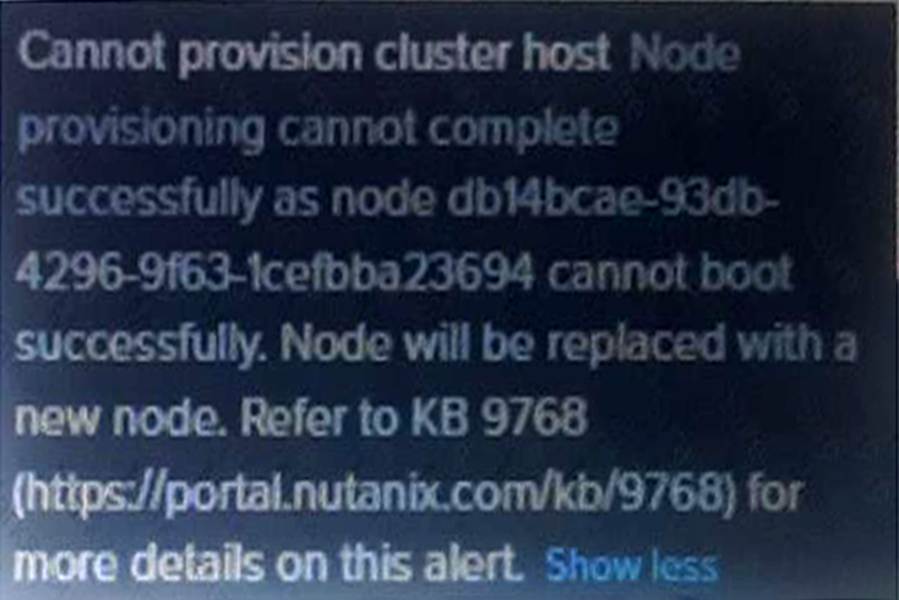
An administrator is trying to figure out why the NC2 cluster deployment in Azure failed.
Which issue might be the cause?
- A . The administrator has not specified a DNS server during deployment.
- B . The selected bare metal node type is not supported in the deployment region.
- C . DNS servers are not reachable from cluster management VNet.
- D . The company does not have sufficient NCI/AOS licenses.
B
Explanation:
Error Message Analysis: The error message indicates that the node cannot boot successfully and will be replaced with a new node. This points towards an issue related to the specific node type or configuration. Bare Metal Node Support: One common cause for such deployment failures is selecting a bare metal node type that is not supported in the chosen deployment region. Azure has specific regions where certain node types are available, and attempting to use an unsupported node type in a region can result in provisioning failures.
Reference: Nutanix KB 9768 for troubleshooting deployment issues: KB 9768 Azure Region Availability Documentation Nutanix NC2 on Azure Deployment Guide
An administrator needs the permission to create and manage multiple organizations and clusters in NC2, as well as manage user access for the entire company.
What role should be assigned to meet the minimum requirements of this task?
- A . Customer Administrator
- B . Cluster Administrator
- C . Customer Security Administrator
- D . Organization Administrator
A
Explanation:
Role Requirements: The task involves creating and managing multiple organizations and clusters, along with managing user access across the company.
Role Capabilities: The "Customer Administrator" role is designed to provide extensive administrative capabilities, including:
Creating and managing organizations.
Managing clusters.
Handling user access and permissions.
Comparison of Roles:
Cluster Administrator: Primarily focuses on managing individual clusters but does not encompass organization-wide administrative tasks.
Customer Security Administrator: Focuses on security-related tasks and does not have broad administrative capabilities across organizations and clusters.
Organization Administrator: Manages organizational settings but might not cover all aspects needed for multiple clusters and user access management.
Conclusion: The "Customer Administrator" role meets all the requirements for managing organizations, clusters, and user access comprehensively.
Reference: Nutanix Role-Based Access Control Documentation
NC2 on Azure User Roles Guide