
Netskope NSK101 Practice Exams
Last updated on Oct 21,2026- Exam Code: NSK101
- Exam Name: Netskope Certified Cloud Security Administrator (NCCSA)
- Certification Provider: Netskope
- Latest update: Oct 21,2026
You are working with a large retail chain and have concerns about their customer data. You want to protect customer credit card data so that it is never exposed in transit or at rest.
In this scenario, which regulatory compliance standard should be used to govern this data?
- A . SOC 3
- B . PCI-DSS
- C . AES-256
- D . ISO 27001
A customer changes CCI scoring from the default objective score to another score.
In this scenario, what would be a valid reason for making this change?
- A . The customer has discovered a new SaaS application that is not yet rated in the CCI database.
- B . The customer’s organization places a higher business risk weight on vendors that claim ownership of their data.
- C . The customer wants to punish an application vendor for providing poor customer service.
- D . The customer’s organization uses a SaaS application that is currently listed as "under research".
What correctly defines the Zero Trust security model?
- A . least privilege access
- B . multi-layered security
- C . strong authentication
- D . double encryption
Which two capabilities are part of Netskope’s Adaptive Zero Trust Data Protection? (Choose two.)
- A . contextual risk awareness
- B . continuous adaptive policies
- C . continuous enforcement of all policies
- D . contextual metadata storage
Which three components make up the Borderless SD-WAN solution? (Choose three)
- A . Endpoint SD-WAN Client
- B . SASE Orchestrator
- C . NPA Publisher
- D . SASE Gateway
- E . On-Premises Log Parser
Click the Exhibit button.
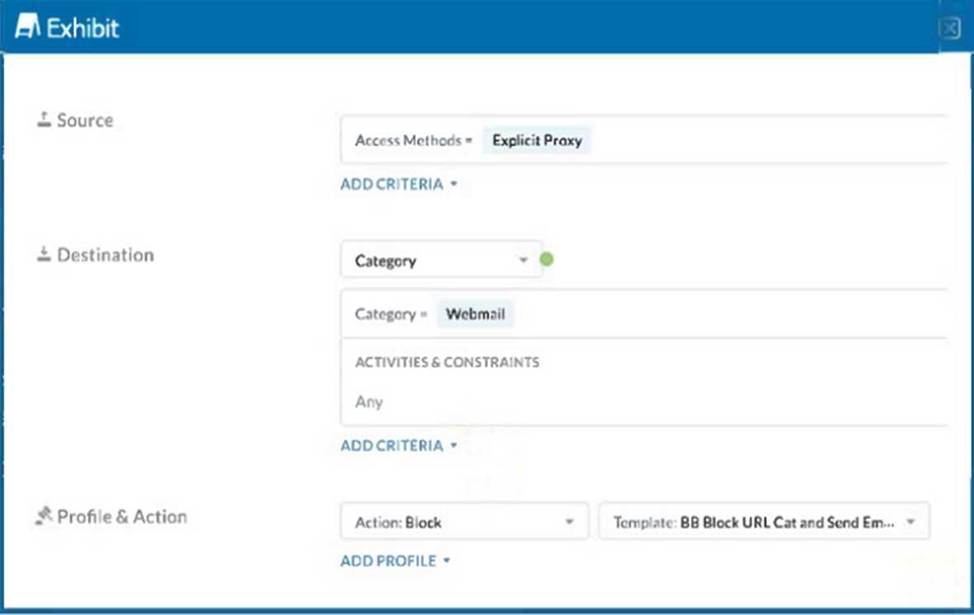
A user has the Netskope Client enabled with the correct steering configuration applied. The exhibit shows an inline policy that has a predefined webmail category blocked. However the user is still able to access Yahoo mail.
Which statement is correct in this scenario?
- A . The user is not part of the correct AD group or OU.
- B . The user is not steered using an explicit proxy.
- C . The webmail category does not include Yahoo mail when using an explicit proxy
- D . The user’s AD group must be added to the policy.
A customer asks you to create several real-time policies. Policy A generates alerts when any user downloads, uploads, or shares files on a cloud storage application. Policy B blocks users from downloading files from any operating system (OS) other than Mac or Windows for cloud storage. In this case, policy A is least restrictive and policy B is more restrictive.
Which statement is correct in this scenario?
- A . Policy A is implemented before policy B.
- B . Policy B is implemented before policy A.
- C . The policy order is not important; policies are independent of each other.
- D . These two policies would actually not work together.
Which two statements are correct about Netskope’s NewEdge Security Cloud Network Infrastructure? (Choose two.)
- A . It utilizes virtual POPs for traffic onboarding ensuring low latency.
- B . It includes direct peering with Microsoft and Google in every data center.
- C . It is a private security cloud network that is over-provisioned, elastic, and built for scale.
- D . It utilizes multiple public cloud providers for inline services ensuring high availability and elasticity.
You have applied a DLP Profile to block all Personally Identifiable Information data uploads to Microsoft 365 OneDrive. DLP Alerts are not displayed and no OneDrive-related activities are displayed in the Skope IT App Events table.
In this scenario, what are two possible reasons for this issue? (Choose two.)
- A . The Cloud Storage category is in the Steering Configuration as an exception.
- B . The destination domain is excluded from decryption in the decryption policy.
- C . A Netskope POP is not in your local country and therefore DLP policies cannot be applied.
- D . DLP policies do not apply when using IPsec as a steering option.
A user has performed a bulk delete activity.
In this scenario, which Netskope feature monitors potential risky users for a malicious activity that would cause data loss?
- A . Netskope’s Threat Protection inline policies
- B . Netskope’s Behavior Analytics rule-based policies
- C . Netskope’s API Data Protection policies
- D . Netskope’s Cloud Threat Exchange integration