
Microsoft PL-400 Practice Exams
Last updated on Nov 16,2026- Exam Code: PL-400
- Exam Name: Microsoft Power Platform Developer
- Certification Provider: Microsoft
- Latest update: Nov 16,2026
A Microsoft Dataverse database contains two custom tables named TableA and TableB.
The tables are configured with the following:
• A one-To-many relationship is configured between TableA and TableB.
• A lookup to TableA appears on a form in TableB.
• Both tables are components of an unmanaged solution.
• Both tables are components in a Power Bl report.
You receive an error when attempting to delete Table A. You need to delete the table.
What should you do?
- A . Remove TableA from the unmanaged solution.
- B . Remove the relationship between TableA and TableB.
- C . Remove the lookup field to TableA on the TableB form.
- D . Remove TableA from the Power Bl report.
HOTSPOT
You are developing a Power Platform solution. You plan to add three buttons to a form.
The buttons have the following requirements:
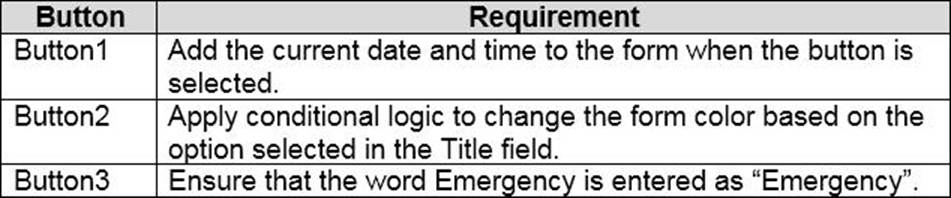
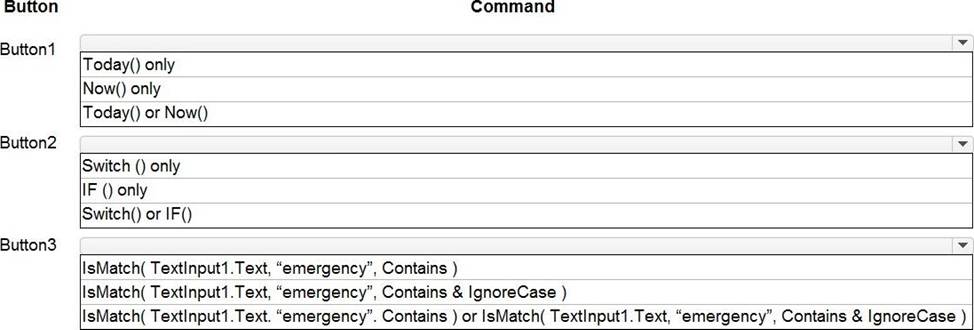
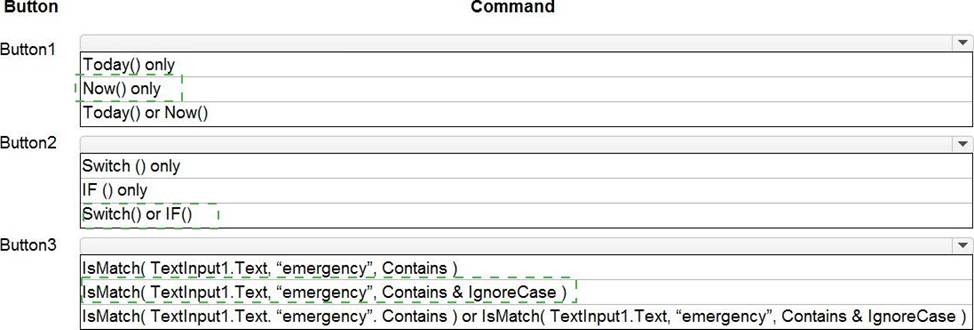
You need to complete each button’s action.
Which commands should you use? To answer, select the appropriate options in the answer area. NOTE: Each correct selection is worth one point.
HOTSPOT
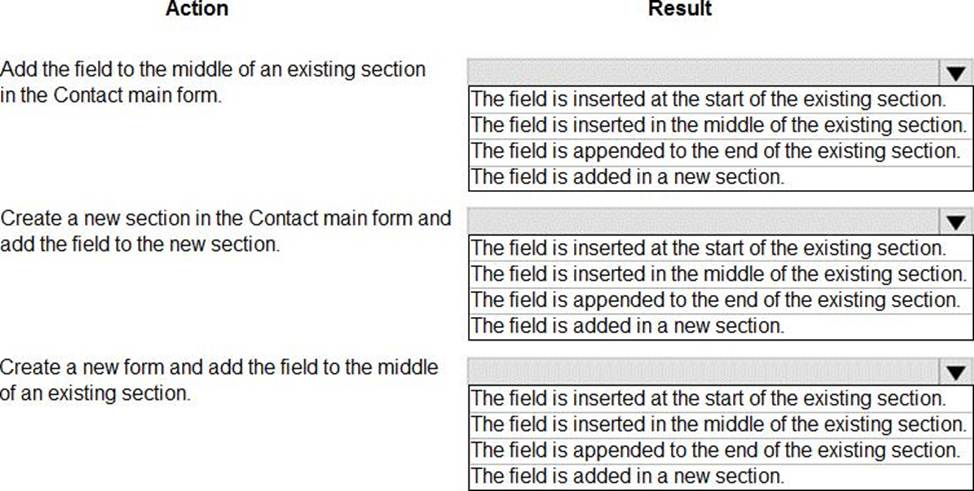
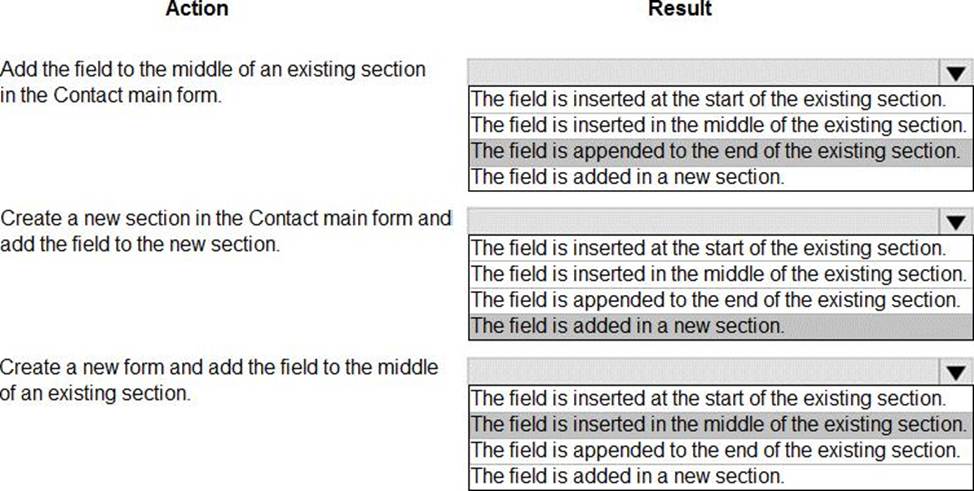
A company has a development environment and a production environment. The production environment has several third-party managed and unmanaged solutions that made changes to the Contact main form.
You create a new solution in the development environment. You add the Contact entity and the Contact main form to the solution. You create a custom field on the Contact entity.
What happens when you perform these actions and import the solution into the production environment? To answer, select the appropriate options in the answer area. NOTE: Each correct selection is worth one point.
DRAG DROP
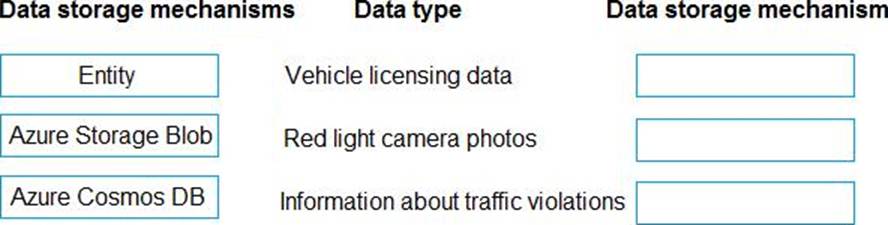
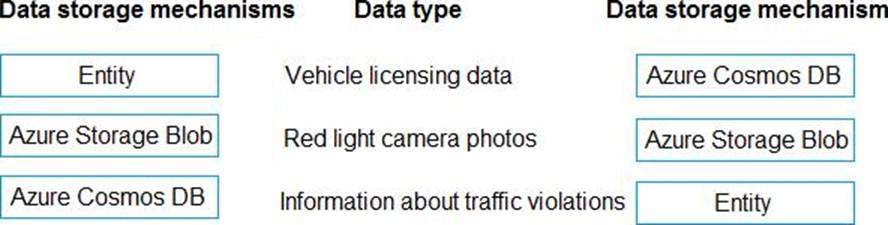
An international organization has a series of client-server applications that manage red light cameras and traffic violations across a wide geographic region. The daily volume of traffic violations is very high and growing.
You plan to use Microsoft Power Platform apps to manage the following types of data:
✑ Existing vehicle licensing data must be imported into Common Data Service and easily queried.
✑ Red light camera images must be stored in a repository for later analysis.
✑ Information about traffic violations must be stored and related to vehicle details.
You need to select data storage mechanisms for the new apps.
Which data storage mechanisms should you use? To answer, drag the appropriate data storage mechanisms to the correct data types. Each storage mechanism may be used once, more than once, or not at all. You may need to drag the split bar between panes or scroll to view content. NOTE: Each correct selection is worth one point.
A company requires a plug-in that makes multiple requests to an external web service. The plug-in must not time out when the web service has issues or is slow to respond.
You need to create the plug-in.
What should you do?
- A . Register the plug-in step once for each web service request.
- B . Register the plug-in to run synchronously.
- C . Send requests to use multiple threads.
- D . Set the HTTP connection timeout value explicitly to limit how long each connection can remain open.
You are developing a model-driven app. The app uses data from two custom tables. The tables have a parent-child relationship. The parent record form contains a subgrid that displays the child records.
When creating a new child record from the parent form, data must automatically populate in the child record form to reduce data input errors.
You need to implement the solution.
What should you do?
- A . Use a Power Automate flow to read data from the parent record and update the child record upon creation.
- B . Map table columns from the parent record to the child record.
- C . Create a business rule that sets the default values on the child record fields to values from the parent record.
- D . Include a quick view form on the child record showing the data from the parent record.
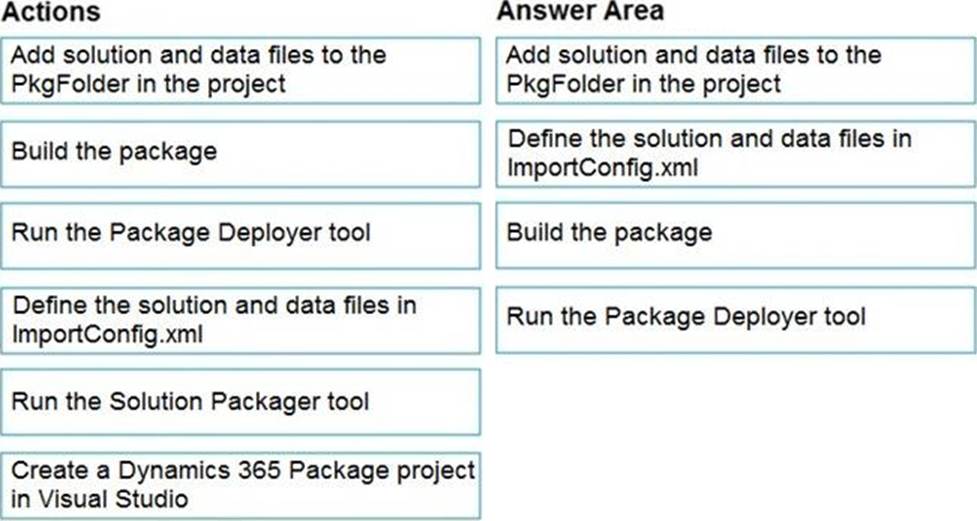
DRAG DROP
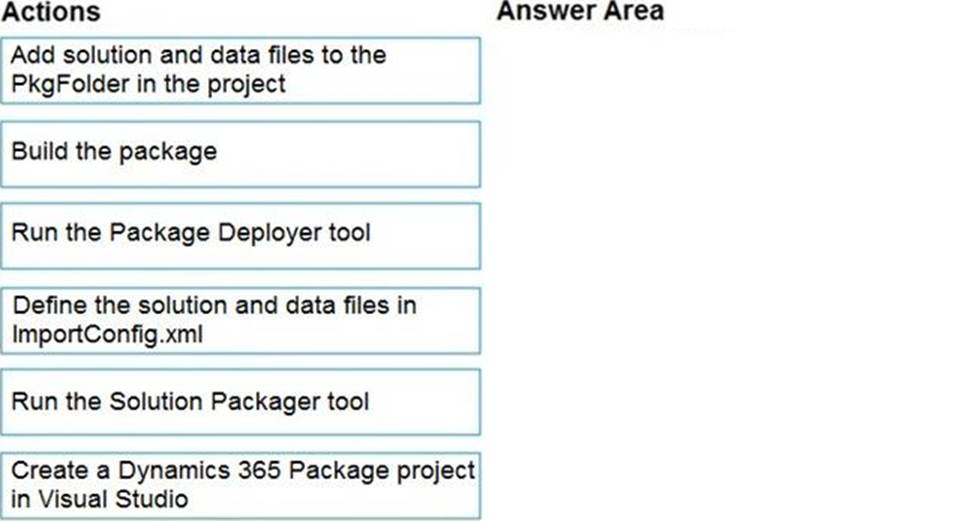
A company has Common Data Service (CDS) environments for development, test, and production.
You have a model-driven app that consists of two solutions. The solutions include settings and reference data. You plan to move the solutions, app settings, and reference data from a development environment to a production environment.
You export each solution from the development environment as a zip file.
You run the Configuration Manager to export the settings and reference data as zip files.
You need to prepare the app and its settings for deployment.
Which four actions should you perform in sequence? To answer, move the appropriate actions from the list of actions to the answer area and arrange them in the correct order. NOTE: More than one order of answer choices is correct. You will receive credit for any of the correct orders you select.
DRAG DROP
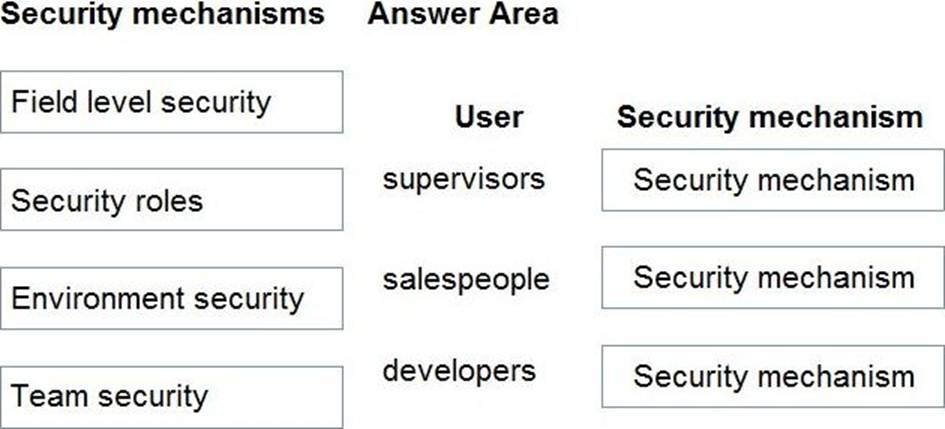
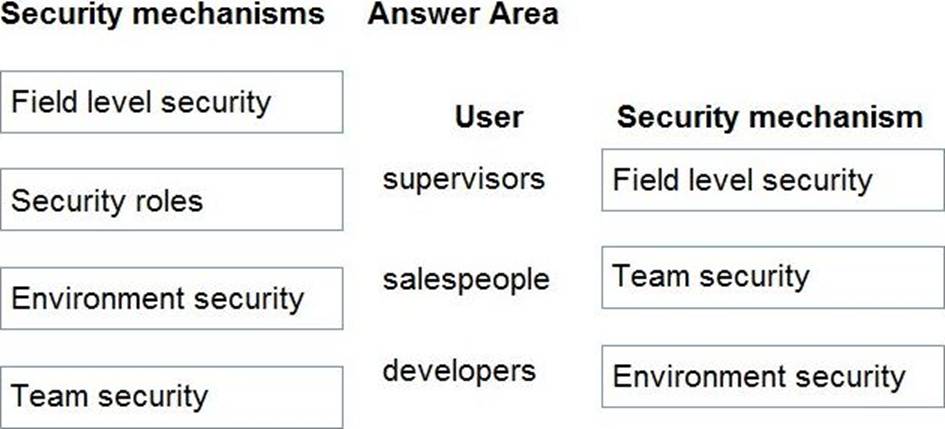
You need to set up security to meet the requirements.
How should you configure security? To answer, drag the appropriate security mechanisms to the correct users. Each security mechanism may be used once, more than once, or not at all. You may need to drag the split bar between panes or scroll to view content. NOTE: Each correct selection is worth one point.
HOTSPOT
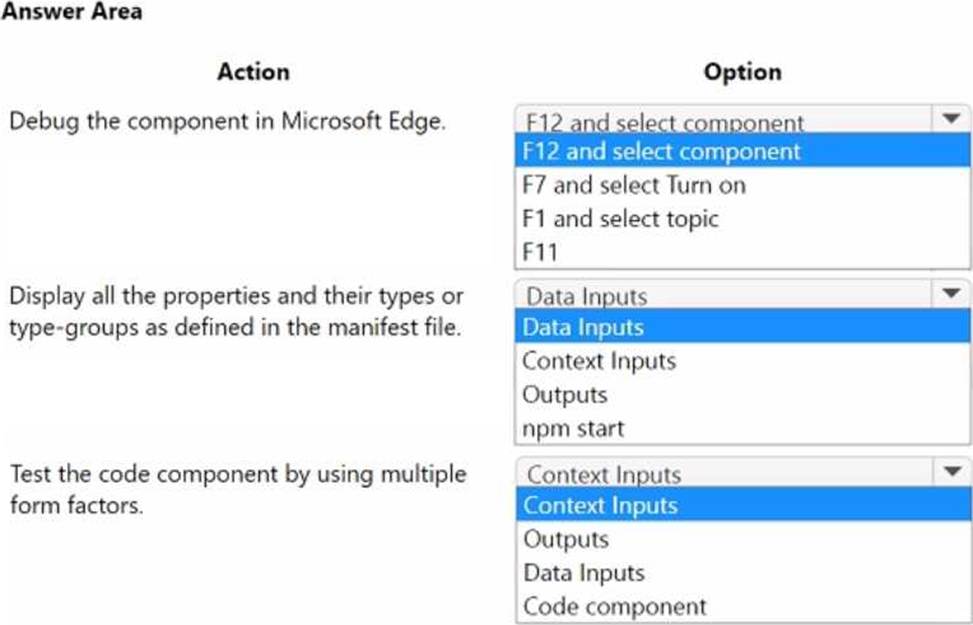
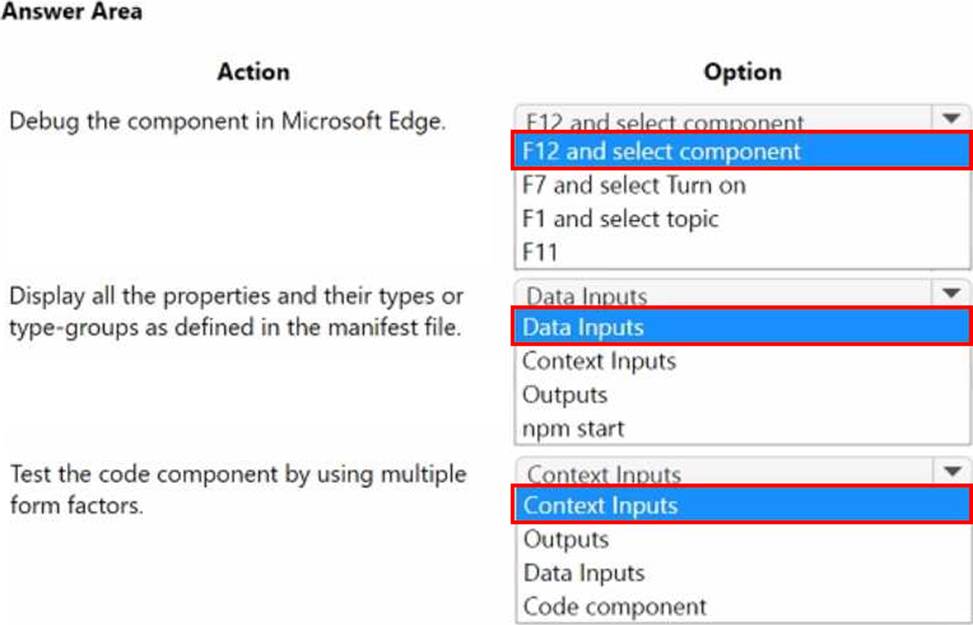
You create a Power Apps component framework component.
You need to test the component.
Which option should you use? To answer, select the appropriate options in the answer area. NOTE: Each correct selection is worth one point.
A company performs an update to an existing column-bound Power Apps Component Framework (PCF) code component.
You test the changes to the code component in the development environment. You then import the component to the production environment as a part of a managed solution. You observe that the changes to the component are not reflected in the production environment.
You need to ensure that the changes are effective in the production environment.
What should you do?
- A . Import the PCF code component to the production environment directly from Visual Studio Code by using the pac pcf push instruction.
- B . Publish the form that uses the PCF code component in the production environment.
- C . Increment the PCF control version property in the manifest.xml file, and then reimport the solution from development to the production environment.
- D . Publish the PCF code component in the production environment