Microsoft DP-100 Practice Exams
Last updated on Nov 16,2026- Exam Code: DP-100
- Exam Name: Designing and Implementing a Data Science Solution on Azure
- Certification Provider: Microsoft
- Latest update: Nov 16,2026
You are a data scientist working for a hotel booking website company. You use the Azure Machine Learning service to train a model that identifies fraudulent transactions.
You must deploy the model as an Azure Machine Learning real-time web service using the Model.deploy method in the Azure Machine Learning SDK. The deployed web service must return real-time predictions of fraud based on transaction data input.
You need to create the script that is specified as the entry_script parameter for the InferenceConfig class used to deploy the model.
What should the entry script do?
- A . Start a node on the inference cluster where the web service is deployed.
- B . Register the model with appropriate tags and properties.
- C . Create a Conda environment for the web service compute and install the necessary Python packages.
- D . Load the model and use it to predict labels from input data.
- E . Specify the number of cores and the amount of memory required for the inference compute.
Note: This question is part of a series of questions that present the same scenario. Each question in the series contains a unique solution that might meet the stated goals. Some question sets might have more than one correct solution, while others might not have a correct solution.
After you answer a question in this section, you will NOT be able to return to it. As a result, these questions will not appear in the review screen.
You train a classification model by using a logistic regression algorithm.
You must be able to explain the model’s predictions by calculating the importance of each feature, both as an overall global relative importance value and as a measure of local importance for a specific set of predictions.
You need to create an explainer that you can use to retrieve the required global and local feature importance values.
Solution: Create a PFIExplainer.
Does the solution meet the goal?
- A . Yes
- B . No
You are with a time series dataset in Azure Machine Learning Studio.
You need to split your dataset into training and testing subsets by using the Split Data module.
Which splitting mode should you use?
- A . Regular Expression Split
- B . Split Rows with the Randomized split parameter set to true
- C . Relative Expression Split
- D . Recommender Split
You are with a time series dataset in Azure Machine Learning Studio.
You need to split your dataset into training and testing subsets by using the Split Data module.
Which splitting mode should you use?
- A . Regular Expression Split
- B . Split Rows with the Randomized split parameter set to true
- C . Relative Expression Split
- D . Recommender Split
DRAG DROP
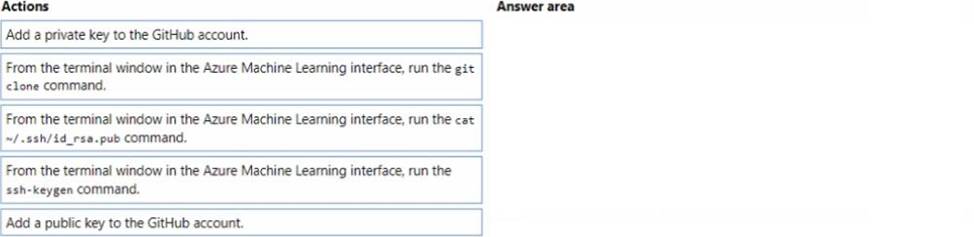
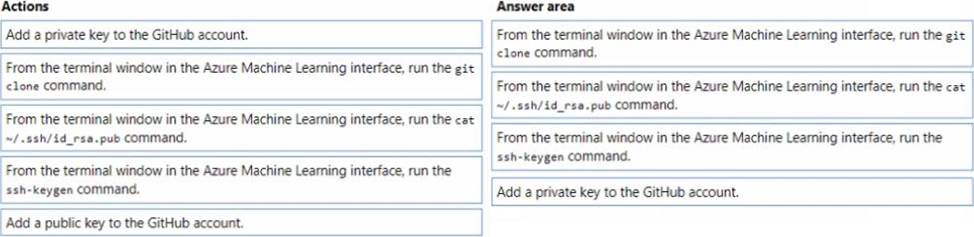
You have an existing GitHub repository containing Azure Machine Learning project files.
You need to clone the repository to your Azure Machine Learning shared workspace file system.
Which four actions should you perform in sequence? To answer, move the appropriate actions from the list of actions to the answer area and arrange them in the correct order. NOTE: More than one order of answer choices is correct. You will receive credit for any of the correct orders you select.
HOTSPOT
You manage an Azure Machine Learning workspace. You create an experiment named experiment1 by using the Azure Machine Learning Python SDK v2 and MLflow.
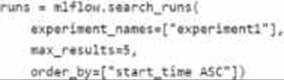
You are reviewing the results of experiment1 by using the following code segment:
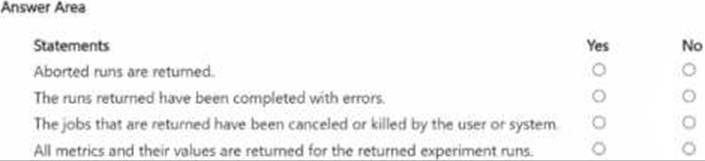
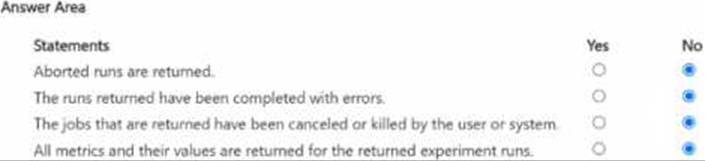
For each of the following statements, Select Yes if the statement is true Otherwise, select No.
Topic 2, Case Study 2
Case study
Overview
You are a data scientist for Fabrikam Residences, a company specializing in quality private and commercial property in the United States. Fabrikam Residences is considering expanding into Europe and has asked you to investigate prices for private residences in major European cities. You use Azure Machine Learning Studio to measure the median value of properties. You produce a regression model to predict property prices by using the Linear Regression and Bayesian Linear Regression modules.
Datasets
There are two datasets in CSV format that contain property details for two cities, London and Paris, with the following columns:
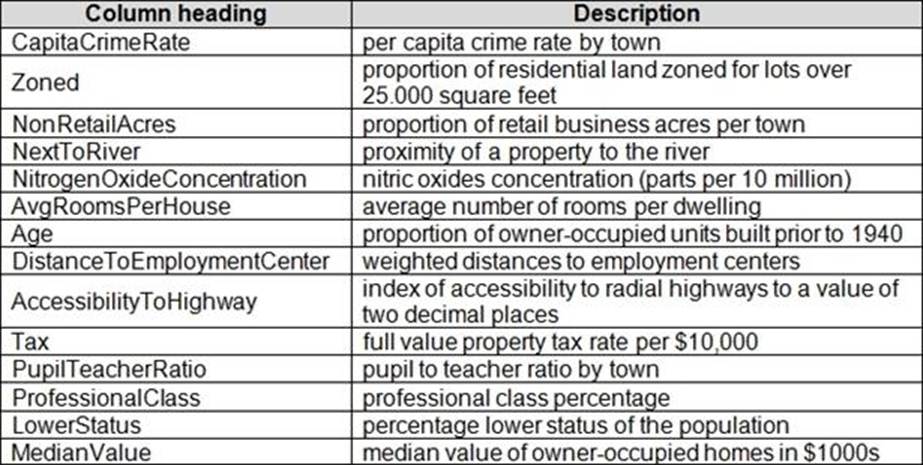
The two datasets have been added to Azure Machine Learning Studio as separate datasets and included as the starting point of the experiment.
Dataset issues
The AccessibilityToHighway column in both datasets contains missing values. The missing data must be replaced with new data so that it is modeled conditionally using the other variables in the data before filling in the missing values.
Columns in each dataset contain missing and null values. The dataset also contains many outliers. The Age column has a high proportion of outliers. You need to remove the rows that have outliers in the Age column. The MedianValue and AvgRoomsinHouse columns both hold data in numeric format. You need to select a feature selection algorithm to analyze the relationship between the two columns in more detail.
Model fit
The model shows signs of overfitting. You need to produce a more refined regression model that reduces the overfitting.
Experiment requirements
You must set up the experiment to cross-validate the Linear Regression and Bayesian Linear Regression modules to evaluate performance.
In each case, the predictor of the dataset is the column named MedianValue. An initial investigation showed that the datasets are identical in structure apart from the MedianValue column. The smaller Paris dataset contains the MedianValue in text format, whereas the larger London dataset contains the MedianValue in numerical format. You must ensure that the datatype of the MedianValue column of the Paris dataset matches the structure of the London dataset.
You must prioritize the columns of data for predicting the outcome. You must use non-parameters statistics to measure the relationships.
You must use a feature selection algorithm to analyze the relationship between the MedianValue and AvgRoomsinHouse columns.
Model training
Given a trained model and a test dataset, you need to compute the permutation feature importance scores of feature variables. You need to set up the Permutation Feature Importance module to select the correct metric to investigate the model’s accuracy and replicate the findings.
You want to configure hyperparameters in the model learning process to speed the learning phase by using hyperparameters. In addition, this configuration should cancel the lowest performing runs at each evaluation interval, thereby directing effort and resources towards models that are more likely to be successful.
You are concerned that the model might not efficiently use compute resources in hyperparameter tuning. You also are concerned that the model might prevent an increase in the overall tuning time. Therefore, you need to implement an early stopping criterion on models that provides savings without terminating promising jobs.
Testing
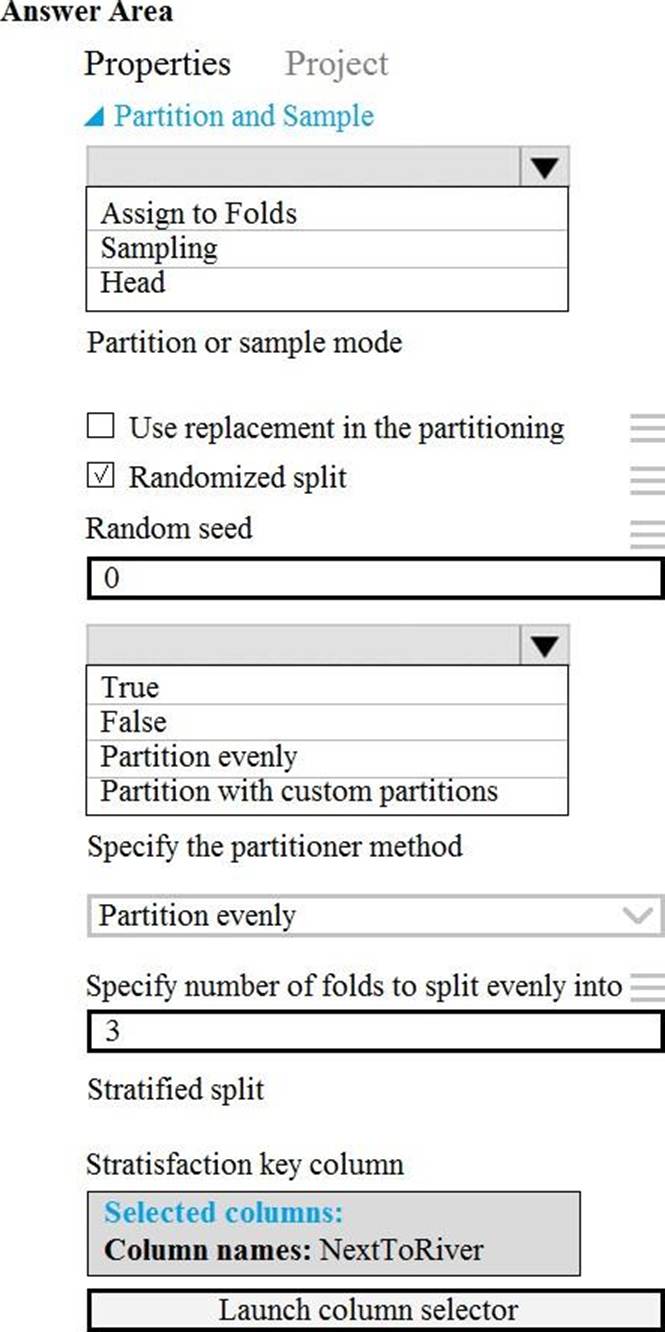
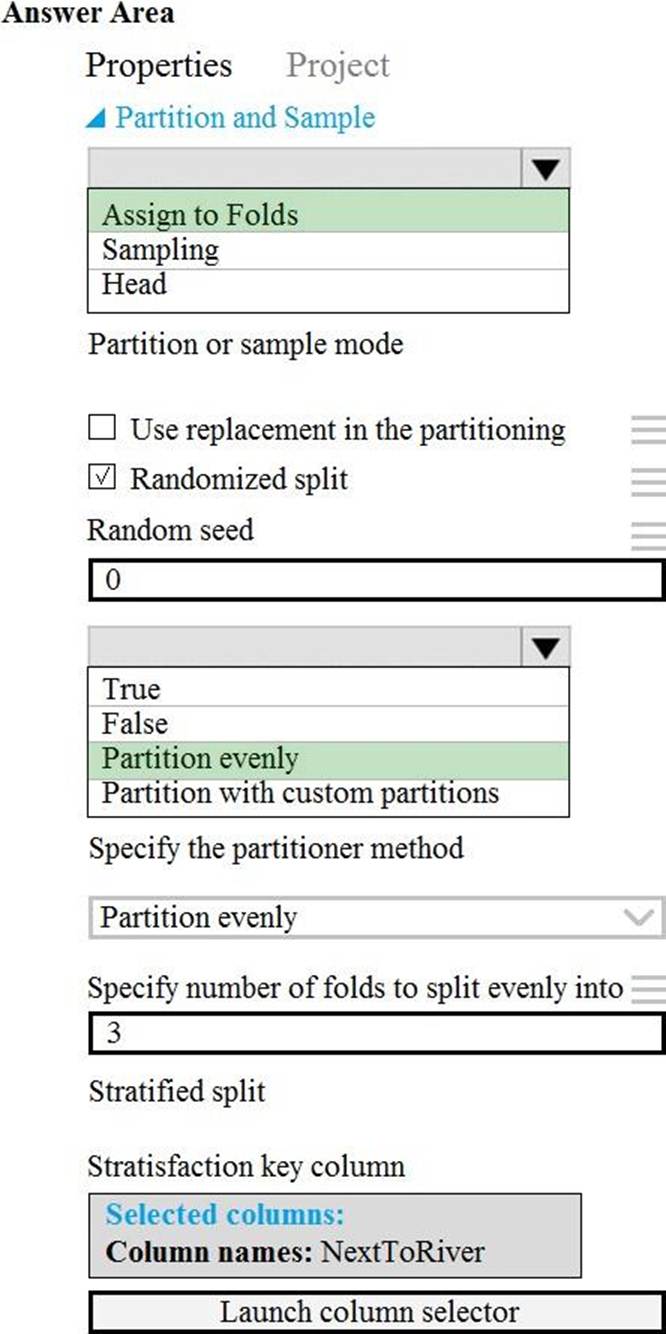
You must produce multiple partitions of a dataset based on sampling using the Partition and Sample module in Azure Machine Learning Studio. You must create three equal partitions for cross-validation. You must also configure the cross-validation process so that the rows in the test and training datasets are divided evenly by properties that are near each city’s main river. The data that identifies that a property is near a river is held in the column named NextToRiver. You want to complete this task before the data goes through the sampling process.
When you train a Linear Regression module using a property dataset that shows data for property prices for a large city, you need to determine the best features to use in a model. You can choose standard metrics provided to measure performance before and after the feature importance process completes. You must ensure that the distribution of the features across multiple training models is consistent.
Data visualization
You need to provide the test results to the Fabrikam Residences team. You create data visualizations to aid in presenting the results.
You must produce a Receiver Operating Characteristic (ROC) curve to conduct a
diagnostic test evaluation of the model. You need to select appropriate methods for producing the ROC curve in Azure Machine Learning Studio to compare the Two-Class Decision Forest and the Two-Class Decision Jungle modules with one another.
DRAG DROP
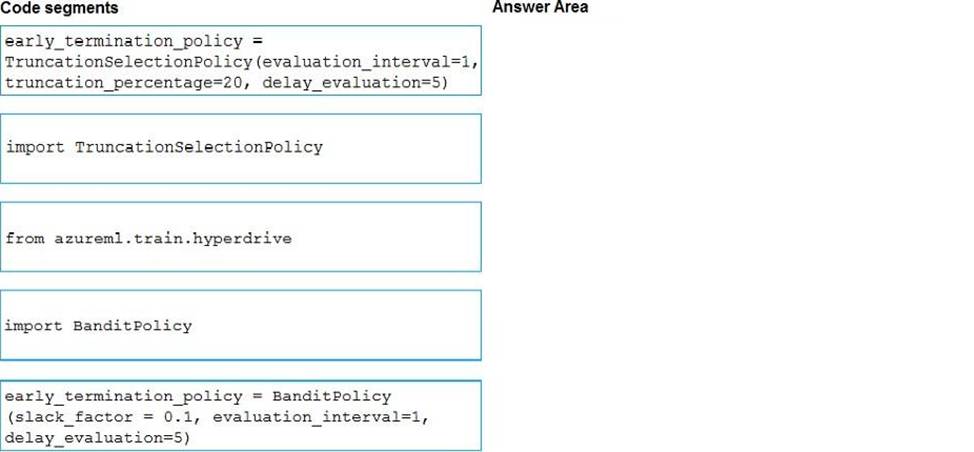
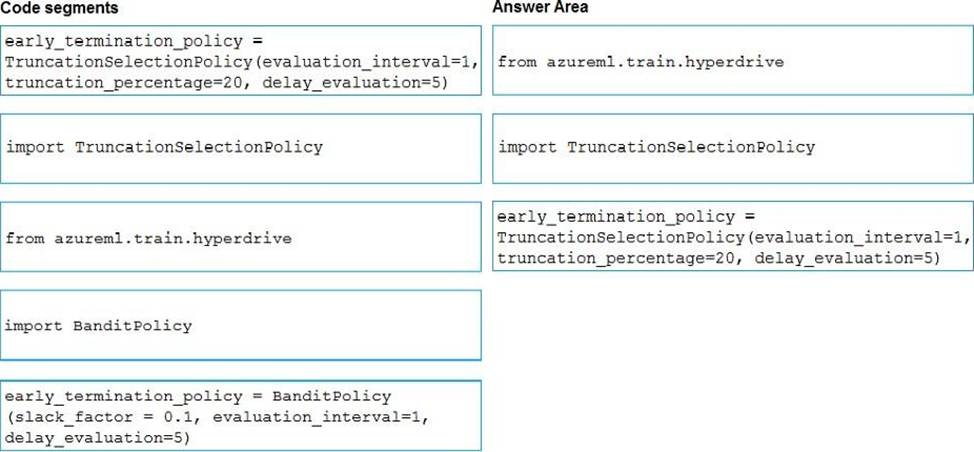
You need to implement early stopping criteria as suited in the model training requirements.
Which three code segments should you use to develop the solution? To answer, move the appropriate code segments from the list of code segments to the answer area and arrange them in the correct order. NOTE: More than one order of answer choices is correct. You will receive credit for any of the correct orders you select.
DRAG DROP
You previously deployed a model that was trained using a tabular dataset named training-dataset, which is based on a folder of CSV files.
Over time, you have collected the features and predicted labels generated by the model in a folder containing a CSV file for each month. You have created two tabular datasets based on the folder containing the inference data: one named predictions-dataset with a schema that matches the training data exactly, including the predicted label; and another named features-dataset with a schema containing all of the feature columns and a timestamp column based on the filename, which includes the day, month, and year.
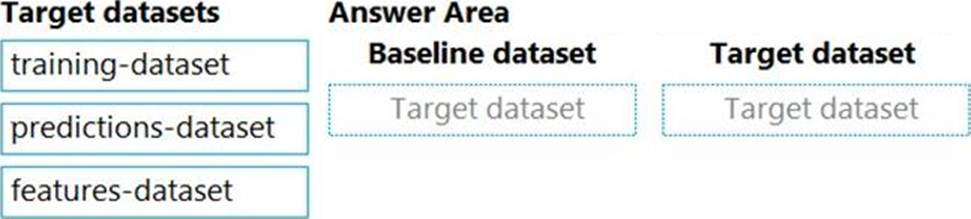
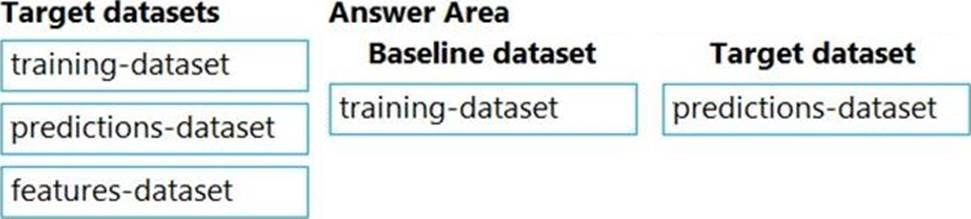
You need to create a data drift monitor to identify any changing trends in the feature data since the model was trained. To accomplish this, you must define the required datasets for the data drift monitor.
Which datasets should you use to configure the data drift monitor? To answer, drag the appropriate datasets to the correct data drift monitor options. Each source may be used once, more than once, or not at all. You may need to drag the split bar between panes or scroll to view content. NOTE: Each correct selection is worth one point.
You need to select a pre built development environment for a series of data science experiments. You must use the R language for the experiments.
Which three environments can you use? Each correct answer presents a complete solution. NOTE:
Each correct selection is worth one point.
- A . MI.NET Library on a local environment
- B . Azure Machine Learning Studio
- C . Data Science Virtual Machine (OSVM)
- D . Azure Data bricks
- E . Azure Cognitive Services
HOTSPOT
You need to identify the methods for dividing the data according to the testing requirements.
Which properties should you select? To answer, select the appropriate options in the answer area. NOTE: Each correct selection is worth one point.