Microsoft DP-100 Practice Exams
Last updated on Nov 16,2026- Exam Code: DP-100
- Exam Name: Designing and Implementing a Data Science Solution on Azure
- Certification Provider: Microsoft
- Latest update: Nov 16,2026
HOTSPOT
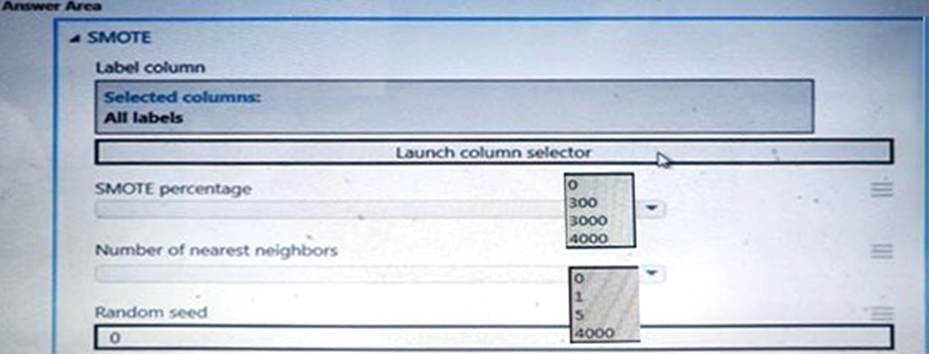
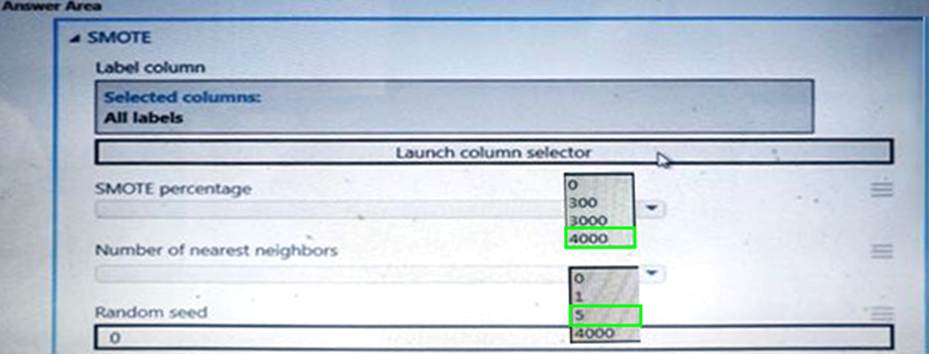
You create an experiment in Azure Machine Learning Studio- You add a training dataset that contains 10.000 rows. The first 9.000 rows represent class 0 (90 percent). The first 1.000 rows represent class 1 (10 percent).
The training set is unbalanced between two Classes. You must increase the number of training examples for class 1 to 4,000 by using data rows. You add the Synthetic Minority Oversampling Technique (SMOTE) module to the experiment.
You need to configure the module.
Which values should you use? To answer, select the appropriate options in the dialog box in the answer area. NOTE: Each correct selection is worth one point.
You plan to use the Hyperdrive feature of Azure Machine Learning to determine the optimal hyperparameter values when training a model.
You must use Hyperdrive to try combinations of the following hyperparameter values:
• learning_rate: any value between 0.001 and 0.1
• batch_size: 16, 32, or 64
You need to configure the search space for the Hyperdrive experiment.
Which two parameter expressions should you use? Each correct answer presents part of the solution. NOTE: Each correct selection is worth one point.
- A . a choice expression for learning_rate
- B . a uniform expression for learning_rate
- C . a normal expression for batch_size
- D . a choice expression for batch_size
- E . a uniform expression for batch_size
You arc creating a new experiment in Azure Machine Learning Studio. You have a small dataset that has missing values in many columns. The data does not require the application of predictors for each column. You plan to use the Clean Missing Data module to handle the missing data.
You need to select a data cleaning method.
Which method should you use?
- A . Synthetic Minority
- B . Replace using Probabilistic PAC
- C . Replace using MICE
- D . Normalization
You have the following Azure subscriptions and Azure Machine Learning service workspaces:

You need to obtain a reference to the mi-protect workspace
Solution: Run the following Python code.

Does the solution meet the goal?
- A . Yes
- B . No
DRAG DROP
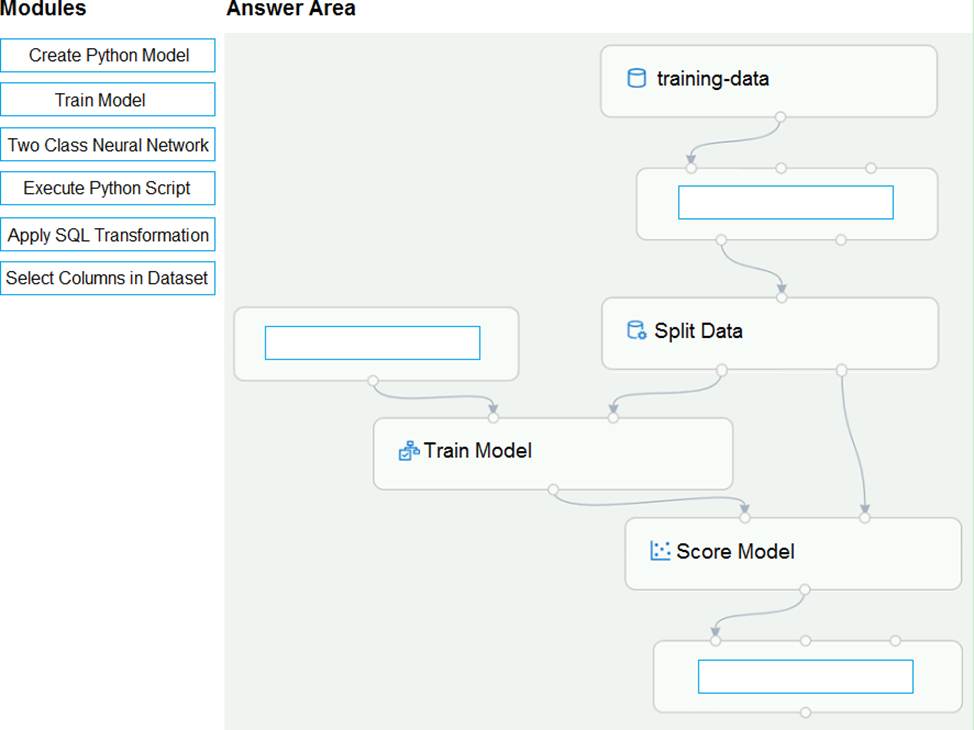
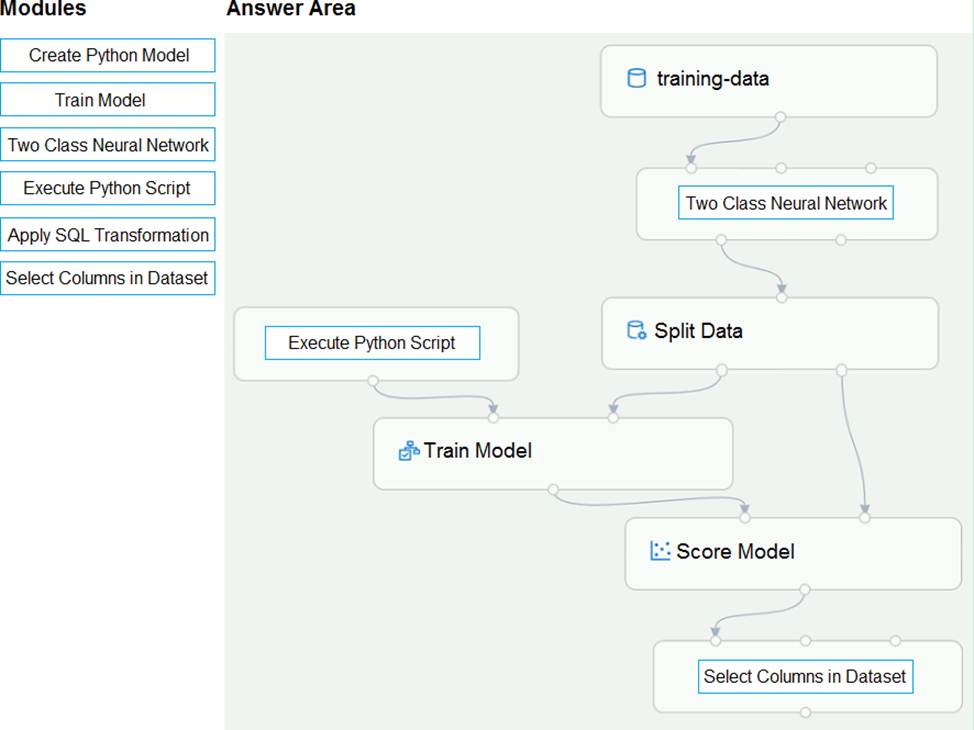
You create a training pipeline using the Azure Machine Learning designer. You upload a CSV file that contains the data from which you want to train your model.
You need to use the designer to create a pipeline that includes steps to perform the following tasks:
Select the training features using the pandas filter method.
Train a model based on the naive_bayes.GaussianNB algorithm.
Return only the Scored Labels column by using the query SELECT [Scored Labels] FROM t1;
Which modules should you use? To answer, drag the appropriate modules to the appropriate locations. Each module name may be used once, more than once, or not at all. You may need to drag the split bar between panes or scroll to view content. NOTE: Each correct selection is worth one point.
You manage an Azure Machine Learning workspace.
You must log multiple metrics by using MLflow.
You need to maximize logging performance.
What are two possible ways to achieve this goal? Each correct answer presents a complete solution. NOTE: Each correct selection is worth one point.
- A . MLflowClient.log_batch
- B . mlflowlog_metrics
- C . mlflow.log_param
- D . mlflow.log. metric
Note: This question is part of a series of questions that present the same scenario. Each question in the series contains a unique solution that might meet the stated goals. Some question sets might have more than one correct solution, while others might not have a correct solution.
After you answer a question in this section, you will NOT be able to return to it. As a result, these questions will not appear in the review screen.
You use Azure Machine Learning designer to load the following datasets into an experiment:
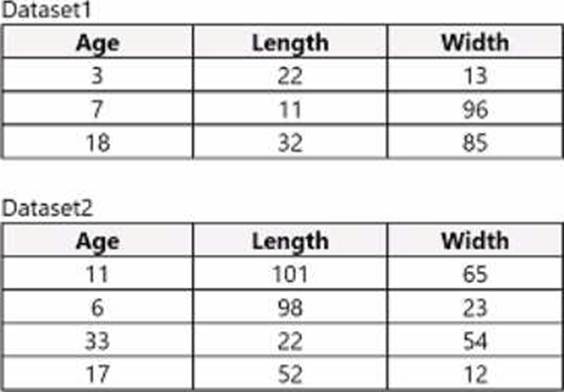
You need to create a dataset that has the same columns and header row as the input datasets and contains all rows from both input datasets.
Solution: Use the Execute Python Script module.
Does the solution meet the goal?
- A . Yes
- B . No
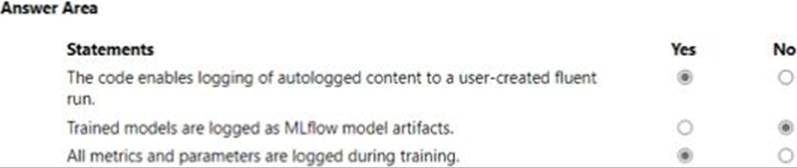
HOTSPOT
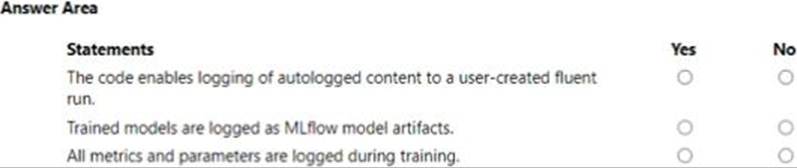
You manage an Azure Machine Learning workspace. You submit a training job with the Azure Machine Learning Python SDK v2. You must use MLflow to log metrics, model parameters, and mode! artifacts automatically when training a model.
You start by writing the following code segment:

For each of the following statements, select Yes If the statement is true. Otherwise, select No.
You are using Azure Machine Learning to monitor a trained and deployed model. You implement Event Grid to respond to Azure Machine Learning events.
Model performance has degraded due to model input data changes.
You need to trigger a remediation ML pipeline based on an Azure Machine Learning event.
Which event should you use?
- A . RunStatusChanged
- B . DatasetDriftDetected
- C . ModelDeployed
- D . RunCompleted
HOTSPOT
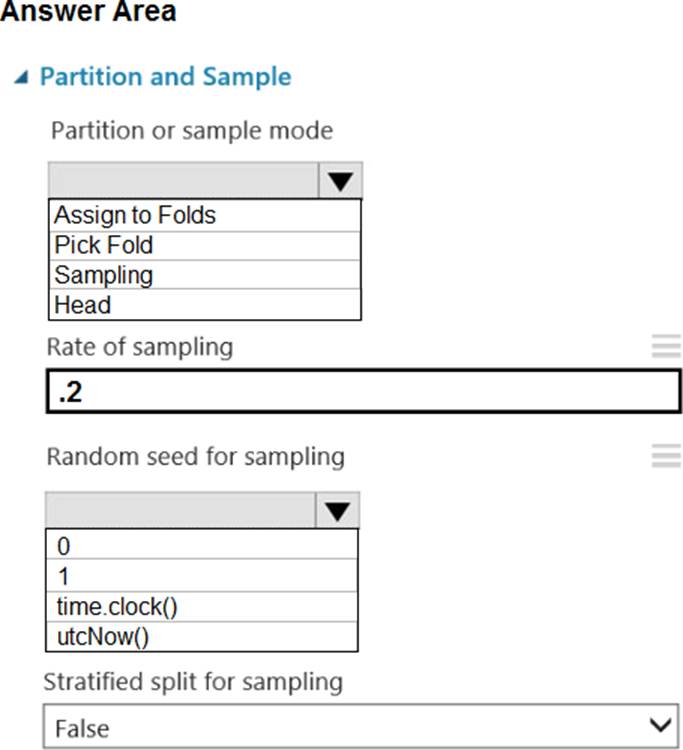
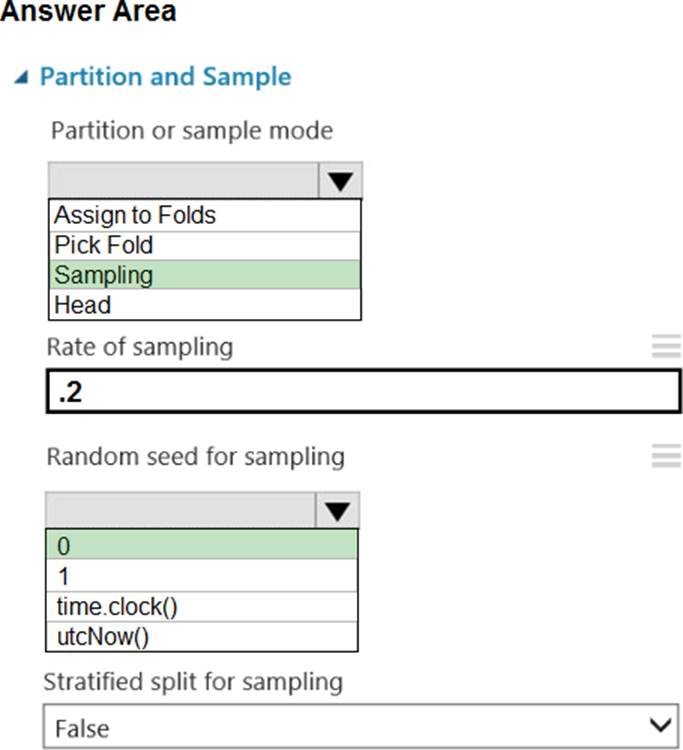
You are retrieving data from a large datastore by using Azure Machine Learning Studio.
You must create a subset of the data for testing purposes using a random sampling seed based on the system clock.
You add the Partition and Sample module to your experiment.
You need to select the properties for the module.
Which values should you select? To answer, select the appropriate options in the answer area. NOTE: Each correct selection is worth one point.