
Microsoft AZ-801 Practice Exams
Last updated on Nov 16,2026- Exam Code: AZ-801
- Exam Name: Configuring Windows Server Hybrid Advanced Services
- Certification Provider: Microsoft
- Latest update: Nov 16,2026
You have 100 Azure virtual machines that run Windows Server. The virtual machines are onboarded to Microsoft Defender for Cloud.
You need to shut down a virtual machine automatically if Microsoft Defender for Cloud generates the "Antimalware disabled in the virtual machine" alert for the virtual machine.
What should you use in Microsoft Defender for Cloud?
- A . a logic app
- B . a workbook
- C . a security policy
- D . adaptive network hardening
A
Explanation:
Reference: https://docs.microsoft.com/en-us/azure/defender-for-cloud/managing-and-responding-alerts
You have a server named Server1 that runs Windows Server.
You need to ensure that only specific applications can modify the data in protected folders on Server1.
Solution: From App & browser control, you configure the Reputation-based protection.
Does this meet the goal?
- A . Yes
- B . No
You have three Azure virtual machines named VM1, VM2, and VM3 that host a multitier application.
You plan to implement Azure Site Recovery.
You need to ensure that VM1, VM2, and VM3 fail over as a group.
What should you configure?
- A . an availability zone
- B . a recovery plan
- C . an availability set
B
Explanation:
Reference: https://docs.microsoft.com/en-us/azure/site-recovery/site-recovery-overview
You have three servers named Server 1. Servers and Server3 that run Windows Server. The servers have the Hyper-V server rote installed and are configured in a Storage Spaces Deed cluster named Cluster1.
Cluster1 hosts a virtual machine named VM1 that has Windows Admin Center Installed.
You manage all servers and clusters by using Windows Admin Center.
You purchase an Azure subscription.
You need to configure email alerts in Azure Monitor for the following:
• Disk Capacity Utilization Over 80% for 10 Minutes
• Any critical alert in the cluster system event log
• Memory Utilization over 95% for 10 minutes
• Heartbeat fewer than 5 beats for 5 Minutes.
• CPU Utilization over 85 % for 10 Minutes.
• Any hearth service faults for the cluster
The solution must use the minimum amount of administrative effort.
What should you do?
- A . From Windows Admin Center, configure Azure Monitor and onboard clustered.
- B . From Azure portal, configure Azure Monitor and onboard Cluster1 by using Azure Arc.
- C . Configure Azure Monitor and manually install the Microsoft Monitoring Agent on Server1, Server2 and Server3
You have two Azure virtual networks named Vnet1 and Vnet2.
You have a Windows 10 device named Client1 that connects to Vnet1 by using a Point-to-Site (P2S) IKEv2 VPN.
You implement virtual network peering between Vnet1 and Vnet2. Vnet1 allows gateway transit Vnet2 can use the remote gateway.
You discover that Client1 cannot communicate with Vnet2. You need to ensure that Client1 can communicate with Vnet2.
Solution: You resize the gateway of Vnet1 to a larger SKU.
Does this meet the goal?
- A . Yes
- B . No
Your company uses Storage Spaces Direct.
You need to view the available storage in a Storage Space Direct storage pool.
What should you use?
- A . System Configuration
- B . File Server Resource Manager (FSRM)
- C . the Get-ScorageFileServer cmdlet
- D . Failover Cluster Manager
D
Explanation:
If Failover Cluster Manager, select the Storage Space Direct storage pool. The information displayed in the main window includes the free space and used space.
HOTSPOT
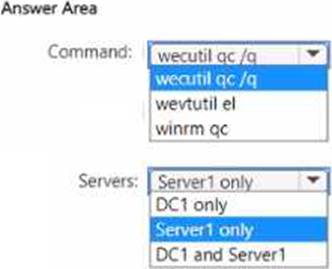
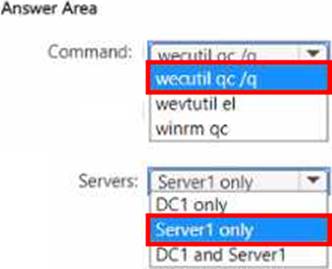
Your network contains an Active Directory domain. The domain contains a domain controller named DC1 and a server named Server1 that runs Windows Server.
You need to enable event log subscriptions to forward events from DC1 to Server1.
Which command should you run to enable the Windows Event Collector service, and on which servers should you run the command? To answer, select the appropriate options in the answer area. NOTE: Each correct selection is worth one point.
You have two Azure Virtual machines that run Windows Server.
You plan to create a failover cluster that will host the virtual machines.
You need to configure an Azure Storage account that will be used by the cluster as a cloud witness.
The solution must maximize resiliency.
Which type of redundancy should you configure for the storage account?
- A . Geo-zone-redundant storage (GZRS)
- B . Geo-redundant storage (GRS)
- C . Zone-redundant storage (ZRS)
- D . Locally-redundant storage (LRS)
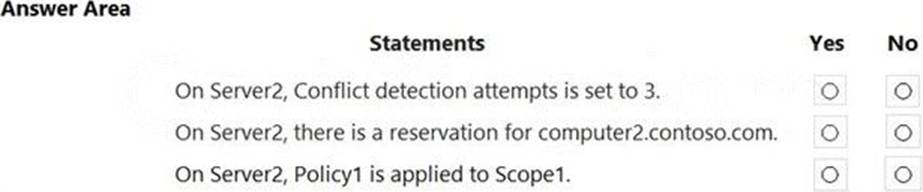
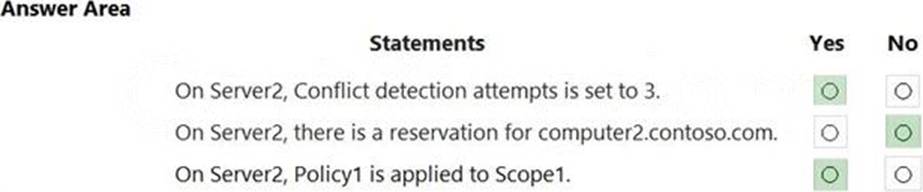
Address Leases:
– 172.16.10.100 computer1.contoso.com
– 172.16.10.101 computer2.contoso.com
Reservations: 172.16.10.101 computer2.contoso.com
Policies: Policy1
You perform the following actions:
✑ On Server1, you run
Export-DhcpServer -File \Server3Share1File1.xml.
✑ On Server2, you run
Import-DhcpServer -File \Server3Share1File1.xml
-BackupPath \Server3Share1.
For each of the following statements, select Yes if the statement is true. Otherwise, select No. NOTE: Each correct selection is worth one point.
Explanation:
Reference:
https://docs.microsoft.com/en-us/powershell/module/dhcpserver/export-dhcpserver?view=windowsserver2022-ps
https://docs.microsoft.com/en-us/powershell/module/dhcpserver/import-dhcpserver?view=windowsserver2022-ps
HOTSPOT
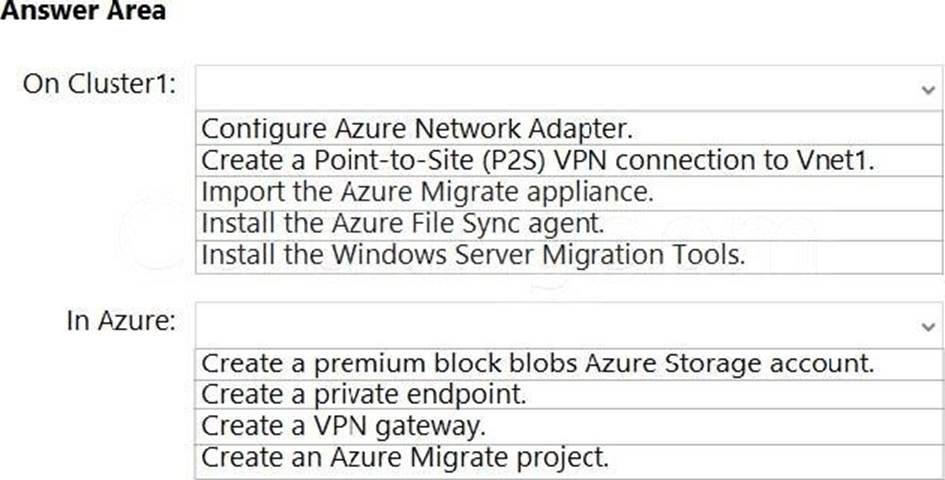
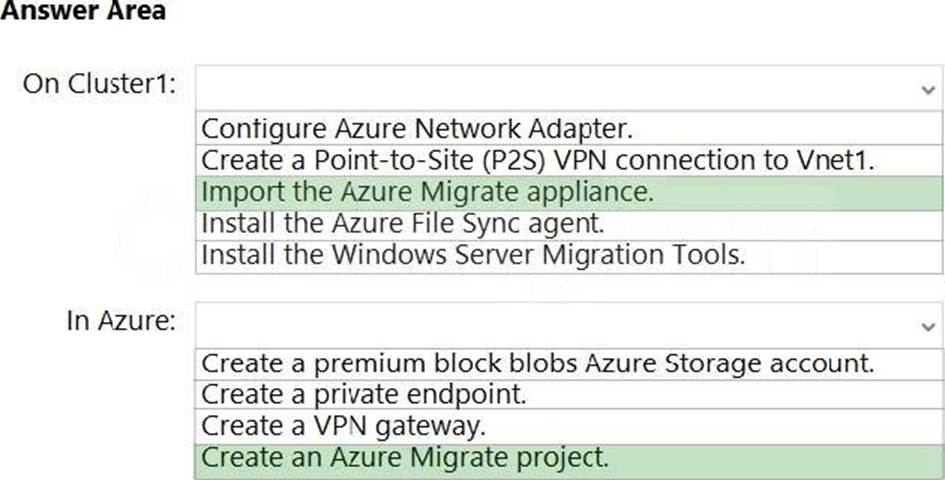
You are planning the migration of APP3 and APP4 to support the Azure migration plan.
What should you do on Cluster1 and in Azure before you perform the migration? To answer, select the appropriate options in the answer area. NOTE: Each correct selection is worth one point.
Explanation:
Reference: https://docs.microsoft.com/en-us/azure/migrate/tutorial-discover-hyper-v