
Microsoft AZ-801 Practice Exams
Last updated on Nov 16,2026- Exam Code: AZ-801
- Exam Name: Configuring Windows Server Hybrid Advanced Services
- Certification Provider: Microsoft
- Latest update: Nov 16,2026
Your network contains a single-domain Active Directory Domain Services (AD DS) forest named contoso.com. The functional level of the forest is Windows Server 2012 R2. All domain controllers run Windows Server 2012 R2.
Sysvol replicates by using the File Replication Service (FRS).
You plan to replace the existing domain controllers with new domain controllers that will run Windows Server 2022.
You need to ensure that you can add the first domain controller that runs Windows Server 2022.
Solution; You raise the domain and forest functional levels.
Does this meet the goal?
- A . Yes
- B . No
DRAG DROP
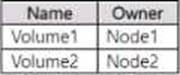
You have a Windows Server 2022 failover cluster named Cluster1 that contains the Cluster Shared Volumes (CSV) shown in the following table.
All the nodes in Cluster1 have BitLocker Drive Encryption (BitLocker) installed.
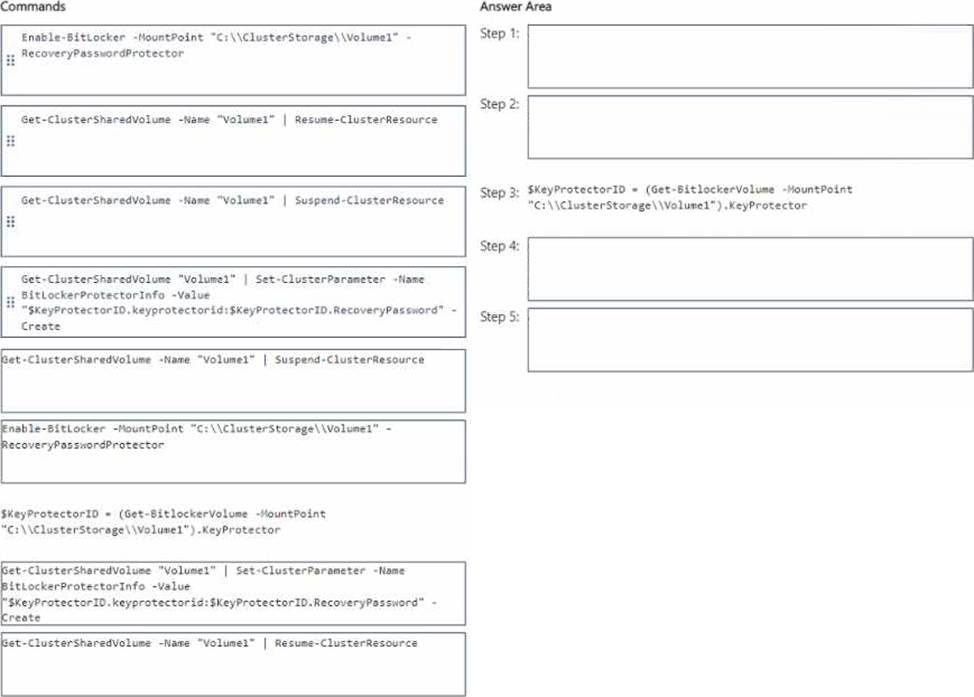
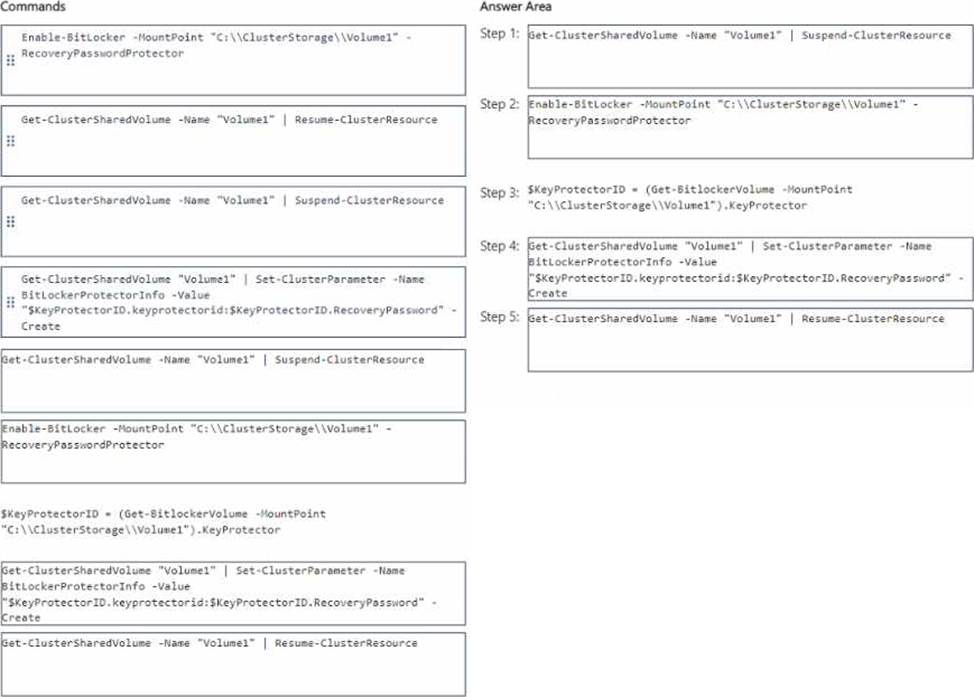
You need to use PowerShell to enable BitLocker on Volume1.
In which order should you run the commands? To answer, drag the appropriate commands to the correct order. You may need to drag the split bar between panes or scroll to view content. NOTE Each correct selection is worth one point.
You have two file servers named Server1 and Server2 that run Windows Server. Server1 contains a shared folder named Data. Data contains 10 TB of data.
You plan to decommission Server1.
You need to migrate the files from Data to a new shared folder on Server2.
The solution must meet the following requirements:
✑ Ensure that share, file, and folder permissions are copied.
✑ After the initial copy occurs, ensure that changes in \Server1Data can be synced to the destination without initiating a full copy.
✑ Minimize administrative effort.
What should you use?
- A . xcopy
- B . Storage Replica
- C . Storage Migration Service
- D . azcopy
C
Explanation:
Reference: https://docs.microsoft.com/en-us/windows-server/storage/storage-migration-service/overview#why-use-storage-migration-service
You have two servers named Server1 and Server2 that run Windows Server. Both servers have the Hyper-V server role installed.
Server1 hosts three virtual machines named VM1, VM2, and VM3. The virtual machines replicate to Server2.
Server1 experiences a hardware failure.
You need to bring VM1, VM2, and VM3 back online as soon as possible.
From the Hyper-V Manager console on Server2, what should you run for each virtual machine?
- A . Start
- B . Move
- C . Unplanned Failover
- D . Planned Failover
C
Explanation:
Reference: https://docs.microsoft.com/en-us/windows-server/virtualization/hyper-v/manage/set-up-hyper-v-replica
You have a server named Server1 that runs the Remote Desktop Session Host role service. Server1 has five custom applications installed.
Users who sign in to Server1 report that the server is slow. Task Manager shows that the average CPU usage on Server1 is above 90 percent. You suspect that a custom application on Server1 is consuming excessive processor capacity.
You plan to create a Data Collector Set in Performance Monitor to gather performance statistics from Server1.
You need to view the resources used by each of the five applications.
Which object should you add to the Data Collector Set?
- A . Processor information
- B . Processor
- C . Process
- D . Processor performance
You have five Azure virtual machines.
You need to collect performance data and Windows Event logs from the virtual machines. The data collected must be sent to an Azure Storage account.
What should you install on the virtual machines?
- A . the Azure Connected Machine agent
- B . the Azure Monitor agent
- C . the Dependency agent
- D . the Telegraf agent
- E . the Azure Diagnostics extension
E
Explanation:
Reference: https://docs.microsoft.com/en-us/azure/azure-monitor/agents/diagnostics-extension-overview
HOTSPOT
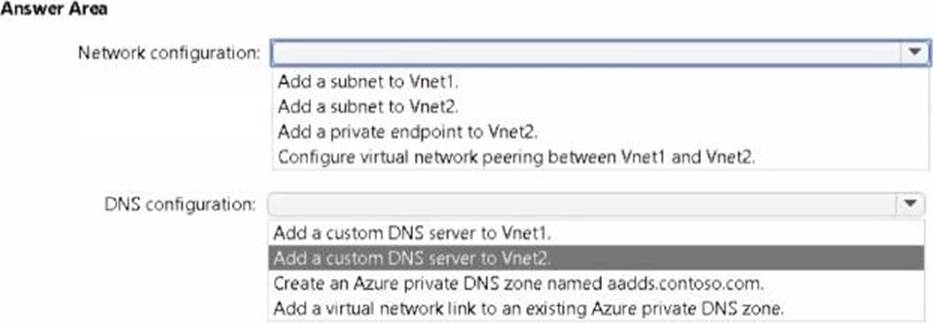
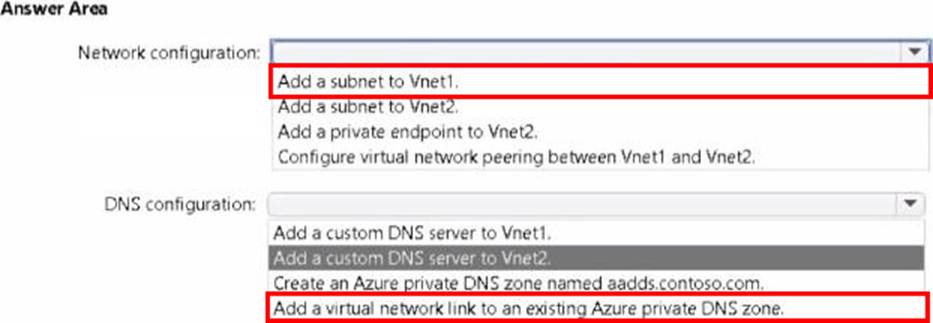
You have an Azure Active Directory Domain Services (Azure AD DS) domain named aadds.contoso.com.
You have an Azure virtual network named Vnet1. Vnet1 contains two virtual machines named VM1 and VM2 that run Windows Server. VMI and VM2 are joined to aadds.contoso.com.
You create a new Azure virtual network named Vnet2. You add a new server named VM3 to Vnet2. When you attempt to join VM3 to aadds.contoso.com, you get an error message that the domain cannot be found.
You need to ensure that you can join VM3 toaadds.contoso.com.
You have an Azure virtual machine named VM1 that runs Windows Server.
The operating system on VM1 fails to fully initialize its network stack, and you cannot establish a network connection.
You need to establish an interactive shell session.
What should you use?
- A . Azure Bastion
- B . Serial console
- C . just-in-time (JIT) VM access
You have an on-premises Active Directory Domain Services (AD DS) domain that syncs with an Azure Active Directory (Azure AD) tenant by using password hash synchronization.
You have a Microsoft 365 subscription.
All devices are hybrid Azure AD-joined.
Users report that they must enter their password manually when accessing Microsoft 365 applications.
You need to reduce the number of times the users are prompted for their password when they access Microsoft 365 and Azure services.
What should you do?
- A . In Azure AD. configure a Conditional Access policy for the Microsoft Office 365 applications.
- B . In the DNS zone of the AD DS domain, create an autodiscover record.
- C . From Azure AD Connect, enable single sign-on (SSO).
- D . From Azure AD Connect, configure pass-through authentication.
C
Explanation:
Reference: https://docs.microsoft.com/en-us/azure/active-directory/hybrid/how-to-connect-sso-quick-start
Note: This question is part of a series of questions that present the same scenario. Each question in the series contains a unique solution that might meet the stated goals. Some question sets might have more than one correct solution, while others might not have a correct solution.
After you answer a question in this section, you will NOT be able to return to it. As a result, these questions will not appear in the review screen.
You have a server named Server1 that runs Windows Server.
You need to ensure that only specific applications can modify the data in protected folders on Server1.
Solution: From App & browser control, you configure Reputation-based protection.
Does this meet the goal?
- A . Yes
- B . No