
Microsoft AZ-700 Practice Exams
Last updated on Oct 21,2026- Exam Code: AZ-700
- Exam Name: Designing and Implementing Microsoft Azure Networking Solutions
- Certification Provider: Microsoft
- Latest update: Oct 21,2026
You have an Azure application gateway for a web app named App1. The application gateway allows end-to-end encryption.
You configure the listener for HTTPS by uploading an enterprise signed certificate.
You need to ensure that the application gateway can provide end-to-end encryption for App1.
What should you do?
- A . Set Listener type to Multi site.
- B . Increase the Unhealthy threshold setting in the custom probe.
- C . Upload the public key certificate to the HTTPS settings.
- D . Enable the SSL profile for the listener.
Note: This question is part of a series of questions that present the same scenario. Each question in the series contains a unique solution that might meet the stated goals. Some question sets might have more than one correct solution, while others might not have a correct solution.
After you answer a question in this section, you will NOT be able to return to it. As a result, these questions will not appear in the review screen.
You have an Azure application gateway that has Azure Web Application Firewall (WAF) enabled. You configure the application gateway to direct traffic to the URL of the application gateway.
You attempt to access the URL and receive an HTTP 403 error. You view the diagnostics log and discover the following error.
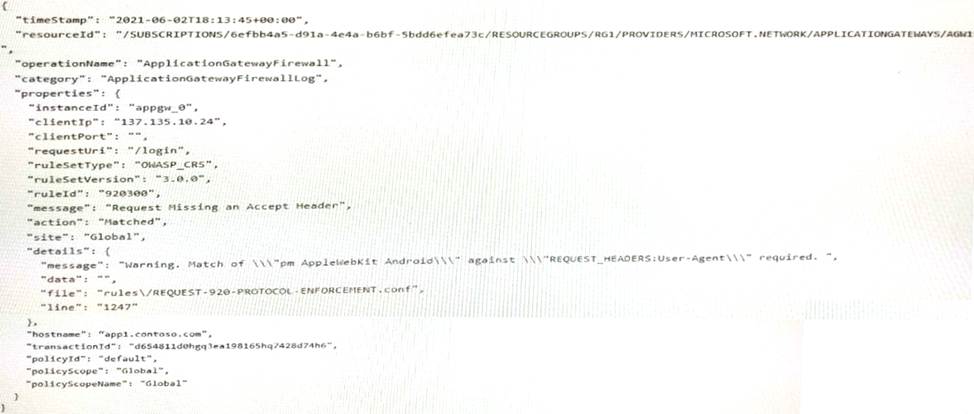
You need to ensure that the URL is accessible through the application gateway.
Solution: You create a WAF policy exclusion request headers that contain 137.135.10.24.
Does this meet the goat?
- A . Yes
- B . No
You need to provide access to storage2. The solution must meet the PaaS networking requirements and the business requirements.
Which connectivity method should you use?
- A . a service endpoint
- B . a private endpoint
- C . Azure Firewall
- D . Azure Front Door
Note: This question is part of a series of questions that present the same scenario. Each question in the series contains a unique solution that might meet the stated goals. Some question sets might have more than one correct solution, while others might not have a correct solution.
After you answer a question in this section, you will NOT be able to return to it. As a result, these questions will not appear in the review screen.
You have an Azure application gateway that has Azure Web Application Firewall (WAF) enabled. You configure the application gateway to direct traffic to the URL of the application gateway.
You attempt to access the URL and receive an HTTP 403 error. You view the diagnostics log and discover the following error.
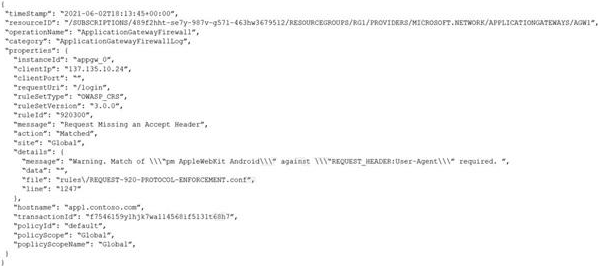
You need to ensure that the URL is accessible through the application gateway.
Solution: You configure a custom cookie and an exclusion rule.
Does this meet the goal?
- A . Yes
- B . No
You have five virtual machines that run Windows Server. Each virtual machine hosts a different web app.
You plan to use an Azure application gateway to provide access to each web app by using a hostname of www.contoso.corn and a different URL path for each web app, for example: https://www.contoso.com/app1.
You need to control the flow of traffic based on the URL path.
What should you configure?
- A . rules
- B . rewrites
- C . HTTP settings
- D . listeners
HOTSPOT
Which virtual machines can VM1 and VM4 ping successfully? To answer, select the appropriate options in the answer area. NOTE: Each correct selection is worth one point.
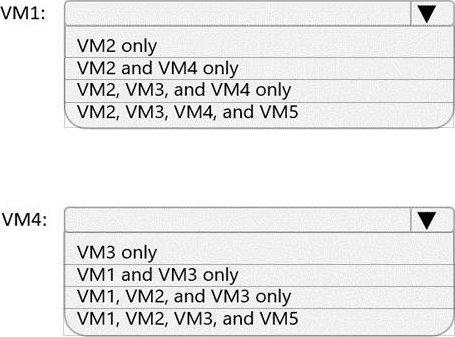
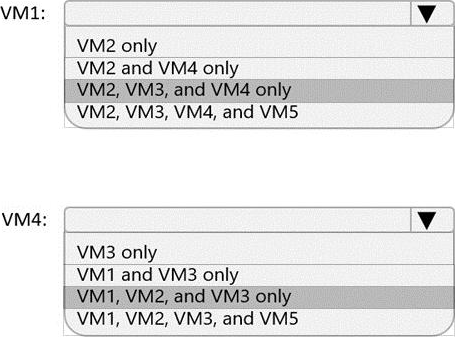
Note: This question is part of a series of questions that present the same scenario. Each question in the series contains a unique solution that might meet the stated goals. Some question sets might have more than one correct solution, while others might not have a correct solution.
After you answer a question in this section, you will NOT be able to return to it. As a result, these questions will not appear in the review screen.
You have an Azure subscription that contains the following resources:
* A virtual network named Vnet1
* A subnet named Subnet1 in Vnet1
* A virtual machine named VM1 that connects to Subnet1
* Three storage accounts named storage1, storage2, and storage3
You need to ensure that VM1 can access storage1. VM1 must be prevented from accessing any other storage accounts.
Solution: You configure the firewall on storage1 to only accept connections from Vnet1.
Does this meet the goal?
- A . Yes
- B . No
You have 10 Azure App Service instances. Each instance hosts the same web app. Each instance is in a different Azure region.
You need to configure Azure Traffic Manager to direct users to the instance that has the lowest latency.
Which routing method should you use?
- A . geographic
- B . weighted
- C . performance
- D . priority
You have a hybrid environment that uses ExpressRoute to connect an on-premises network and Azure.
You need to log the uptime and the latency of the connection periodically by using an Azure virtual machine and an on-premises virtual machine.
What should you use?
- A . Azure Monitor
- B . IP flow verify
- C . Connection Monitor
- D . Azure Internet Analyzer
Note: This question is part of a series of questions that present the same scenario. Each question in the series contains a unique solution that might meet the stated goals. Some question sets might have more than one correct solution, while others might not have a correct solution.
After you answer a question in this section, you will NOT be able to return to it. As a result, these questions will not appear in the review screen.
You have two Azure virtual networks named Vnet1 and Vnet2.
You have a Windows 10 device named Client1 that connects to Vnet1 by using a Point-to-Site (P2S) IKEv2 VPN.
You implement virtual network peering between Vnet1 and Vnet2. Vnet1 allows gateway transit.
Vnet2 can use the remote gateway.
You discover that Client1 cannot communicate with Vnet2.
You need to ensure that Client1 can communicate with Vnet2.
Solution: You download and reinstall the VPN client configuration.
Does this meet the goal?
- A . Yes
- B . No