
Microsoft AZ-400 Practice Exams
Last updated on Nov 16,2026- Exam Code: AZ-400
- Exam Name: Designing and Implementing Microsoft DevOps Solutions
- Certification Provider: Microsoft
- Latest update: Nov 16,2026
You have an Azure subscription that contains an Azure container registry. The container registry contains an ACR Tasks task named Task1.
Task1 is configured to run once every five days.
You need to trigger Task1 to run immediately.
Which command should you run?
- A . az acr task run
- B . az acr build
- C . az acr taskrun
- D . az acr run
You have an Azure DevOps project named Project1 and an Azure subscription named Sub1. Sub1 contains an Azure virtual machine scale set named VMSS1.
VMSS1 hosts a web application named WebApp1. WebApp1 uses stateful sessions.
The WebApp1 installation is managed by using the Custom Script extension. The script resides in an Azure Storage account named sa1.
You plan to make a minor change to a UI element of WebApp1 and to gather user feedback about the change.
You need to implement limited user testing for the new version of WebApp1 on VMSS1.
Which three actions should you perform? Each correct answer presents part of the solution. NOTE: Each correct selection is worth one point.
- A . Modify the load balancer settings of VMSS1.
- B . Redeploy VMSS1.
- C . Upload a custom script le to sa1.
- D . Modify the Custom Script extension settings of VMSS1.
- E . Update the configuration of a virtual machine in VMSS1.
You manage build pipelines and deployment pipelines by using Azure DevOps.
Your company has a team of 500 developers. New members are added continually to the team.
You need to automate the management of users and licenses whenever possible.
Which task must you perform manually?
- A . modifying group memberships
- B . adding users
- C . assigning entitlements
- D . procuring licenses
Introductory Info
This is a case study. Case studies are not timed separately. You can use as much exam time as you would like to complete each case. However, there may be additional case studies and sections on this exam. You must manage your time to ensure that you are able to complete all questions included on this exam in the time provided.
To answer the questions included in a case study, you will need to reference information that is provided in the case study. Case studies might contain exhibits and other resources that provide more information about the scenario that is described in the case study. Each question is independent of the other questions in this case study.
At the end of this case study, a review screen will appear. This screen allows you to review your answers and to make changes before you move to the next section of the exam. After you begin a new section, you cannot return to this section.
To start the case study
To display the first question in this case study, click the Next button. Use the buttons in the left pane to explore the content of the case study before you answer the questions. Clicking these buttons displays information such as business requirements, existing environment, and problem statements. If the case study has an All Information tab, note that the information displayed is identical to the information displayed on the subsequent tabs. When you are ready to answer a question, click the Question button to return to the question.
Overview
General Overview
Woodgrove Bank is a financial services company that has a main office in the United Kingdom.
Technical Requirements and Planned Changes
Planned Changes
Woodgrove Bank plans to implement the following project management changes:
Implement Azure DevOps for project tracking.
Centralize source code control in private GitHub repositories.
Implement Azure Pipelines for build pipelines and release pipelines.
Woodgrove Bank plans to implement the following changes to the identity environment:
Deploy an Azure AD tenant named woodgrovebank.com.
Sync the Active Directory domain to Azure AD.
Configure App1 to use a service principal.
Integrate GitHub with Azure AD.
Woodgrove Bank plans to implement the following changes to the core apps:
Migrate App1 to ASP.NET Core.
Integrate Azure Pipelines and the third-party build tool used to develop App2.
Woodgrove Bank plans to implement the following changes to the DevOps environment:
Deploy App1 to Azure App Service.
Implement source control for the DB1 schema.
Migrate all the source code from TFS1 to GitHub.
Deploy App2 to an Azure virtual machine named VM1.
Merge the POC branch into the GitHub default branch.
Implement an Azure DevOps dashboard for stakeholders to monitor development progress.
Technical Requirements
Woodgrove Bank identifies the following technical requirements:
The initial databases for new environments must contain both schema and reference data.
An Azure Monitor alert for VM1 must be configured to meet the following requirements:
– Be triggered when average CPU usage exceeds 80 percent for 15 minutes.
– Calculate CPU usage averages once every minute.
The commit history of the POC branch must replace the history of the default branch.
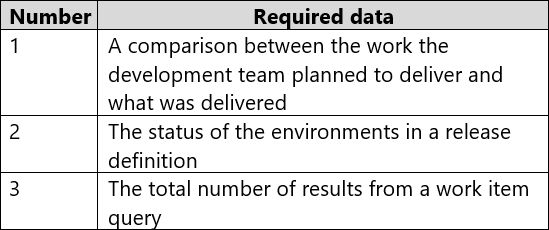
The Azure DevOps dashboard must display the metrics shown in the following table.
Access to Azure DevOps must be restricted to specific IP addresses.
Page load times for App1 must be captured and monitored.
Administrative effort must be minimized.
You need to the merge the POC branch into the default branch. The solution must meet the technical requirements.
Which command should you run?
- A . git rebase
- B . git merge –squash
- C . git push
- D . git merge –allow-unrelated-histories
SIMULATION
You need to create and configure an Azure Storage account named az400lod123456789stor in a resource group named RG1lod123456789 to store the boot diagnostics for a virtual machine named VM1.
To complete this task, sign in to the Microsoft Azure portal.
Introductory Info
Case Study
This is a case study. Case studies are not timed separately. You can use as much exam time as you would like to complete each case. However, there may be additional case studies and sections on this exam. You must manage your time to ensure that you are able to complete all questions included on this exam in the time provided.
To answer the questions included in a case study, you will need to reference information that is provided in the case study. Case studies might contain exhibits and other resources that provide more information about the scenario that is described in the case study. Each question is independent of the other questions in this case study.
At the end of this case study, a review screen will appear. This screen allows you to review your answers and to make changes before you move to the next section of the exam. After you begin a new section, you cannot return to this section.
To start the case study
To display the first question in this case study, click the Next button. Use the buttons in the left pane to explore the content of the case study before you answer the questions. Clicking these buttons displays information such as business requirements, existing environment, and problem statements. If the case study has an All Information tab, note that the information displayed is identical to the information displayed on the subsequent tabs. When you are ready to answer a question, click the Question button to return to the question.
Overview
Contoso, Ltd. is a manufacturing company that has a main office in Chicago.
Existing Environment
Contoso plans to improve its IT development and operations processes by implementing Azure DevOps principles. Contoso has an Azure
subscription and creates an Azure DevOps organization.
The Azure DevOps organization includes:
The Docker extension
A deployment pool named Pool7 that contains 10 Azure virtual machines that run Windows Server 2019 The Azure subscription contains an Azure Automation account.
Requirements
Planned changes
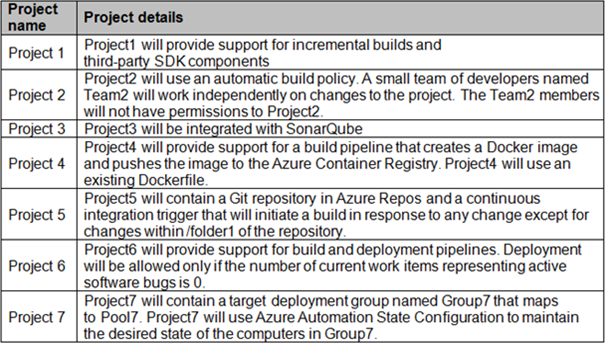
Contoso plans to create projects in Azure DevOps as shown in the following table.
Technical requirements
Contoso identifies the following technical requirements:
Implement build agents for Project1.
Whenever possible, use Azure resources.
Avoid using deprecated technologies.
Implement a code ow strategy for Project2 that will:
– Enable Team2 to submit pull requests for Project2.
– Enable Team2 to work independently on changes to a copy of Project2.
– Ensure that any intermediary changes performed by Team2 on a copy of Project2 will be subject to the same restrictions as the ones defined in the build policy of Project2.
Whenever possible, implement automation and minimize administrative effort. Implement Project3, Project5, Project6, and Project7 based on the planned changes.
Implement Project4 and configure the project to push Docker images to Azure Container Registry.
In Azure DevOps, you create Project3.
You need to meet the requirements of the project.
What should you do first?
- A . From Azure DevOps, modify the build definition.
- B . From SonarQube, obtain an authentication token.
- C . From Azure DevOps, create a service endpoint.
- D . From SonarQube, create a project.
You need to configure GitHub to use Azure Active Directory (Azure AD) for authentication.
What should you do first?
- A . Create a conditional access policy in Azure AD.
- B . Register GitHub in Azure AD.
- C . Create an Azure Active Directory B2C (Azure AD B2C) tenant.
- D . Modify the Security settings of the GitHub organization.
You manage projects by using Azure Boards.
You have a current work item name itemA that is dependant on a work item named itemB.
You need to de ne the dependency for itemA.
What should you do in the web portal for Azure DevOps?
- A . Add a Parent link to the user story of itemA.
- B . From Backlogs, open the context menu, select Add link, and then select itemA. Set Link type to References and add the ID of itemB.
- C . From itemA, open the Links tab, and then select Add link. Set Link type to References and add the ID of itemB.
- D . From itemA, open the Links tab, and then select Add link. Set Link type to Successor and add the ID of itemB.
SIMULATION
You have a web app that connects to an Azure SQL Database named db1.
You need to configure db1 to send Query Store runtime statistics to Azure Log Analytics.
To complete this task, sign in to the Microsoft Azure portal.
SIMULATION
You have a web app that connects to an Azure SQL Database named db1.
You need to configure db1 to send Query Store runtime statistics to Azure Log Analytics.
To complete this task, sign in to the Microsoft Azure portal.