
Microsoft AZ-204 Practice Exams
Last updated on Nov 16,2026- Exam Code: AZ-204
- Exam Name: Developing Solutions for Microsoft Azure
- Certification Provider: Microsoft
- Latest update: Nov 16,2026
HOTSPOT
You develop a containerized application. You plan to deploy the application to a new Azure Container instance by using a third-party continuous integration and continuous delivery (CI/CD) utility.
The deployment must be unattended and include all application assets. The third-party utility must only be able to push and pull images from the registry. The authentication must be managed by Azure Active Directory (Azure AD). The solution must use the principle of least privilege.
You need to ensure that the third-party utility can access the registry.
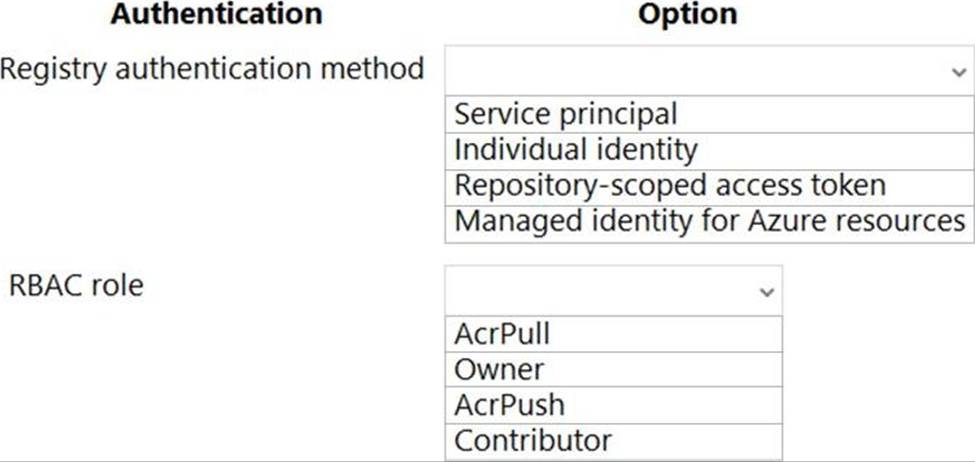
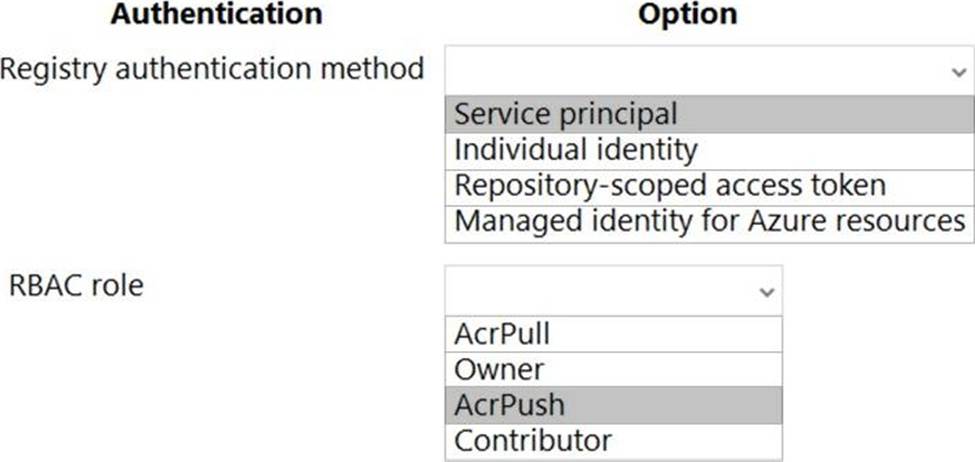
Which authentication options should you use? To answer, select the appropriate options in the answer area. NOTE: Each correct selection is worth one point.
Explanation:
Box 1: Service principal
Applications and container orchestrators can perform unattended, or "headless," authentication by using an Azure Active Directory (Azure AD) service principal.
Box 2: AcrPush
AcrPush provides pull/push permissions only and meets the principle of least privilege.
Reference:
https://docs.microsoft.com/en-us/azure/container-registry/container-registry-authentication?tabs=azure-cli
https://docs.microsoft.com/en-us/azure/container-registry/container-registry-roles?tabs=azure-cli
HOTSPOT
You develop a containerized application. You plan to deploy the application to a new Azure Container instance by using a third-party continuous integration and continuous delivery (CI/CD) utility.
The deployment must be unattended and include all application assets. The third-party utility must only be able to push and pull images from the registry. The authentication must be managed by Azure Active Directory (Azure AD). The solution must use the principle of least privilege.
You need to ensure that the third-party utility can access the registry.
Which authentication options should you use? To answer, select the appropriate options in the answer area. NOTE: Each correct selection is worth one point.
Explanation:
Box 1: Service principal
Applications and container orchestrators can perform unattended, or "headless," authentication by using an Azure Active Directory (Azure AD) service principal.
Box 2: AcrPush
AcrPush provides pull/push permissions only and meets the principle of least privilege.
Reference:
https://docs.microsoft.com/en-us/azure/container-registry/container-registry-authentication?tabs=azure-cli
https://docs.microsoft.com/en-us/azure/container-registry/container-registry-roles?tabs=azure-cli
HOTSPOT
You develop a containerized application. You plan to deploy the application to a new Azure Container instance by using a third-party continuous integration and continuous delivery (CI/CD) utility.
The deployment must be unattended and include all application assets. The third-party utility must only be able to push and pull images from the registry. The authentication must be managed by Azure Active Directory (Azure AD). The solution must use the principle of least privilege.
You need to ensure that the third-party utility can access the registry.
Which authentication options should you use? To answer, select the appropriate options in the answer area. NOTE: Each correct selection is worth one point.
Explanation:
Box 1: Service principal
Applications and container orchestrators can perform unattended, or "headless," authentication by using an Azure Active Directory (Azure AD) service principal.
Box 2: AcrPush
AcrPush provides pull/push permissions only and meets the principle of least privilege.
Reference:
https://docs.microsoft.com/en-us/azure/container-registry/container-registry-authentication?tabs=azure-cli
https://docs.microsoft.com/en-us/azure/container-registry/container-registry-roles?tabs=azure-cli
DRAG DROP
You are developing a .NET Core model-view controller (MVC) application hosted on Azure for a health care system that allows providers access to their information.
You develop the following code:
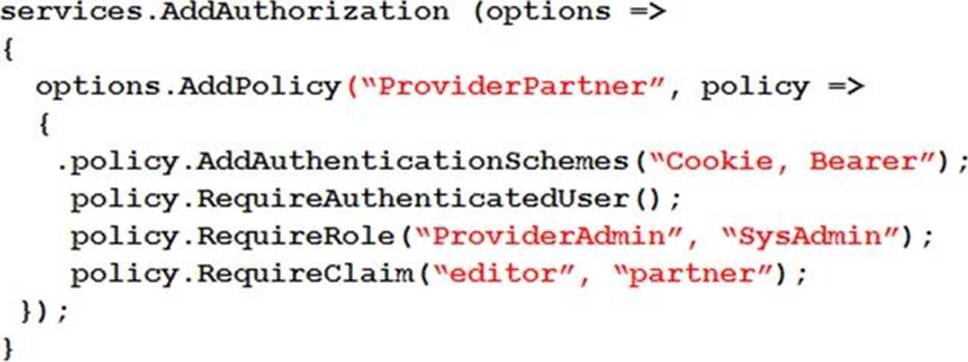
You define a role named SysAdmin.
You need to ensure that the application meets the following authorization requirements:
✑ Allow the ProviderAdmin and SysAdmin roles access to the Partner controller regardless of whether the user holds an editor claim of partner.
✑ Limit access to the Manage action of the controller to users with an editor claim of partner who are also members of the SysAdmin role.
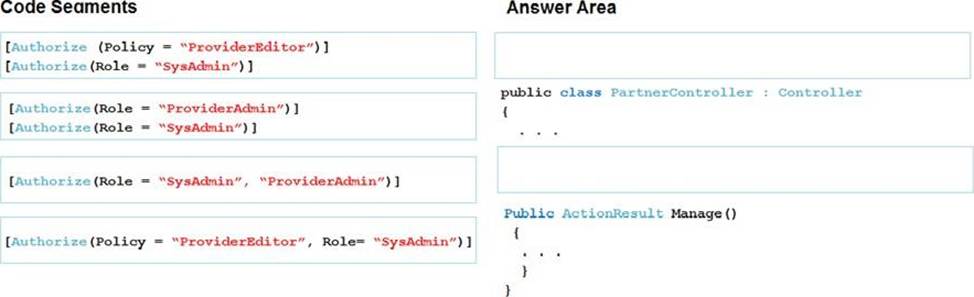
How should you complete the code? To answer, drag the appropriate code segments to the correct locations. Each code segment may be used once, more than once, or not at all.
You may need to drag the split bar between panes or scroll to view content. NOTE: Each correct selection is worth one point.
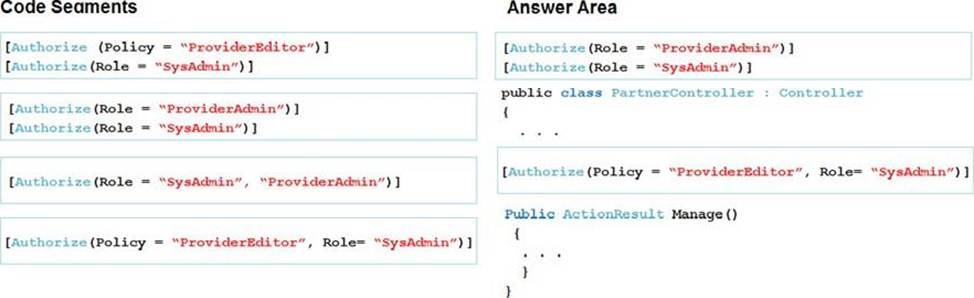
Explanation:
Box 1:
Allow the ProviderAdmin and SysAdmin roles access to the Partner controller regardless of whether the user holds an editor claim of partner.
Box 2:
Limit access to the Manage action of the controller to users with an editor claim of partner who are also members of the SysAdmin role.
You are developing an application that uses Azure Blob storage.
The application must read the transaction logs of all the changes that occur to the blobs and the blob metadata in the storage account for auditing purposes. The changes must be in the order in which they occurred, include only create, update, delete, and copy operations and be retained for compliance reasons.
You need to process the transaction logs asynchronously.
What should you do?
- A . Process all Azure Blob storage events by using Azure Event Grid with a subscriber Azure Function app.
- B . Enable the change feed on the storage account and process all changes for available events.
- C . Process all Azure Storage Analytics logs for successful blob events.
- D . Use the Azure Monitor HTTP Data Collector API and scan the request body for successful blob events.
B
Explanation:
Change feed support in Azure Blob Storage
The purpose of the change feed is to provide transaction logs of all the changes that occur to the blobs and the blob metadata in your storage account. The change feed provides ordered, guaranteed, durable, immutable, read-only log of these changes. Client applications can read these logs at any time, either in streaming or in batch mode. The change feed enables you to build efficient and scalable solutions that process change events that occur in your Blob Storage account at a low cost.
Reference: https://docs.microsoft.com/en-us/azure/storage/blobs/storage-blob-change-feed
HOTSPOT
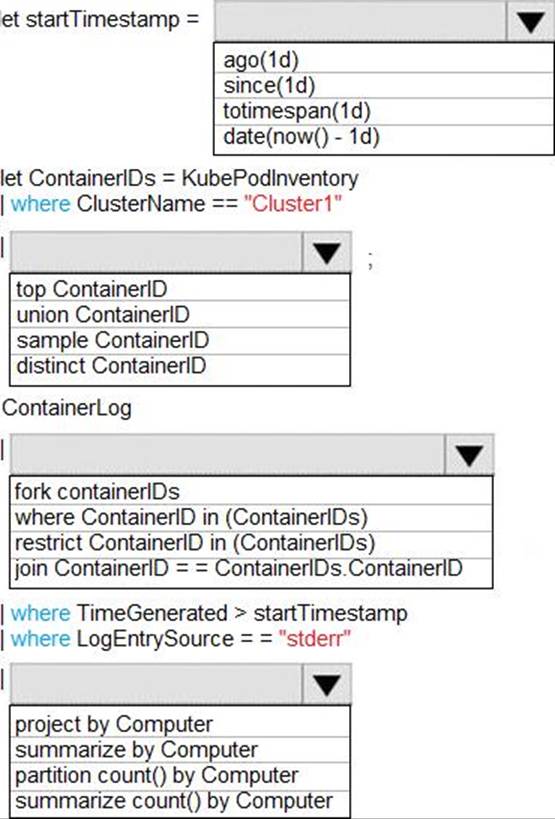
You are debugging an application that is running on Azure Kubernetes cluster named cluster1. The cluster uses Azure Monitor for containers to monitor the cluster.
The application has sticky sessions enabled on the ingress controller.
Some customers report a large number of errors in the application over the last 24 hours.
You need to determine on which virtual machines (VMs) the errors are occurring.
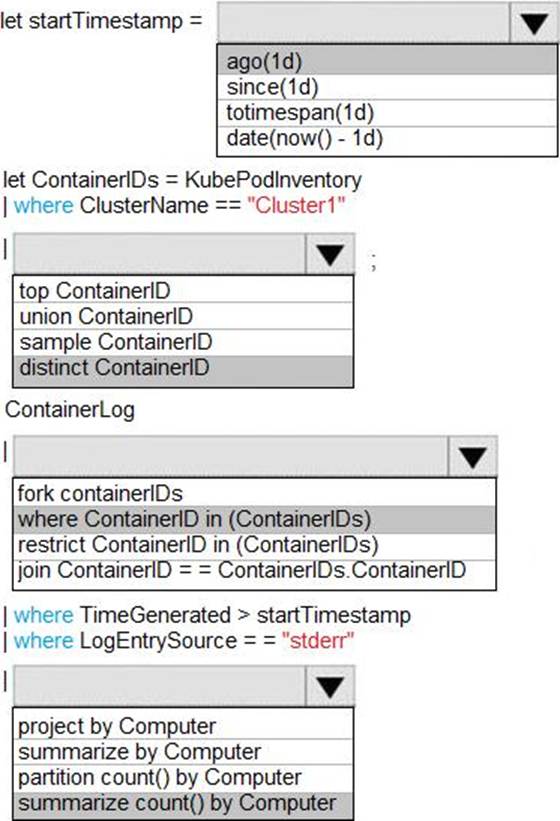
How should you complete the Azure Monitor query? To answer, select the appropriate options in the answer area. NOTE: Each correct selection is worth one point.
Explanation:
Box 1: ago(1d)
Box 2: distinct containerID
Box 3: where ContainerID in (ContainerIDs)
Box 4: summarize Count by Computer
Summarize: aggregate groups of rows
Use summarize to identify groups of records, according to one or more columns, and apply aggregations to them. The most common use of summarize is count, which returns the number of results in each group.
Reference:
https://docs.microsoft.com/en-us/azure/azure-monitor/log-query/get-started-queries
https://docs.microsoft.com/en-us/azure/azure-monitor/log-query/query-optimization
You are developing an ASP.NET Core Web API web service. The web service uses Azure Application Insights for all telemetry and dependency tracking. The web service reads and writes data to a database other than Microsoft SQL Server.
You need to ensure that dependency tracking works for calls to the third-party database.
Which two Dependency Telemetry properties should you store in the database? Each correct answer presents part of the solution. NOTE: Each correct selection is worth one point.
- A . Telemetry.Context.Operation.Id
- B . Tetemetry.Context.Cloud.Rolelnstance
- C . Telemetry.Id
- D . Telemetry.ContextSession.Id
- E . Telemetry.Name
AC
Explanation:
Reference: https://docs.microsoft.com/en-us/azure/azure-monitor/app/custom-operations-tracking
Example:
public async Task Enqueue(string payload)
{
// StartOperation is a helper method that initializes the telemetry item
// and allows correlation of this operation with its parent and children.
var operation = telemetryClient.StartOperation<DependencyTelemetry>("enqueue " + queueName);
operation.Telemetry.Type = "Azure Service Bus";
operation.Telemetry.Data = "Enqueue " + queueName;
var message = new BrokeredMessage(payload);
// Service Bus queue allows the property bag to pass along with the message.
// We will use them to pass our correlation identifiers (and other context)
// to the consumer.
message.Properties.Add("ParentId", operation.Telemetry.Id); message.Properties.Add("RootId", operation.Telemetry.Context.Operation.Id);
Reference: https://docs.microsoft.com/en-us/azure/azure-monitor/app/custom-operations-tracking
You develop an app that allows users to upload photos and videos to Azure storage. The app uses a storage REST API call to upload the media to a blob storage account named Account1. You have blob storage containers named Container1 and Container2.
Uploading of videos occurs on an irregular basis.
You need to copy specific blobs from Container1 to Container2 in real time when specific requirements are met, excluding backup blob copies.
What should you do?
- A . Download the blob to a virtual machine and then upload the blob to Container2.
- B . Run the Azure PowerShell command Start-AzureStorageBlobCopy.
- C . Copy blobs to Container2 by using the Put Blob operation of the Blob Service REST API.
- D . Use AzCopy with the Snapshot switch blobs to Container2.
B
Explanation:
The Start-AzureStorageBlobCopy cmdlet starts to copy a blob.
Example 1: Copy a named blob
C:PS>Start-AzureStorageBlobCopy -SrcBlob "ContosoPlanning2015" -DestContainer "ContosoArchives" -SrcContainer "ContosoUploads"
This command starts the copy operation of the blob named ContosoPlanning2015 from the container named ContosoUploads to the container named ContosoArchives.
Reference: https://docs.microsoft.com/en-us/powershell/module/azure.storage/start-azurestorageblobcopy?view=azurermps-6.13.0
Topic 8, Munson’s Pickles and Preserves Farm
Overview
Munson’s Pickles and Preserves Farm is an agricultural cooperative corporation based in Washington, US, with farms located across the United States. The company supports agricultural production resources by distributing seeds, fertilizers, chemicals, fuel, and farm machinery to the farms.
The company is migrating all applications from an on-premises datacenter to Microsoft Azure.
Applications support distributors, farmers, and internal company staff.
Corporate website
• The company hosts a public website located at http://www.munsonspicklesandpreservesfarm.com. The site supports farmers and distributors who request agricultural production resources.
Farms
• The company created a new customer tenant in the Microsoft Entra admin center to support authentication and authorization for applications.
Distributors
• Distributors integrate their applications with data that is accessible by using APIs hosted at http://www.munsonspicklesandpreservesfarm com/api to receive and update resource data.
The application components must meet the following requirements:
Corporate website
• The site must be migrated to Azure App Service.
• Costs must be minimized when hosting in Azure.
• Applications must automatically scale independent of the compute resources.
• All code changes must be validated by internal staff before release to production.
• File transfer speeds must improve, and webpage-load performance must increase.
• All site settings must be centrally stored, secured without using secrets, and encrypted at rest and in transit.
• A queue-based load leveling pattern must be implemented by using Azure Service Bus queues to support high volumes of website agricultural production resource requests.
Farms
• Farmers must authenticate to applications by using Microsoft Entra ID.
Distributors
• The company must track a custom telemetry value with each API call and monitor performance of all APIs.
• API telemetry values must be charted to evaluate variations and trends for resource data.
Internal staff
• App and API updates must be validated before release to production.
• Staff must be able to select a link to direct them back to the production app when validating an app or API update.
• Staff profile photos and email must be displayed on the website once they authenticate to applications by using their Microsoft Entra ID.
Security
• All web communications must be secured by using TLS/HTTPS.
• Web content must be restricted by country/region to support corporate compliance standards
• The principle of least privilege must be applied when providing any user rights or process access rights
• Managed identities for Azure resources must be used to authenticate services that support Microsoft Entra ID authentication.
Corporate website
• Farmers report HTTP 503 errors at the same time as internal staff report that CPU and memory usage are high.
• Distributors report HTTP 502 errors at the same time as internal staff report that average response times and networking traffic are high.
• Internal staff report webpage load sizes are large and take a long time to load.
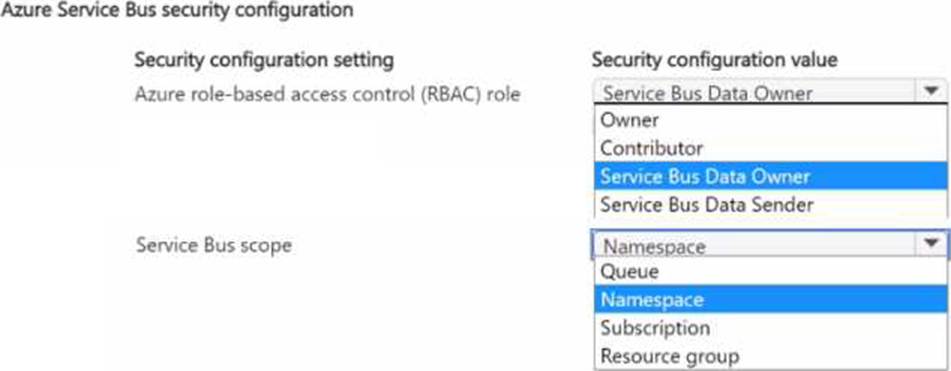
• Developers receive authentication errors to Service Bus when they debug locally.
Distributors
• Many API telemetry values are sent in a short period of time. Telemetry traffic, data costs, and storage costs must be reduced while preserving a statistically correct analysis of the data points sent by the APIs.
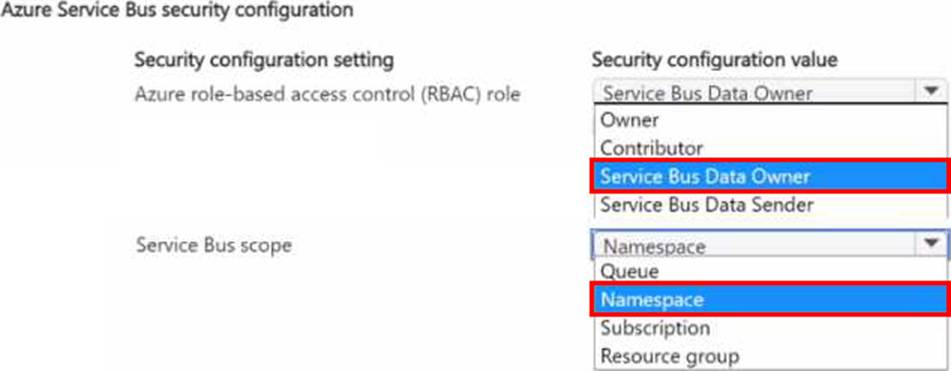
HOTSPOT
You need to resolve the authentication errors for developers.
Which Service Bus security configuration should you use? To answer, select the appropriate options in the answer area. NOTE: Each correct selection is worth one point.
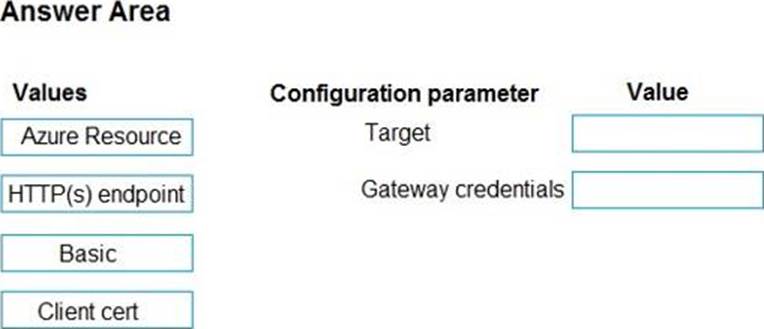
DRAG DROP
You develop a gateway solution for a public facing news API.
The news API back end is implemented as a RESTful service and hosted in an Azure App Service instance.
You need to configure back-end authentication for the API Management service instance.
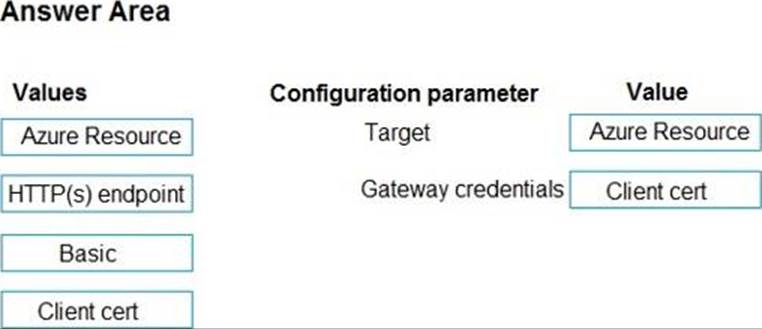
Which target and gateway credential type should you use? To answer, drag the appropriate values to the correct parameters. Each value may be used once, more than once, or not at all. You may need to drag the split bar between panes or scroll to view content. NOTE: Each correct selection is worth one point.
Explanation:
Box 1: Azure Resource
Box 2: Client cert
API Management allows to secure access to the back-end service of an API using client certificates.
Reference: https://docs.microsoft.com/en-us/rest/api/apimanagement/apimanagementrest/azure-api-management-rest-api-backend-entity