
Microsoft AZ-120 Practice Exams
Last updated on Nov 16,2026- Exam Code: AZ-120
- Exam Name: Planning and Administering Microsoft Azure for SAP Workloads
- Certification Provider: Microsoft
- Latest update: Nov 16,2026
You plan to implement a highly available SAP HANA deployment by using two Azure virtual machines that run SUSE Linux Enterprise Server (SLES). You need to create an Azure Fence agent STONITH block device (SBD).
What should you do first?
- A . Create a system-assigned managed identity.
- B . Create a storage account
- C . Create an application registration in Azure AD.
- D . Create a user-assigned managed identity
HOTSPOT
For each of the following statements, select Yes if the statement is true. Otherwise, select No. NOTE: Each correct selection is worth one point.
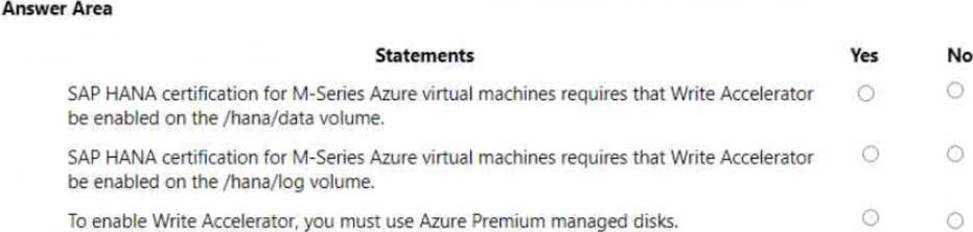
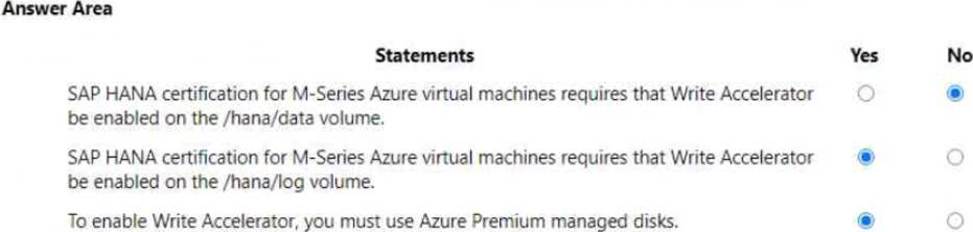
You have a Hyper-V generation 2 virtual machine image that was prepared by running sysprep.exe. You plan to use the image as part of an SAP application server deployment on Azure. You need to ensure that you can deploy the image as an Azure virtual machine.
What should you do first?
- A . Convert the virtual disk to a dynamically expanding disk.
- B . Use Azure Storage Explorer to upload the VHDX file to a storage account.
- C . Convert the VHDX disk image to a VHD disk image.
- D . Run azcopy to upload the VHDX file to a managed disk.
You plan to migrate an on-premises SAP development system to Azure.
Before the migration, you need to check the usage of the source system hardware, such as CPU, memory, network, etc.
Which transaction should you run from SAP GUI?
- A . SM51
- B . DB01
- C . DB12
- D . OS07N
D
Explanation:
SAP transaction OS07N (Remote Operating System Activity) is classified in the Basis Component module under application component Operating System Monitors and runs Monitoring Operating System program RSHOST1N upon execution.
Incorrect Answers:
A: Transaction code SM51 is to display list of active application servers that have registered in the SAP message server.
B: DB01 is a transaction code used for Analyze Exclusive Lockwaits in SAP.
C: Transaction code DB12 is to collects and presents information that is necessary to monitor database backups.
Reference: http://www.saptransactions.com/codes/OS07N/
A company named Contoso, Ltd. has users across the globe. Contoso is evaluating whether to migrate SAP to Azure.
The SAP environment runs on SUSE Linux Enterprise Server (SLES) servers and SAP HANA databases.
The Suite on HANA database is 4 TB.
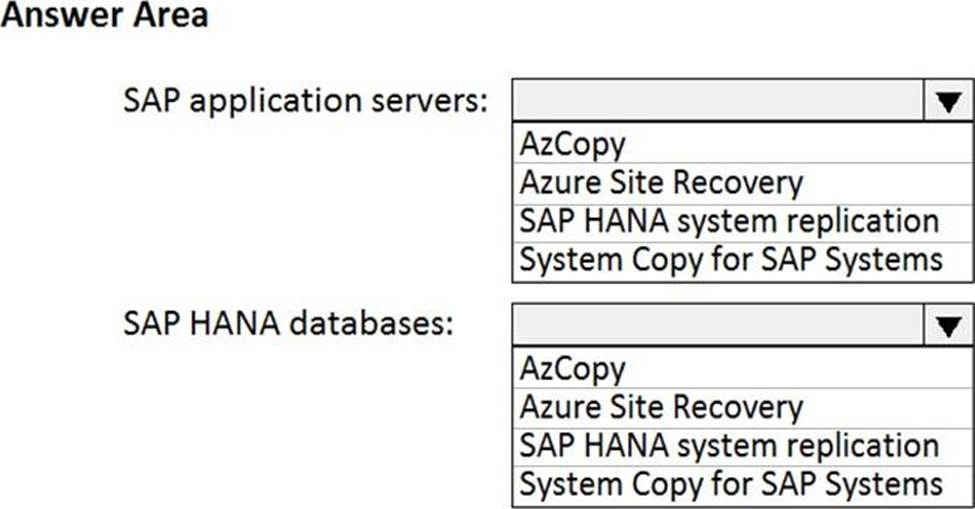
You need to recommend a migration solution to migrate SAP application servers and the SAP HANA databases. The solution must minimize downtime.
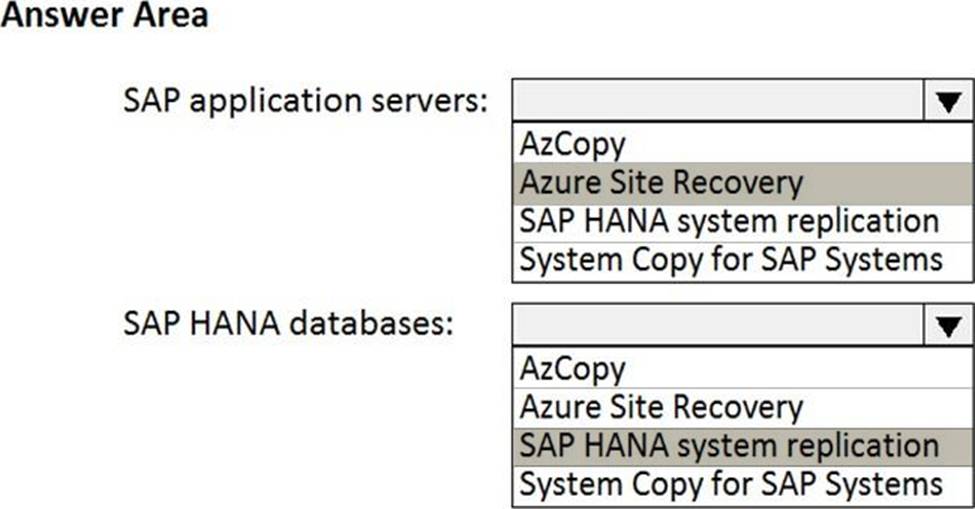
Which migration solutions should you recommend? To answer, select the appropriate options in the answer area. NOTE: Each correct selection is worth one point.
Explanation:
Box 1: Azure Site Recovery
Microsoft Azure Site Recovery (ASR) now supports SUSE Linux Enterprise Server 11 SP3/SP4 and SUSE Linux Enterprise Server 12 SP1/SP2/SP3. This is great for customers that are planning to migrate systems to Microsoft Azure or customers who need to have a business continuity strategy for their Azure deployments.
Azure Site Recovery enables SUSE customers to migrate their non-Azure virtual machines or physical servers to Microsoft Azure virtual machines.
Box 2: SAP Hana System replication
Reference:
https://www.suse.com/c/asr_supports_suse/
https://www.netapp.com/us/media/tr-4746.pdf
You are planning high availability for an SAP environment on Azure. The SAP environment will use datacenters in to different zones.
Testing shows that the latency between the two zones supports synchronous DBMS replication. You need to design a solution to ensure that SAP services are available if an Azure datacenter within a zone fails.
The solution must meet the following requirements:
* Provide automatic failover
* Minimize costs
Which high availability configuration meet the requirements?
- A . Azure Availability Zones with an active/passive deployment
- B . Azure Site Recovery
- C . Azure Availability Sets with active/passive clustering
- D . Azure Availability Sets with active/active clustering
This question requires that you evaluate the underlined BOLD text to determine if it is correct.
You are planning for the administration of resources in Azure.
To meet the technical requirements, you must first implement Active Directory Federation Services (AD FS).
Instructions: Review the underlined text. If it makes the statement correct, select “No change is needed”. If the statement is incorrect, select the answer choice that makes the statement correct.
- A . No change is needed
- B . Azure AD Connect
- C . Azure AD join
- D . Enterprise State Roaming
A
Explanation:
AD connect, it’s not mandatory to have AD FS, you can use Password HAsh Synch or Passthrough Authentication, but AD Connect is mandatory to synch you on-promises accounts to Azure AD
Reference: https://docs.microsoft.com/en-us/azure/active-directory/saas-apps/sap-hana-cloud-platform-identity-authentication-tutorial
You have an SAP production landscape on Azure that contains the virtual machines shown in the following table.

VM1 cannot connect to an employee self-service application hosted on VM2.
You need to identify what is causing the issue.
Which two options in Azure Network Watcher should you use? Each correct answer presents part of the solution. NOTE: Each correct selection is worth one point
- A . Connection troubeshoot
- B . Connection monitor
- C . IP flow verify
- D . Network Performance Monitor
You are designing an SAP HANA deployment.
You estimate that the database will be 1.8 TB in three years.
You need to ensure that the deployment supports 60,000 IOPS. The solution must minimize costs and provide the lowest latency possible.
Which type of disk should you use?
- A . Standard HDD
- B . Premium SSD
- C . Ultra disk
- D . Standard SSD
You have an SAP landscape on Azure.
You deploy an SAP Web Dispatcher named web1.
You need to confirm that web1 can support 1,500 users.
What should you use?
- A . Apache JMeter
- B . lometer
- C . ABAPMeter
- D . FIO