
Microsoft AZ-120 Practice Exams
Last updated on Nov 16,2026- Exam Code: AZ-120
- Exam Name: Planning and Administering Microsoft Azure for SAP Workloads
- Certification Provider: Microsoft
- Latest update: Nov 16,2026
HOTSPOT
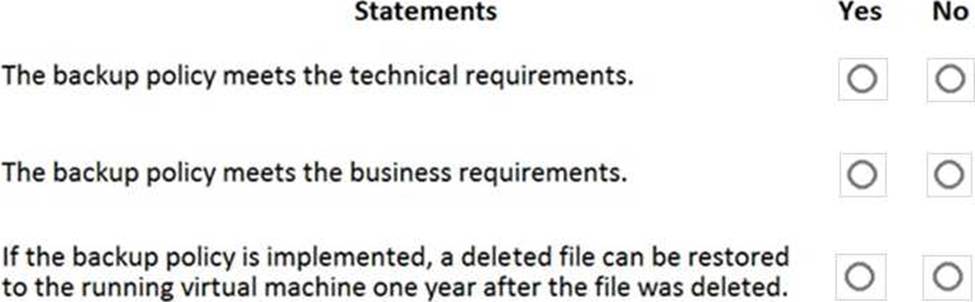
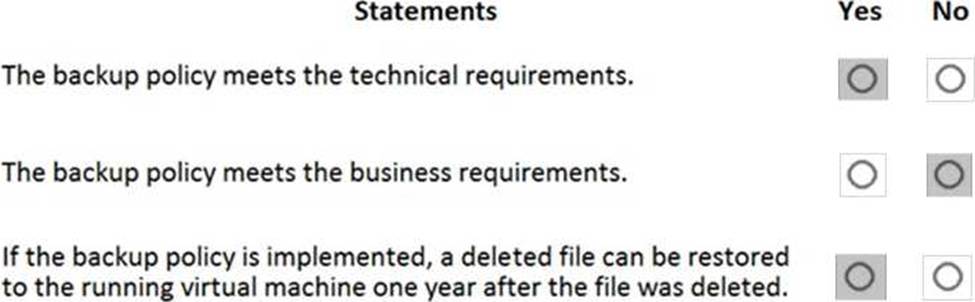
You are evaluating the proposed backup policy.
For each of the following statements, select Yes if the statement is true. otherwise, select No. NOTE: Each correct selection is worth one point.
Explanation:
Box 1: Yes
Scenario: Technical requirements: Ensure that an application server can be restored from a backup created during the last five days within 15 minutes.
Instant Restore has ‘The instance recovery snapshot(s) for 5 Day(s)’.
Box 2: No
Scenario: Ensure that all the production application servers can restore daily backups from the last 21 days.
The Retention of daily backup point is set to for 14 days only.
Box 3: Yes
Reference: https://docs.microsoft.com/en-us/azure/backup/backup-instant-restore-capability
You deploy an SAP environment on Azure by following the SAP workload on Azure planning and deployment checklist.
You need to verify whether Azure Diagnostics is enabled.
Which cmdlet should you run?
- A . Get-AzureVMAvailableExtension
- B . Get-AzVmDiagnosticsExtension
- C . Test-AzDeployment
- D . Test-VMConfigForSAP
B
Explanation:
The Get-AzVMDiagnosticsExtension cmdlet gets the settings of the Azure Diagnostics extension on a virtual machine.
Incorrect Answers:
D: You can check the configuration of a virtual machine by calling the Test-VMConfigForSAP_GUI commandlet.
Reference: https://docs.microsoft.com/en-us/powershell/module/az.compute/get-azvmdiagnosticsextension
DRAG DROP
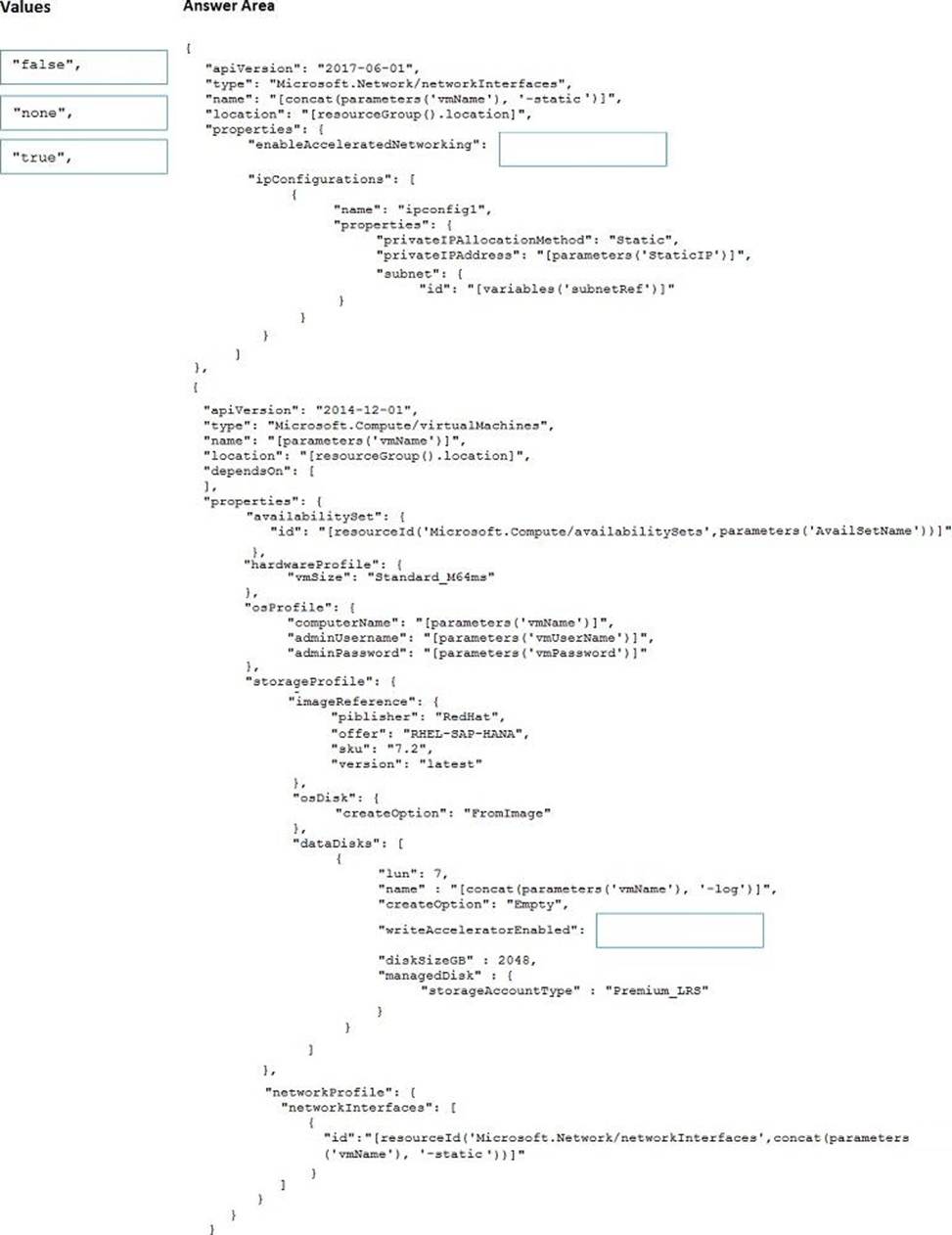
You plan to deploy multiple SAP HANA virtual machines to Azure by using an Azure Resource Manager template.
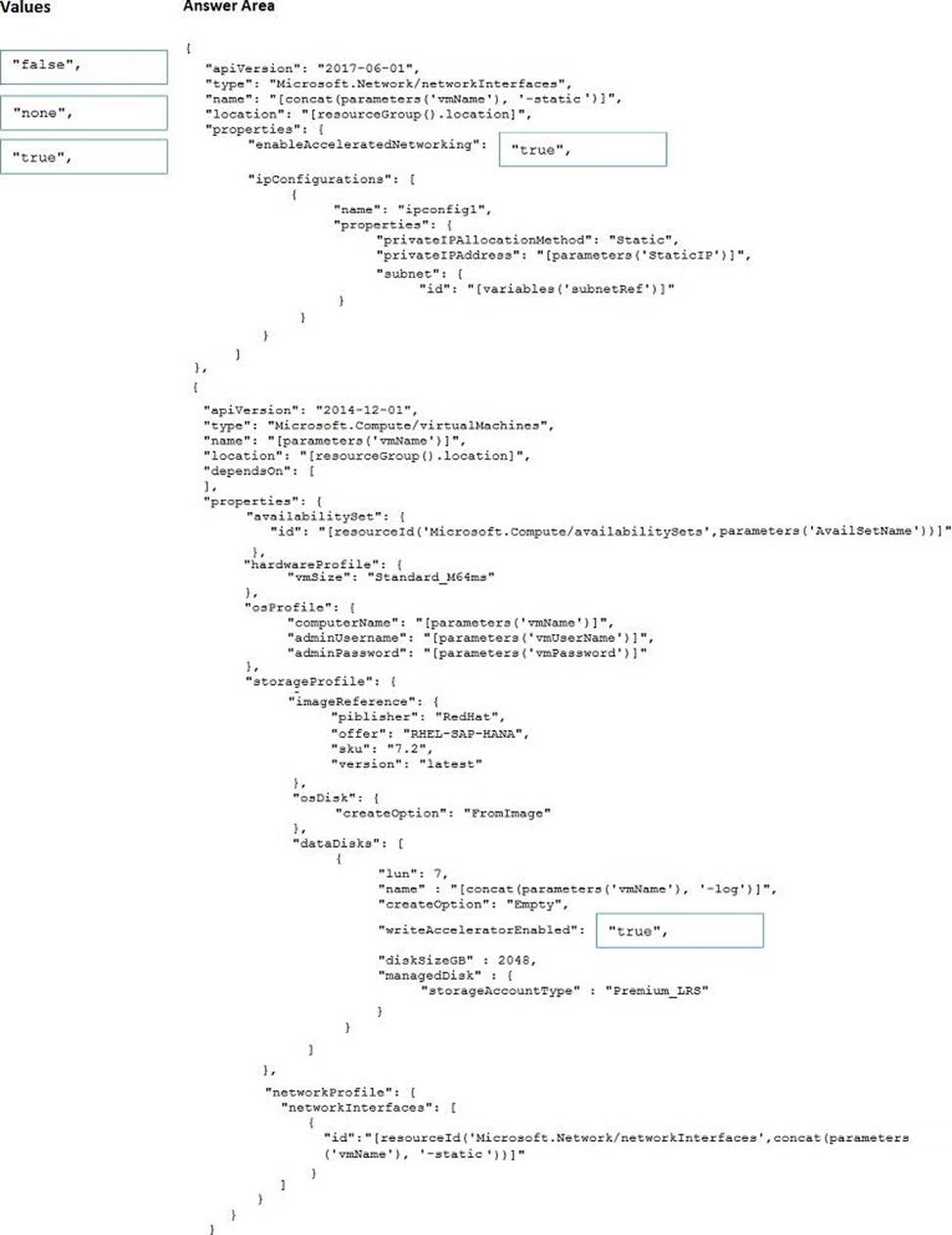
How should you configure Accelerated Networking and Write Accelerator in the template? To answer, drag the appropriate values to the correct targets. Each value may be used once, more than once, or not at all. You may need to drag the split bar between panes or scroll to view content. NOTE: Each correct selection is worth one point.
Explanation:
Box 1: true
enableAcceleratedNetworking: If the network interface is accelerated networking enabled.
To further reduce network latency between Azure VMs, we [Micorosoft] recommend that you choose Azure Accelerated Networking. Use it when you deploy Azure VMs for an SAP workload, especially for the SAP application layer and the SAP DBMS layer.
Box 2: true
Write Accelerator should be used for the volumes that contain the transaction log or redo logs of a DBMS. It is not recommended to use Write Accelerator for the data volumes of a DBMS as the feature has been optimized to be used against log disks.
Reference: https://docs.microsoft.com/en-us/azure/virtual-machines/workloads/sap/dbms_guide_general
You recently migrated an SAP HANA environment to Azure.
You plan to back up SAP HANA databases to disk on the virtual machines, and then move the backup tiles to Azure Blob storage for retention.
Which command should you run to move the backups to the Blob storage?
- A . backint
- B . robocopy
- C . azcopy
- D . scp
C
Explanation:
To store directories and files on Azure storage, one could use CLI or PowerShell. There is also a ready-to-use utility, AzCopy, for copying data to Azure storage.
Reference: https://docs.microsoft.com/en-us/azure/virtual-machines/workloads/sap/sap-hana-backup-file-level
You have an SAP production landscape in Azure.
Users access the landscape from the internet by using Azure Application Gateway.
You need to analyze the network traffic of the landscape by using Azure Network Watcher traffic analytics.
What should you configure?
- A . network security group (NSG) flow logs
- B . Network Manager
- C . Connection Monitor
- D . Diagnostic settings in Application Gateway
HOTSPOT
You are planning the Azure network infrastructure for an SAP environment.
For each of the following statements, select Yes if the statement is true. Otherwise, select No. NOTE: Each correct selection is worth one point.
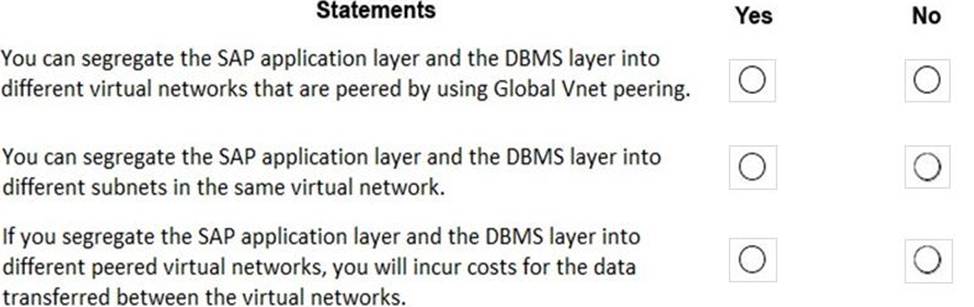
Box 1: NO
Box 2: Yes
Box 3: Yes
Be aware that network traffic between two peered Azure virtual networks is subject to transfer costs. Huge data volume that consists of many terabytes is exchanged between the SAP application layer and the DBMS layer. You can accumulate substantial costs if the SAP application layer and DBMS layer are segregated between two peered Azure virtual networks.
Reference: https://docs.microsoft.com/en-us/azure/virtual-machines/workloads/sap/dbms_guide_general
DRAG DROP
You have an Azure subscription.
You plan to deploy a SAP NetWeaver landscape that will use SQL Server on Azure virtual machines.
The solution must meet the following requirements:
✑ The SAP application and database tiers must reside in the same Azure zone.
✑ The application tier in the Azure virtual machines must belong to the same Availability Set.
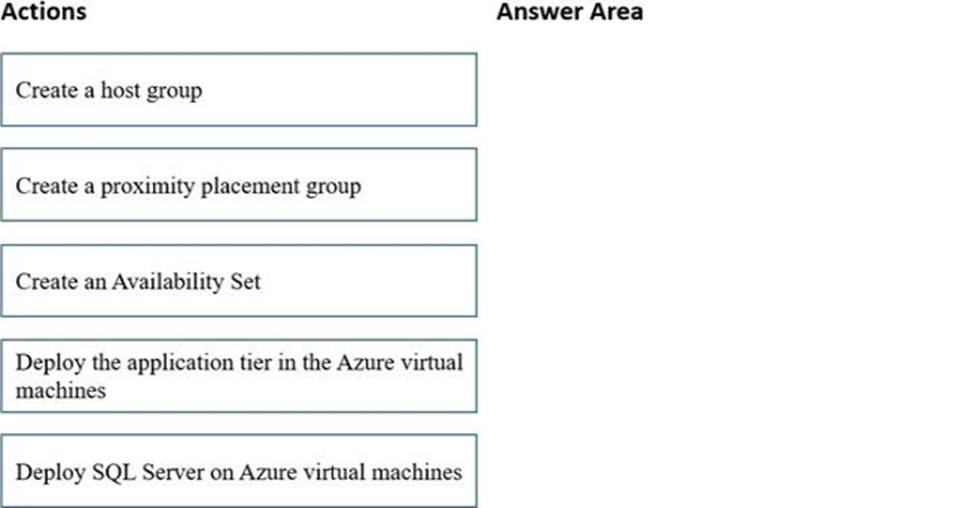
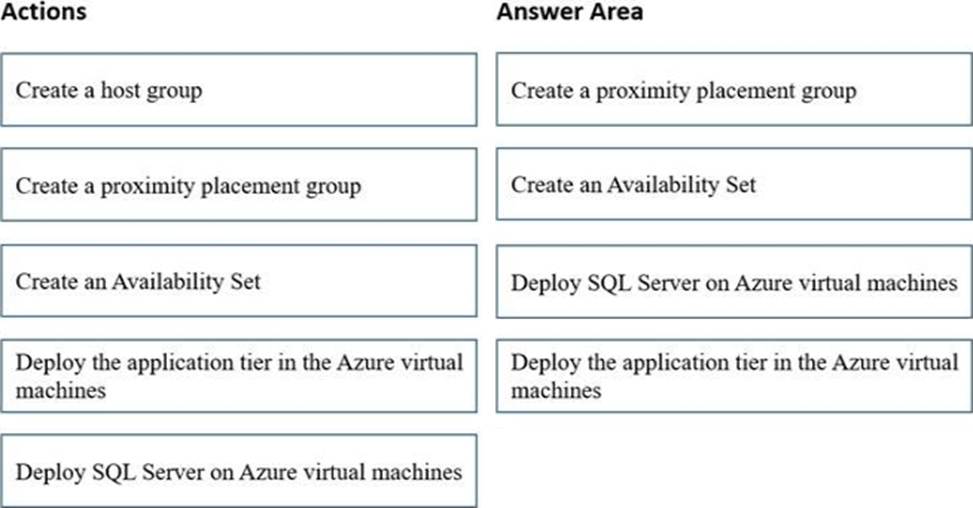
Which four actions should you perform in sequence? To answer, move the appropriate actions from the list of actions to the answer area and arrange them in the correct order. NOTE: More than one order of answer choices is correct. You will receive credit for any of the correct orders you select.
Explanation:
Step 1: Create a proximity placement group
A proximity placement group is a logical grouping of Azure resources within the same Azure data center in order to reduce latency.
Step 2: Create an Availability Set
Create an availability set that references the Azure proximity group.
By adding the availability sets to proximity placement groups, the network latencies are considerably reduced, thereby improving the overall performance.
Step 3: Deploy SQL Server on Azure Virtual machines
Step 4: Deploy the application tier in the Azure virtual machines
Deploy the application layer VMs by referencing the availability set and the proximity placement group.
Reference: https://docs.microsoft.com/en-us/azure/virtual-machines/workloads/sap/sap-proximity-placement-scenarios
Your company has an SAP environment that contains the following components:
✑ SAP systems based on SAP HANA and SAP Adaptive Server Enterprise (SAP ASE) that run on SUSE
✑ Linux Enterprise Server 12 (SLES 12)
✑ Multiple SAP applications
The company plans to migrate all the applications to Azure.
You need to get a comprehensive list of all the applications that are part of the SAP environment.
What should you use?
- A . the SAP license information
- B . the SAP Solution Manager
- C . the data volume management report
- D . the network inventory and locations
B
Explanation:
The SAP Solution Manager is a centralized robust application management and administration solution used to implement, support, operate and monitor your SAP enterprise solutions, SAP Solution Manager is a platform providing integrated content, tools, methodologies and access to SAP systems.
Incorrect Answers:
C: Data volume management is a framework that helps the solution operations team of an SAP-centric solution to balance the need of business’ access to a wealth of data and IT efforts to monitor and control data growth and to minimize data volume.
Reference: https://blogs.sap.com/2009/02/20/sap-solution-manager-overview-for-dummies/
Note: This question is part of a series of questions that present the same scenario. Each question in the series contains a unique solution that might meet the stated goals. Some question sets might have more than one correct solution, while others might not have a correct solution.
After you answer a question in this section, you will NOT be able to return to it. As a result, these questions will not appear in the review screen.
You have an SAP production landscape on-premises and an SAP development landscape on Azure.
You deploy a network virtual appliance to act as a firewall between the Azure subnets and the on-premises network.
You need to ensure that all traffic is routed through the network virtual appliance.
Solution: You create an Azure Traffic Manager profile.
Does this meet the goal?
- A . Yes
- B . No