
Juniper JN0-335 Practice Exams
Last updated on Oct 22,2026- Exam Code: JN0-335
- Exam Name: Security, Specialist (JNCIS-SEC)
- Certification Provider: Juniper
- Latest update: Oct 22,2026
What information does encrypted traffic insights (ETI) use to notify SRX Series devices about known malware sites?
- A . certificates
- B . dynamic address groups
- C . MAC addresses
- D . domain names
D
Explanation:
Encrypted traffic insights (ETI) uses domain names to notify SRX Series devices about known malware sites. ETI is a feature of the SRX Series firewall that can detect and block malware that is hidden in encrypted traffic. It works by analyzing the domain names of the websites that the encrypted traffic is attempting to access. If the domain name matches a known malware site, ETIwill send an alert to the SRX Series device, which can then take appropriate action to block the traffic. ETI is a useful tool for protecting against threats that attempt to evade detection by hiding in encrypted traffic.
Click the Exhibit button.
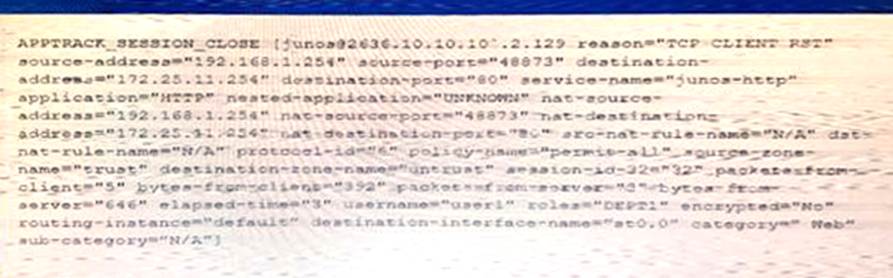
Which two statements about the log output shown in the exhibit are correct? (Choose two?
- A . AppTrack is enabled on the trost zone:
- B . AppTrack is enabled on the untrust zone
- C . Traffic destined to the HTTP server is placed in an IPsec tunnel
- D . Source NAT is performed
Which two statements are correct about a reth LAG? (Choose two.)
- A . Links must have the same speed and duplex setting.
- B . Links must use the same cable type
- C . You must have a "minimum-links" statement value of two.
- D . You should have two or more interfaces.
A, D
Explanation:
A reth LAG is a redundant Ethernet link aggregation group that combines multiple physical interfaces into a single logical interface in a chassis cluster. A reth LAG provides load balancing and redundancy for traffic within or between redundancy groups. Two statements that are correct about a reth LAG are:
Links must have the same speed and duplex setting: To form a reth LAG, the physical interfaces must have the same speed and duplex setting. This ensures that the links can operate at the same capacity and avoid performance issues or errors.
You should have two or more interfaces: To create a reth LAG, you need to have at least two physical interfaces. One interface should be connected to node 0 and the other interface should be connected to node 1. You can also have more than two interfaces in a reth LAG for increased bandwidth and redundancy.
Reference: = Configuring Redundant Ethernet Interfaces, [Understanding Redundant Ethernet Interfaces]
Which two statements are correct about the fab interface in a chassis cluster? (Choose two.)
- A . Real-time objects (RTOs) are exchanged on the fab interface to maintain session synchronization.
- B . In an active/active configuration, inter-chassis transit traffic is sent over the fab interface.
- C . The fab interface enables configuration synchronization.
- D . Heartbeat signals sent on the fab interface monitor the health of the control plane link.
A, B
Explanation:
The fab interface is a fabric link that connects the two nodes in a chassis cluster. A chassis cluster is a high-availability feature that groups two identical SRX Series devices into a cluster that acts as a single device.
The fab interface has two functions:
Real-time objects (RTOs) are exchanged on the fab interface to maintain session synchronization: RTOs are data structures that store information about active sessions, such as source and destination IP addresses, ports, protocols, and security policies. RTOs are exchanged between the nodes on the fab interface to ensure that both nodes have the same session information and can take over the traffic in case of a failover.
In an active/active configuration, inter-chassis transit traffic is sent over the fab interface: In an active/active configuration, both nodes in a cluster can process traffic for different redundancy groups (RGs). RGs are collections of interfaces or services that fail over together from one node to another. If traffic needs to transit from one RG to another RG that is active on a different node, it is sent over the fab interface.
Reference: = Configuring Chassis Clustering on SRX Series Devices, Chassis Cluster Redundancy Groups, Chassis Cluster Data Plane
You want to set up JSA to collect network traffic flows from network devices on your network.
Which two statements are correct when performing this task? (Choose two.)
- A . BGP FlowSpec is used to collect traffic flows from Junos OS devices.
- B . Statistical sampling increases processor utilization
- C . Statistical sampling decreases event correlation accuracy.
- D . Superflows reduce traffic licensing requirements.
C D
Explanation:
Statistical sampling involves collecting a representative subset of data rather than examining all traffic. While this method decreases processor utilization by reducing the volume of data that must be analyzed and stored, it can also lead to decreased accuracy in event correlation because not all events are captured.
Superflows in JSA are aggregated flow records that represent summaries of multiple flow records. This aggregation reduces the number of flows that need to be processed and stored, which can help in managing licensing requirements related to the volume of traffic being analyzed, especially in environments with high traffic volumes.
Which two statements are correct about the cSRX? (Choose two.)
- A . The cSRX supports firewall, NAT, IPS, and UTM services.
- B . The cSRX only supports Layer 2 "bump-in-the-wire" deployments.
- C . The cSRX supports BGP, OSPF. and IS-IS routing services.
- D . The cSRX has three default zones: trust, untrust, and management
A D
Explanation:
The two statements that are correct about the cSRX are that it supports firewall, NAT, IPS, and UTM services, and that it has three default zones: trust, untrust, and management. The cSRX is a software-defined security solution that provides comprehensive network security capabilities and is designed for virtualized environments. It supports firewall, NAT, IPS, and UTM services to protect against threats, as well as BGP, OSPF, and IS-IS routing services for routing functionality. Additionally, the cSRX has three default zones: trust, untrust, and management. The trust zone is used to define traffic that is allowed to enter the network, the untrust zone is used to define traffic that should be blocked from entering the network, and the management zone is used to manage the device itself. The cSRX does not support Layer 2 "bump-in-the-wire" deployments.
Which two functions does Juniper ATP Cloud perform to reduce delays in the inspection of files? (Choose two.)
- A . Juniper ATP Cloud allows the creation of allowlists.
- B . Juniper ATP Cloud uses a single antivirus software package to analyze files.
- C . Juniper ATP Cloud allows end users to bypass the inspection of files.
- D . Juniper ATP Cloud performs a cache lookup on files.
A, D
Explanation:
Juniper ATP Cloud is a cloud-based service that provides advanced threat prevention and detection for your network. It integrates with SRX Series firewalls and MX Series routers to analyze files and network traffic for signs of malicious activity.
Two functions that Juniper ATP Cloud performs to reduce delays in the inspection of files are:
Juniper ATP Cloud allows the creation of allowlists: Allowlists are lists of trusted files or file hashes that are excluded from scanning by Juniper ATP Cloud. You can create allowlists based on file name, file type, file size, file hash, or sender domain. By using allowlists, you can reduce the number of files that need to be uploaded to Juniper ATP Cloud for analysis and improve the performance and efficiency of your network.
Juniper ATP Cloud performs a cache lookup on files: Cache lookup is a process that checks if a file has been previously scanned by Juniper ATP Cloud and if there is a cached verdict for it. If there is a cached verdict, Juniper ATP Cloud returns it immediately without scanning the file again. If there is no cached verdict, Juniper ATP Cloud uploads the file for analysis. By using cache lookup, you can reduce the time and bandwidth required for scanning files by Juniper ATP Cloud.
Reference: = [Juniper Advanced Threat Prevention Cloud (ATP Cloud)], [Configuring Allowlists], [Understanding Cache Lookup]
Your network uses a single JSA host and you want to implement a cluster.
In this scenario, which two statements are correct? (Choose two.)
- A . The software versions on both primary and secondary hosts
- B . The secondary host can backup multiple JSA primary hosts.
- C . The primary and secondary hosts must be configured with the same storage devices.
- D . The cluster virtual IP will need an unused IP address assigned.
A D
Explanation:
According to the Juniper Networks JNCIP-SEC Study Guide, when setting up a cluster with a single JSA host, both the primary and secondary hosts must have the same software version installed. Additionally, an unused IP address must be assigned to the cluster virtual IP. The primary and secondary hosts do not need to be configured with the same storage devices, and the secondary host cannot be used to backup multiple JSA primary hosts.
How does Juniper ATP Cloud protect a network from zero-day threats?
- A . It uses a cache lookup.
- B . It uses antivirus software.
- C . It uses dynamic analysis.
- D . It uses known virus signatures.
C
Explanation:
Juniper ATP Cloud is a cloud-based service that provides advanced threat prevention and detection for your network. It integrates with SRX Series firewalls and MX Series routers to analyze files and network traffic for signs of malicious activity. Juniper ATP Cloud protects a network from zero-day threats by using dynamic analysis, which is a method of executing files in a sandbox environment and observing their behavior and network interactions. Dynamic analysis can uncover unknown malware that may evade static analysis or signature-based detection methods.
Reference: = Juniper Advanced Threat Prevention – Juniper Networks, Juniper Advanced Threat Prevention Datasheet, Juniper Advanced Threat Prevention | NetworkScreen.com
You are troubleshooting unexpected issues on your JIMS server due to out of order event log timestamps.
Which action should you take to solve this issue?
- A . Enable time synchronization on the client devices.
- B . Enable time synchronization on the JIMS server.
- C . Enable time synchronization on the domain controllers.
- D . Enable time synchronization on the SRX Series devices.
C
Explanation:
To solve the issue of out of order event log timestamps on your JIMS server, you should enable time synchronization on the domain controllers. JIMS (Juniper Identity Management Service) is a Windows service that collects user, device, and group information from Active Directory domains or syslog sources and provides it to SRX Series devices and CSO for identity-based security policies. JIMS relies on the timestamps of the event logs generated by the domain controllers to track user logins, logouts, and IP address changes. If the domain controllers have different or inaccurate clocks, the event logs may have out of order or incorrect timestamps, which can cause JIMS to miss or misinterpret some events and affect its accuracy and performance. Therefore, you should ensure that all the domain controllers in your network are synchronized with a reliable time source, such as an NTP server or a Windows Time service. Reference: = Juniper Identity Management Service User Guide, Juniper Identity Management Service Feature Guide, Configure JIMS Collector to Get Microsoft Event Logs, Considerations for timestamps in centralized logging platforms