
Juniper JN0-231 Practice Exams
Last updated on Oct 22,2026- Exam Code: JN0-231
- Exam Name: Security - Associate (JNCIA-SEC)
- Certification Provider: Juniper
- Latest update: Oct 22,2026
You want to prevent other users from modifying or discarding your changes while you are also editing the configuration file.
In this scenario, which command would accomplish this task?
- A . configure master
- B . cli privileged
- C . configure exclusive
- D . configure
Click the Exhibit button.

Referring to the exhibit, a user is placed in which hierarchy when the exit command is run?
- A . [edit security policies from-zone trust to-zone dmz] user@vSRX-1#
- B . [edit]
user@vSRX-1# - C . [edit security policies]
user@vSRX-1# - D . user@vSRX-1>
You have configured a UTM feature profile.
Which two additional configuration steps are required for your UTM feature profile to take effect? (Choose two.)
- A . Associate the UTM policy with an address book.
- B . Associate the UTM policy with a firewall filter.
- C . Associate the UTM policy with a security policy.
- D . Associate the UTM feature profile with a UTM policy.
C,D
Explanation:
For the UTM feature profile to take effect, it must be associated with a security policy and a UTM policy. The security policy defines the traffic flow and the actions that should be taken on the traffic, while the UTM policy defines the security features to be applied to the traffic, such as antivirus, intrusion prevention, and web filtering. The UTM feature profile provides the necessary configuration for the security features defined in the UTM policy.
Reference:
Juniper Networks SRX Series Services Gateway UTM Configuration Guide: https://www.juniper.net/documentation/en_US/release-independent/junos/topics/topic-map/security-services-utm.html
Which two security features inspect traffic at Layer 7? (Choose two.)
- A . IPS/IDP
- B . security zones
- C . application firewall
- D . integrated user firewall
Which statement about service objects is correct?
- A . All applications are predefined by Junos.
- B . All applications are custom defined by the administrator.
- C . All applications are either custom or Junos defined.
- D . All applications in service objects are not available on the vSRX Series device.
C
Explanation:
"Service objects represent applications and services that can be assigned to a security policy rule. Applications and services can either be predefined by Junos software or custom defined by the administrator."
Reference:
Juniper Networks JNCIA-SEC Exam Guide: https://www.juniper.net/training/certification/certification-exam-guides/jncia-sec-exam-guide/
Which two components are configured for host inbound traffic? (Choose two.)
- A . zone
- B . logical interface
- C . physical interface
- D . routing instance
Which statement is correct about Web filtering?
- A . The Juniper Enhanced Web Filtering solution requires a locally managed server.
- B . The decision to permit or deny is based on the body content of an HTTP packet.
- C . The decision to permit or deny is based on the category to which a URL belongs.
- D . The client can receive an e-mail notification when traffic is blocked.
C
Explanation:
Web filtering is a feature that allows administrators to control access to websites by categorizing URLs into different categories such as gambling, social networking, or adult content. The decision to permit or deny access to a website is based on the category to which a URL belongs. This is done by comparing the URL against a database of categorized websites and making a decision based on the policy defined by the administrator.
Reference:
Juniper Networks SRX Series Services Gateway Web Filtering Configuration Guide: https://www.juniper.net/documentation/en_US/release-independent/junos/topics/topic-map/security-services-web-filtering.html
Click the Exhibit button.
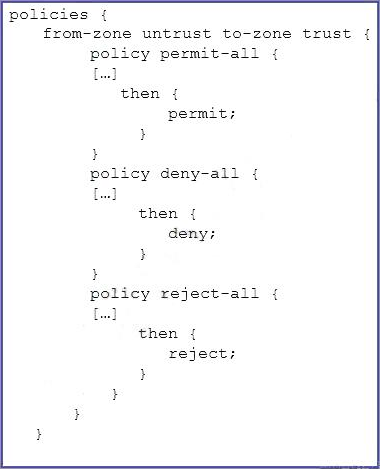
Which two statements are correct about the partial policies shown in the exhibit? (Choose two.)
- A . UDP traffic matched by the deny-all policy will be silently dropped.
- B . TCP traffic matched by the reject-all policy will have a TCP RST sent.
- C . TCP traffic matched from the zone trust is allowed by the permit-all policy.
- D . UDP traffic matched by the reject-all policy will be silently dropped.
You must monitor security policies on SRX Series devices dispersed throughout locations in your organization using a ‘single pane of glass’ cloud-based solution.
Which solution satisfies the requirement?
- A . Juniper Sky Enterprise
- B . J-Web
- C . Junos Secure Connect
- D . Junos Space
D
Explanation:
Junos Space is a management platform that provides a single pane of glass view of SRX Series devices dispersed throughout locations in your organization. It provides visibility into the security policies of the devices, allowing you to quickly identify and respond to security threats. Additionally, it provides the ability to manage multiple devices remotely and in real-time, enabling you to quickly deploy and update security policies on all devices. For more information, please refer to the Juniper Networks Junos Space Network Director User Guide, which can be found on Juniper’s website.
Your ISP gives you an IP address of 203.0.113.0/27 and informs you that your default gateway is 203.0.113.1. You configure destination NAT to your internal server, but the requests sent to the webserver at 203.0.113.5 are not arriving at the server.
In this scenario, which two configuration features need to be added? (Choose two.)
- A . firewall filter
- B . security policy
- C . proxy-ARP
- D . UTM policy