
ISTQB CTAL-TM Practice Exams
Last updated on Oct 21,2026- Exam Code: CTAL-TM
- Exam Name: Certified Tester Advanced Level Test Manager (CTAL-TM)
- Certification Provider: ISTQB
- Latest update: Oct 21,2026
What is the primary use for the traceability information regarding the relationship between test results and test conditions during test execution? [2]
- A . The Test Manager uses this information to control the test execution effort.
- B . The development manager uses this information to determine how many developer resources to allocate to defect repair.
- C . The project manager uses this information to determine if the project is on schedule.
- D . The tester uses this information to determine which test should be run next.
Which of the following aspects should test progress metrics be mapped to? [1]
- A . Lines of code
- B . Exit criteria
- C . Post-implementation defect discovery rate
- D . Defect resolution rate
Cost estimate must not be exceeded
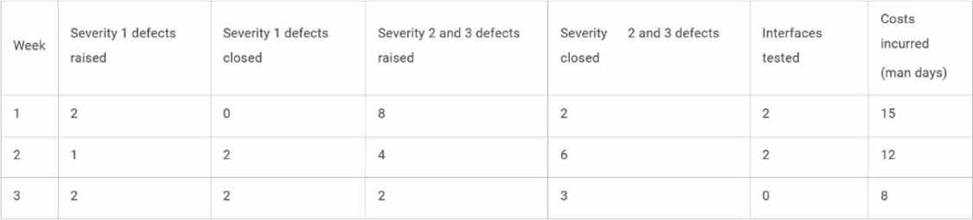
System integration test execution is scheduled to last 5 weeks, with week 5 reserved for regression and bug fixing only.
At the end of week 3 the following test report has been produced (figures on a week by week basis, not cumulative):
b. Open severity 2 and 3 defects
c. Interface testing progress
d. Development resource for debugging
e. Available budget
SELECT ONE OPTION
- A . c and d.
- B . d and e.
- C . b and c.
- D . c and e
Cost estimate must not be exceeded
System integration test execution is scheduled to last 5 weeks, with week 5 reserved for regression and bug fixing only.
At the end of week 3 the following test report has been produced (figures on a week by week basis, not cumulative):
b. Open severity 2 and 3 defects
c. Interface testing progress
d. Development resource for debugging
e. Available budget
SELECT ONE OPTION
- A . c and d.
- B . d and e.
- C . b and c.
- D . c and e
You are the Test Manager of a four-person test team working for a small distribution company with a single warehouse. Your team has been working with a third party development team on a new inventory management system. The company expects this system to generate approximately one million dollars per annum in profits for the company. Early in the project, various risks were identified, and steps taken to mitigate those risks.
For example, you sent your test team for training on the new system, and upgraded the test environment. There are still some lingering risks that have not been addressed, but they have been determined to have a low chance of occurring, with minimal impact if they do occur.
What would be the best option to mitigate these remaining risks? [3]
- A . Note the risks, and ignore them for now.
- B . Redo the project test plan to add additional testing for these risk items.
- C . Contract with the Risk Protection Insurance company to assume these risks at a cost of $500,000 per annum.
- D . Create a cross-functional team to work to reduce the impact and likelihood of these risks coming to fruition.
The Test Manager must assemble team members that have which of the following characteristics? [1]
- A . Thrive in a routine, structured environment
- B . Will not change the severity of a defect report
- C . Will spark informal cross training among themselves
- D . Possess identical skill sets
You are Test Manager for a project which is in the Test Implementation stage for the first planned iteration, creation of the initial Test Cases and required test data is progressing well.
The Test Strategy documents the Stakeholders view that small teams should collaborate together to create and test functionality which is to be released in iterations, with each release building on the success of the last.
Stakeholders are willing to accept the risks of a partly working system in the early stages. Delivery of working functionality (particularly around interfaces to third party systems and performance of back end databases) is the priority for the early releases.
Which of the following test types would you select for this first planned iteration, in order to meet Stakeholders expectations?
a) Usability testing
b) Structural testing
c) Functional testing of process flows
d) Performance testing
e) Business process testing
f) Component integration testing
- A . b, c, d and f.
- B . b, d, e and f.
- C . a. b, d and f.
- D . a, c, d and e.
Consider the following scenario:
Your customer is closely involved in the development project. Requirements are communicated verbally and rarely written down. An iterative development model is being followed and time boxing is used to stay on schedule.
Which of the following statements is true? [3]
- A . A requirements traceability matrix will be created at the start of each iteration.
- B . Your developers are using a waterfall methodology.
- C . There is a risk that the system architecture may have to be changed during the development process.
- D . Testing will start when all coding is completed.
Your Project Manager has challenged you to come up with a process improvement strategy using the IDEAL model.
Which step within the process defines the success criteria? [2]
- A . Entrance
- B . Analysis
- C . Diagnosing
- D . Initiation
Which ONE of the following is considered to be the LEAST independent form of testing for an organisation? SELECT ONE OPTION
- A . Testing is performed by a tester who is part of an independent test team.
- B . Testing is performed by an organisation external to the company that has developed the code.
- C . Testing is performed by a tester who is part of the development team.
- D . Testing is performed by specialists from the business organisation.