
Huawei H13-527_V5.0 Practice Exams
Last updated on Oct 22,2026- Exam Code: H13-527_V5.0
- Exam Name: HCIP-Cloud Computing (Written) V5.0
- Certification Provider: Huawei
- Latest update: Oct 22,2026
In Huawei Cloud Stack, which of the following components is not related to the ECS instance provisioning process?
- A . TaskCenter
- B . DMK
- C . Combination API
- D . HAProxy
In Huawei Cloud Stack, which of the following descriptions of the inspected objects are correct? (Multiple choice)
- A . Actively report alarms. Each component is monitored independently. When an abnormality is found, the alarm is reported to the unified alarm platform of ManageOne operation and maintenance through ManageOne Service Monitor.
- B . For cloud services that are not included in the FusionCare inspection tool, you can use the SmartKit inspection tool, such as Service OM
- C . For components that fail to pass tool inspection, you can inspect them manually by using commands, logging into the system interface, etc.
- D . Each cloud service registers an inspection interface with the API gateway, and implements unified inspection capabilities for each cloud service through FusionCare
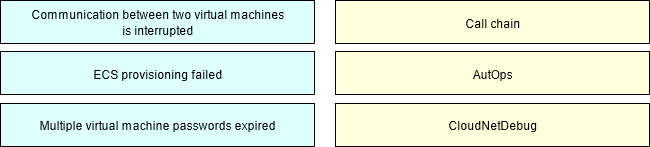
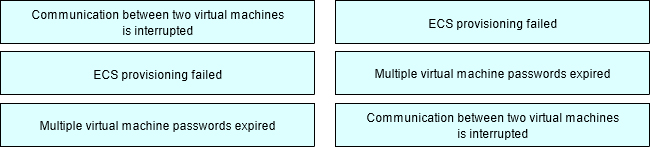
In Huawei Cloud Stack, please match the following scenarios with their corresponding processing tools.
Which of the following commands can convert the Glance image from raw format to qcow2 format?
- A . qemu-img convert -s raw -d qcow2
- B . qemu-img convert -f qcow2 -O raw
- C . qemu-img convert -s qcow2 -d raw
- D . qemu-img convert -f raw -O qcow2
In Huawei Cloud Stack, which of the following descriptions of service templates is wrong?
- A . Resource orchestration templates are divided into two types: visual templates and HOT templates. Visual templates have a graphical interface, and HOT templates are implemented through configuration files. The functions of the two are the same.
- B . System preset templates can be called by users to create new templates
- C . Service templates can be divided into resource orchestration templates and API orchestration templates. Resource orchestration templates have a graphical interface, while API orchestration templates are implemented through configuration files. The functions of the two are the same.
- D . The sources of service templates are diverse
In OpenStack, Firewall-as-a-Service is implemented based on a two-layer network architecture, applying firewalls to OpenStack objects such as projects, routers, and router ports.
- A . True
- B . False
In Huawei Cloud Stack, virtual machines can be deployed to specified hosts by configuring specifications.
- A . True
- B . False
In Huawei Cloud Stack, which of the following descriptions about the differences between network ACLs and security groups are correct? (Multiple choice)
- A . Network ACL supports allow and deny policies, while security groups only support allow policies.
- B . When multiple rules of a network ACL conflict, the rule with the higher priority takes precedence; when multiple rules of a security group conflict, the union of the rules takes effect.
- C . Both network ACL and security group support allow and deny policies
- D . Network ACL can provide east-west security protection based on subnets, and security groups can provide north-south security protection based on virtual machine network cards.
In OpenStack, which of the following descriptions of Horizon interface operations is wrong?
- A . When the administrator creates an instance in the Horizon interface, if you select No when creating a new volume, temporary storage will be used.
- B . Administrators can customize and add dashboards and panels in the Horizon interface
- C . Administrators can customize the quotas for computing, storage, and network in the Horizon interface
- D . Administrators can delete roles created using the command line in the Horizon interface.
In Huawei Cloud Stack, which of the following descriptions about LVS (Linux Virtual Server) are correct? (Multiple choice)
- A . LVS is a four-layer load balancing
- B . The cloud service framework uses the DR (Direct Routing) forwarding mode of LVS
- C . The cloud service framework uses the LVS NAT (Network Address Translation) forwarding mode
- D . LVS is a seven-layer load balancing