
Huawei H12-831_V1.0 Practice Exams
Last updated on Oct 22,2026- Exam Code: H12-831_V1.0
- Exam Name: HCIP-Datacom-Advanced Routing & Switching Technology V1.0
- Certification Provider: Huawei
- Latest update: Oct 22,2026
In the network shown in the figure, PC1 and PC2 are required to belong to the same VLAN, but cannot communicate at Layer 2. Which of the following technologies can be used to achieve this? (Multiple choice)
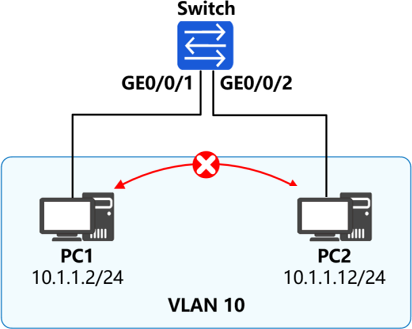
- A . MUX VLAN technology, put PC1 and PC2 into the same Group WAN
- B . Port isolation technology: add the GE0/0/1 and GE0/0/2 ports of the Switch to the same port isolation group.
- C . NUX VLAN technology, put PC1 and PC2 into the same Separate VLAN
- D . VLAN aggregation technology, putting PC1 and PC2 into the same Sub-VLAN
In the network shown in the figure, R1 and R2 are configured with single-hop BFD detection. The network engineer found that the BFD session was Down, so he queried the configuration related to R1 and R2 BD. The configuration information has been marked in the figure. According to the configuration information, the reason for the BFD session Down is that the time parameters configured on R1 and R2 do not match.
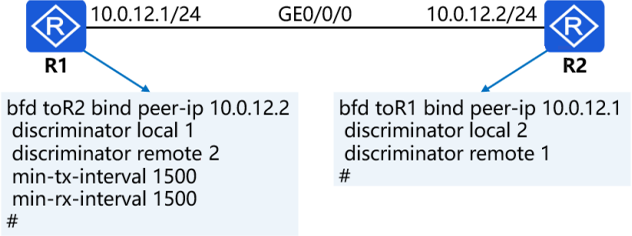
- A . True
- B . False
In the network shown in the figure, adjacent routers use directly connected interfaces to establish EBGP neighbor relationships. The Router ID of each device is 10.0.XX, and the AS number is 6500x, where X is the router number. R1 and R4 both have static routes to 192.168.1.0/24, which are introduced into BGP through import. R1 adds the Community attribute value (1:1) when sending routes to its neighbors, and all routers in the network are enabled to transmit community attributes.
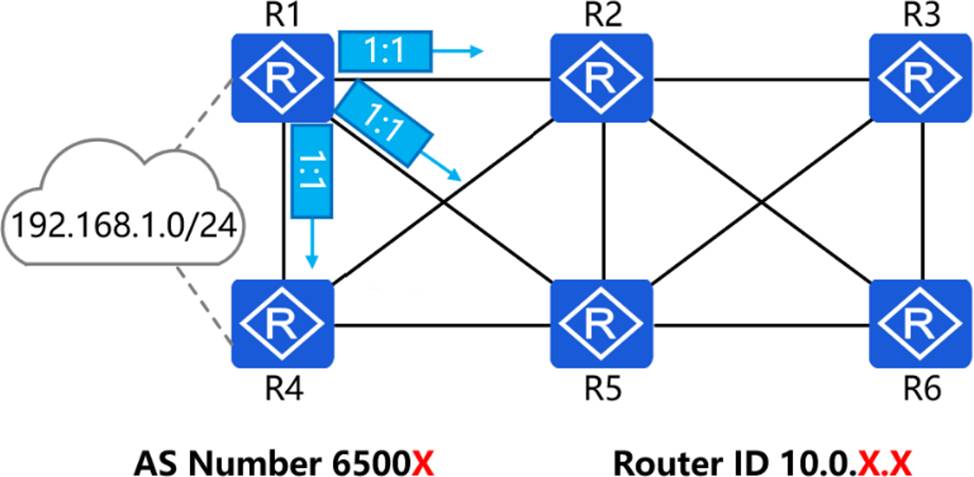
R2 and R3 are configured with routing policies that reject routes with a community attribute value of 1:1. Which of the following is the path for traffic from R3 to 192.168.1.0/24?
- A . R3-R2-R4
- B . R3-R2-R1
- C . R3 has no route to 192.168.1.0/24
- D . R3-R5-R1
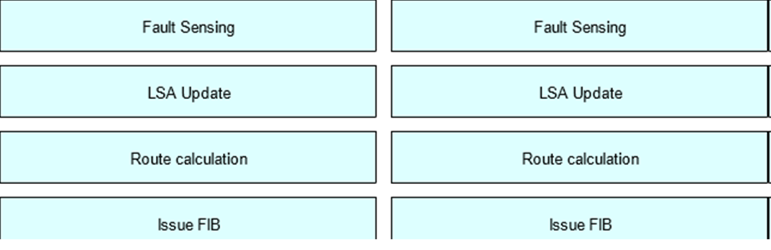
When an OSPF network fails, the following processes are required to switch traffic paths. Please sort the following processes according to the steps for fault recovery:
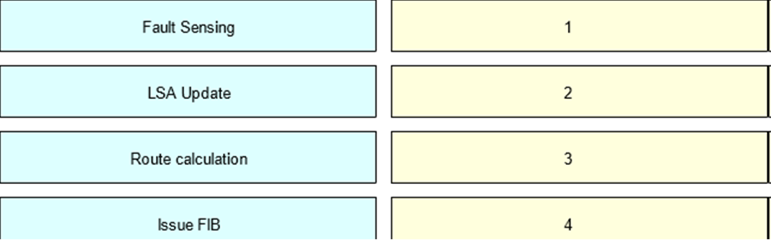
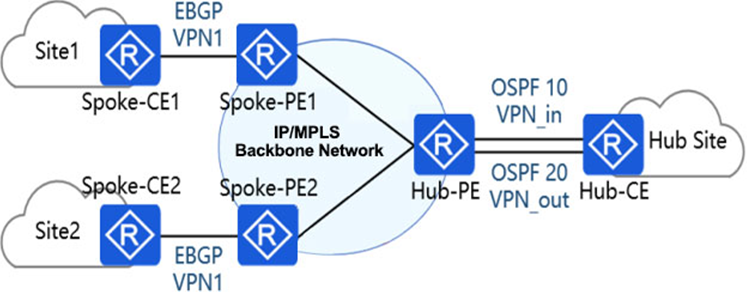
In the Hub&Spoke network shown in the figure, Hub-PE can allow local AS number duplication through manual configuration to achieve correct routing transmission.
- A . True
- B . False
In the OSPFv3 network shown in the figure, the IPv6 address of R3 Loopback0 interface is 2000::3/128, and OSPFv3 is enabled.
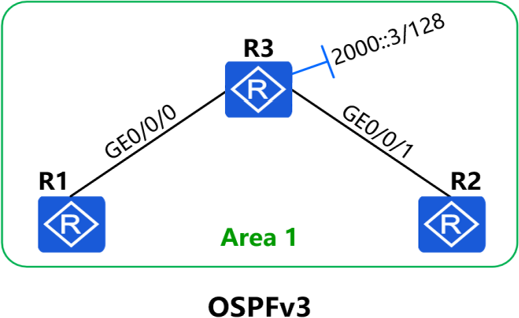
Which of the following descriptions are correct? (Multiple choice)
- A . R2 will definitely generate a Link-LSA
- B . R1 will definitely generate a Network-LSA
- C . R3 will definitely generate an Intra-Area-Prefix-LSA
- D . The Link-LSA generated by R2 will not appear in R1’s LSDB
In the network shown in the figure, R1 and R2 are connected through SW1. If STP is not enabled on SW1, R1 and R2 cannot ping each other.

- A . True
- B . False
In the IS-IS IPv6 network shown in the figure, all routers have multi-topology enabled. The IPv6 address of the R4 Loopback0 interface is 2000::4/128, and "ipv6 summary 2000::64 level-1-2" is configured in the R2 IS-IS process.
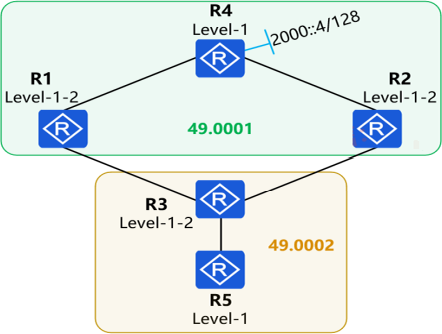
Which of the following is wrong in the default case?
- A . R2 has a routing entry for 2000::4/128 in its routing table.
- B . R1 has a routing entry for 2000::4/128 in its routing table.
- C . R2’s routing table has a route entry for 2000::4/64
- D . R1 routing table has a routing entry for 2000::4/64
Huawei NetEngine AR6120 and AR6121 both have two service interface card slots, and these two slots can be merged into one slot.
- A . True
- B . False
In the IS-IS IPv6 network shown in the figure, all routers have multi-topology enabled. Configure "ipv6 default-route-advertise always level-1" in the R4 IS-IS process.
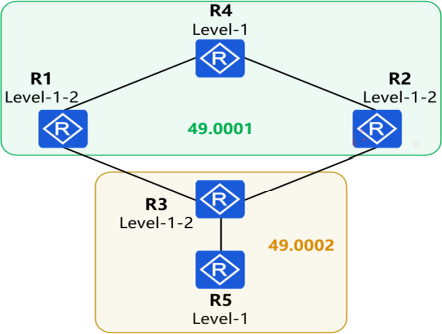
By default, which of the following routers has no default route in its routing table?
- A . R3
- B . R1
- C . R5
- D . R2