
Huawei H12-323_V2.0-ENU Practice Exams
Last updated on Oct 21,2026- Exam Code: H12-323_V2.0-ENU
- Exam Name: HCIP-WLAN V2.0
- Certification Provider: Huawei
- Latest update: Oct 21,2026
In a WLAN network, which of the following descriptions about directional antennas and omnidirectional antennas are correct? (Multiple choice)
- A . When the coverage distance is long, omnidirectional antennas are preferred
- B . Directional antennas are suitable for coverage areas such as pedestrian streets
- C . In outdoor scenarios, try to use omnidirectional antennas for planning
- D . In outdoor scenarios, omnidirectional antennas are easier to plan than directional antennas.
Terminal migration function: Before the terminal is associated, the terminal is guided to access the 5G radio frequency first through () suppression. After the terminal is associated, the terminal is guided to access a better AP through the target AP selection algorithm, which comprehensively measures the terminal’s dual-band capability, AP load and signal quality.
When planning a WLAN network in a hotel scenario, since hotels have high requirements for aesthetics: therefore, when engineers select AP models and design wiring plans, they must communicate with customers in advance and confirm the feasibility of the plan.
- A . True
- B . False
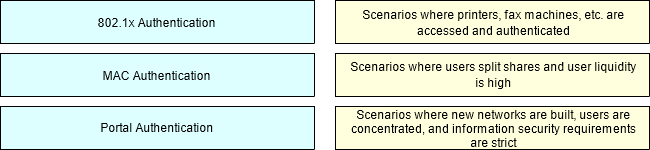
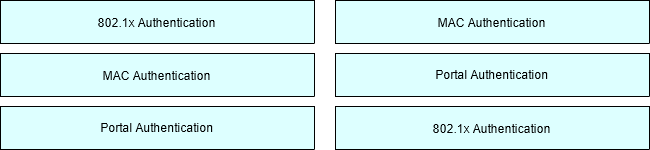
Please match the following NAC authentication methods with the applicable scenarios.
During the wireless network optimization process, which of the following tools can be used to assist in optimization in order to understand information such as wireless signal interference, wireless signal strength, and terminal performance in the network?
- A . Terminal dialing tool
- B . Antenna Alignment
- C . iPerf
- D . CloudCampus APP
As shown in the figure, a company’s WLAN network uses N+1 backup networking. Which of the following descriptions about N+1 backup is wrong?
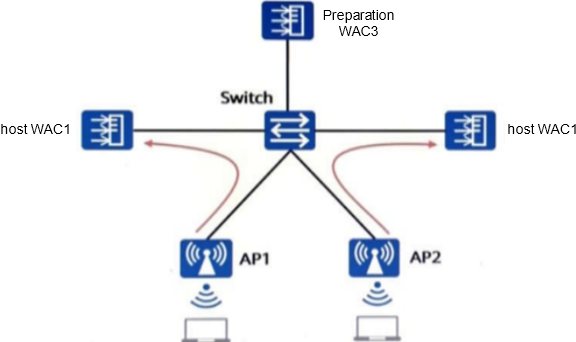
- A . You can configure the AP’s individual priority on the primary and backup WACs. The larger the priority value, the higher the priority.
- B . All APs under the main WAC1 and main WAC2 must be configured on the backup WAC3 to ensure that the APs can obtain the correct configuration after the WAC is switched.
- C . The backup WAC3 and the primary WAC1 and WAC2 can be deployed in different locations to ensure intercommunication between the three-layer networks.
- D . You can configure the corresponding MAC whitelist on the primary WAC to ensure that the AP can go online on the corresponding WAC to assist the AP in selecting the correct primary WAC.
In a WLAN network, which of the following descriptions about roaming is wrong?
- A . The re-authentication process may not occur when the user is roaming
- B . User access rights remain unchanged before and after roaming
- C . Users will notice service interruption during roaming
- D . The user’s IP address does not change before and after roaming
In a wireless mesh network, the node with portal function that can realize communication between the internal nodes of the mesh and the external network is ()
Wireless network capacity optimization needs to consider the service types and user models of customers in different scenarios, and provide customers with capacity optimization suggestions based on network construction standards. When a customer has 300 users accessing the existing network, the concurrency rate is 40%, the average bandwidth of a single user is 16Mbps, and the terminal bandwidth of the currently selected AP is 16 Tlbpsi, the number of concurrent terminals is 15, then in order to meet the capacity requirements, () APs need to be deployed in the area.
When planning a WLAN network, it is recommended that the signal strength within the wireless network coverage area is greater than the edge field strength in the network planning indicators.
- A . True
- B . False