
HP HPE0-J68 Practice Exams
Last updated on Oct 22,2026- Exam Code: HPE0-J68
- Exam Name: HPE Storage Solutions
- Certification Provider: HP
- Latest update: Oct 22,2026
You have just completed a performance analysis of an HPE 3PAR StoreServ 8400 disk array with different tiers at a customer’s site. After reviewing the performance metrics, you determine that they should install a new tier of SSD drives.
Which actions should you recommend they take to fully optimize the array? (Choose two.)
- A . Configure Adaptive Flash Cache.
- B . Configure scheduled tunesys tasks.
- C . Rebalance all flash drives between nodes 0 and 2.
- D . Configure Adaptive Optimization.
- E . Configure dedicated drives to enable Adaptive Flash Cache.
B,D
Explanation:
After determining that a new tier of SSD drives should be installed in the HPE 3PAR StoreServ 8400, the following actions should be recommended:
Configure Adaptive Optimization (AO): AO automatically moves data between storage tiers based on real-time I/O patterns. By configuring AO, the most frequently accessed data will be moved to the new SSD tier, optimizing performance and improving efficiency.
Configure scheduled tunesys tasks: Tunesys is a command used to optimize the storage layout on the HPE 3PAR array. By scheduling regular tunesys tasks, the data is redistributed across the available drives, ensuring that the array maintains optimal performance as the storage environment evolves.
Reference: HPE 3PAR StoreServ Adaptive Optimization
HPE 3PAR Tunesys Command
A customer migrate their infrastructure from a 3rd party storage to a Nimble
environment. During an architecture workshop, you discuss VMvision with the customer and the system engineer.
Which statement is correct when implementing performance monitoring using VMVision?
- A . Nibmle service processor collects relevant per VM performance data and send them using SSL port 443 to VMvision
- B . VMvision is an agentless integration into infosight and needs only the Vcenter server appliance credentials to connect. (page 112)
- C . VMware vSphere storage API’s array integration (VAAI)has to be configured to combine storage and VM performance metrics
- D . SNMP trap service has to be configured to send traps to infosight and integrate performance data using VMvision.
B
Explanation:
VMvision is a feature within HPE InfoSight that provides deep visibility into the performance and resource utilization of virtual machines (VMs) running on HPE Nimble Storage arrays. It offers an agentless approach, meaning it does not require any additional software or agents to be installed on the VMs or hosts. Instead, VMvision leverages the vCenter server appliance credentials to directly gather data from the VMware environment.
Once integrated with vCenter, VMvision can collect and analyze VM-level performance data, such as latency, IOPS, and throughput, in real-time. This data is then correlated with storage performance metrics, allowing administrators to easily identify bottlenecks and optimize VM performance. The agentless nature of VMvision simplifies the deployment process and reduces the management overhead associated with performance monitoring.
Unlike traditional performance monitoring tools that may require configuring SNMP traps or deploying agents on each VM, VMvision’s integration with InfoSight streamlines the process by using existing vCenter APIs to gather the necessary data. This approach not only ensures a seamless integration but also enhances the accuracy of the performance insights provided by InfoSight.
For more details, refer to the following HPE Storage references:
HPE Nimble Storage
HPE InfoSight for Storage
HPE Flash and Hybrid Storage
In an ISCSI based storage system Proof-Of-Concept project, the customer is not satisfied with the performance of their video streaming application.
What would you recommended to the customer to optimize the excisting environment?
- A . Enable hardware ISCSI initiator
- B . Increase the switch buffer to buffer credits
- C . Enable jumbo frames on required components
- D . Consolidate the heterogeneous switches in the network
C
Explanation:
For optimizing an iSCSI-based storage system, especially in environments handling large data volumes such as video streaming, enabling jumbo frames is recommended. Jumbo frames allow the transmission of larger data packets over the network, reducing the overhead caused by smaller packets and improving overall network efficiency. This is particularly important in video streaming, where continuous, high-bandwidth data transfer is required. Enabling jumbo frames across all components, including switches, network interface cards (NICs), and storage devices, can significantly improve performance.
What advantage does the Unified API that is part of HPE’s composable strategy provide?
- A . infrastructure lifecycle managed with standard programming code
- B . single portal for managing servers, networking, and storage
- C . write-back capability and instant cable warmth
- D . dedicated object storage platform
A
Explanation:
The Unified API that is part of HPE’s composable strategy provides the advantage of managing the entire infrastructure lifecycle using standard programming code. This approach allows IT administrators to automate and streamline operations, enabling them to define infrastructure as code, which can be easily integrated into DevOps workflows. This API-driven approach is central to HPE’s composable infrastructure strategy, providing flexibility, efficiency, and ease of management.
Reference: HPE Composable Infrastructure
HPE Unified API
You are presenting the HPE StoreEver portfolio to a media agency.
What advantage is offered when using LTFS?
- A . file management capabilities will be provided with tape cartridges
- B . WORM functionality for file, block and object storage access on tape
- C . file encryption with public and private key management
- D . file and block data management within an HPE HSM solution
A
Explanation:
Linear Tape File System (LTFS) is a file system that enables tape to be used in a manner similar to disk storage, providing file management capabilities directly on the tape cartridges. This allows users to access files stored on tape in a more intuitive way, with the ability to drag and drop files, just like on a traditional file system. LTFS makes tape more accessible and easier to use, especially for archival and data retrieval purposes, which is particularly advantageous for media agencies that manage large volumes of data.
LTFS does not inherently provide WORM (Write Once, Read Many) functionality or file encryption; these features require additional software or configurations. For more information, see:
HPE StoreEver Tape Storage Solutions
Refer to the exhibit.
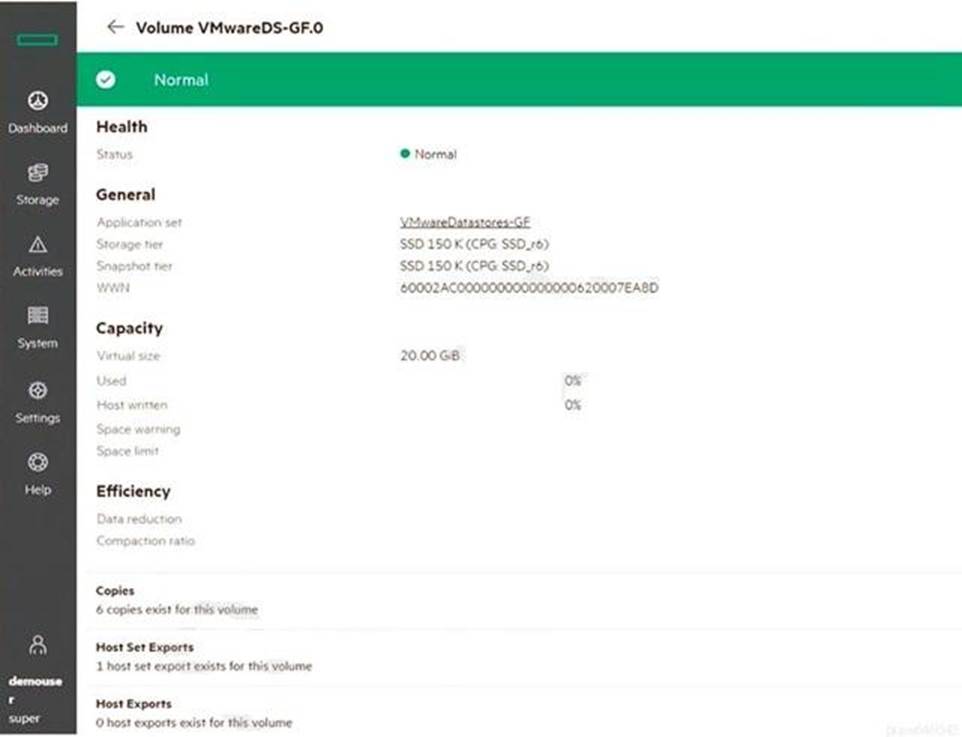
You are configuring a new HPE array and verifying properties of a set of volumes.
Which RAID level is used on the VMwareDatastores-GF volume?
- A . RAID 0
- B . RAID 6
- C . Triple Parity+
- D . RAID 5
D
Explanation:
The exhibit refers to a configuration scenario where properties of a volume set, specifically VMware Datastores-GF, are being verified. The question focuses on identifying the RAID level used on this volume.
RAID 5 is a common configuration in many storage arrays because it provides a balance of performance, capacity, and data protection. In RAID 5, data is striped across multiple disks with parity information distributed among the disks. This parity allows for the recovery of data in the event of a single disk failure, making it a preferred choice for environments that require efficient storage utilization with a degree of fault tolerance.
HPE storage solutions, such as HPE Nimble Storage and HPE 3PAR, often employ RAID 5 for use cases involving virtualized environments like VMware datastores. These solutions are optimized for high performance and data protection, ensuring that even with a single drive failure, the data remains accessible and the system can continue to operate without significant performance degradation.
Reference: HPE Storage Products
HPE Flash and Hybrid Storage
HPE Nimble Storage
These resources provide comprehensive information on HPE’s RAID configurations, data protection mechanisms, and how they integrate with enterprise storage environments.
A customer needs to be manually map out preferred paths within a multi-switch fabric, based on application, priority, and topology, while allowing failover to a non-preferred path if the preferred path fails.
Which B-series FC switch functionality should be used to provide this?
- A . Quality of services
- B . Enhanced group management
- C . Frame filtering
- D . Traffic isolation Zones
D
Explanation:
In a multi-switch fabric where it is necessary to manually map out preferred paths based on application priority and topology, while still allowing failover to non-preferred paths if needed, Traffic Isolation Zones (TIZs) are the recommended functionality. TIZs provide a mechanism to segregate and control traffic within a Fibre Channel (FC) fabric, ensuring that specific application traffic follows the preferred paths while providing the necessary failover capabilities. This enhances the performance and reliability of critical applications by keeping their traffic on dedicated paths, reducing the risk of congestion and ensuring that failover paths are used only when necessary. For more details, refer to the following HPE Storage references:
HPE B-series FC Switches
Which HPE 3PAR StoreServ feature allows a host to continue I/O uninterrupted during a firmware upgrade?
- A . Peer Persistence
- B . Persistent Ports
- C . Persistent Memory
- D . Persistent Cache
B
Explanation:
When using a federated storage approach with HPE 3PAR StoreServ systems, customers can benefit from:
Load Balancing: Federated storage enables the distribution of workloads across multiple storage systems, optimizing resource utilization and ensuring that no single system becomes a bottleneck. This load balancing improves performance and enhances overall system efficiency.
Easier Migration: Federation simplifies the process of migrating data between storage systems. With features like Peer Motion, data can be moved between systems non-disruptively, allowing for seamless upgrades or expansions without impacting ongoing operations. This capability is particularly beneficial in reducing downtime and maintaining business continuity during migrations.
Reference: HPE 3PAR StoreServ Federation
HPE Peer Motion Technology
To improve the deduplication ratio of their MS SQL VMs farm hosted on an HPE Alletra 9000, what steps can you take?
- A . Ensure the datastore-hosting VV has encryption disabled
- B . Enable deduplication on the storage system level
- C . Ensure the guest OS is using multiples of 16 kiB allocation units
- D . Run a database alignment optimization
A customer has a large amount of the data on their Primera that is mission critical. The business needs RPO to be under 5 minutes.
Which protection technology should you recommend?
- A . synchronous replication
- B . asynchronous replication
- C . archiving
- D . backup to tape
A
Explanation:
For mission-critical data where the Recovery Point Objective (RPO) must be under 5 minutes, synchronous replication is the recommended protection technology. Synchronous replication ensures that data is written simultaneously to both the primary and secondary sites. This means that in the event of a failure, there is no data loss, making it ideal for environments where data integrity is crucial and the RPO needs to be minimal.
HPE Primera, with its robust data protection features, supports synchronous replication, which provides real-time mirroring of data between storage arrays to meet stringent RPO requirements.
For more information, refer to:
HPE Primera Storage Solutions